What Is Cartomancy?
Cartomancy is divination using a standard 52-card deck—the same cards you’d use for poker or bridge. Unlike tarot’s 78 cards with elaborate artwork, cartomancy works with the simplicity of red and black suits, making it more accessible than you might think. This method has quietly empowered seekers for centuries, offering clear answers without requiring you to master complex symbolism.
The beauty of cartomancy lies in its straightforwardness. Each card carries defined meanings that shift slightly based on your question, and as you practice, you’ll develop a personal relationship with the deck. You don’t need expensive materials or years of training—just your intuition, a regular playing deck, and willingness to listen.
Why Choose Cartomancy Over Tarot?
If you’ve felt intimidated by tarot’s complexity, cartomancy welcomes you with open arms. Tarot relies heavily on your intuitive interpretation, which can feel overwhelming when you’re starting out. Cartomancy, by contrast, gives you a solid foundation with more literal card meanings. This structure supports you as you build confidence.
You also don’t need to invest in a specialty deck. That standard pack in your drawer works perfectly. This accessibility means you can begin exploring immediately, without financial barriers or the pressure of finding the “right” deck first.
Understanding Card Meanings
Each suit in cartomancy carries distinct energy and themes. Hearts connect to love, relationships, and emotional matters. Diamonds govern finances, material success, and practical concerns. Clubs represent work, creativity, and personal growth. Spades address challenges, obstacles, and deeper transformations.
Within each suit, numbered cards (2-10) build in intensity and complexity. Face cards—Jack, Queen, King, and Ace—hold particular power. As you learn your deck, these meanings become intuitive. You’re not memorizing rules; you’re recognizing patterns your subconscious already understands.
The One-Card Spread: Quick Guidance
Sometimes you need a straightforward answer, and that’s when the single-card spread serves you perfectly. This is your go-to for yes-or-no questions or when you need clarity on a specific moment.
How to do it: Hold your question clearly in your mind. Shuffle the deck while focusing on what you’re asking. When you feel ready, draw one card. The card’s meaning answers your question directly. Red suits typically suggest positive movement or “yes.” Black suits often indicate challenges, delays, or “no.” Face cards represent people or significant developments.
This spread works beautifully when you’re standing in the grocery store trying to decide if you should text that friend, or when you wake up wondering if today holds something important. Keep it close when you need speed and clarity.
The Three-Card Spread: Past, Present, Future
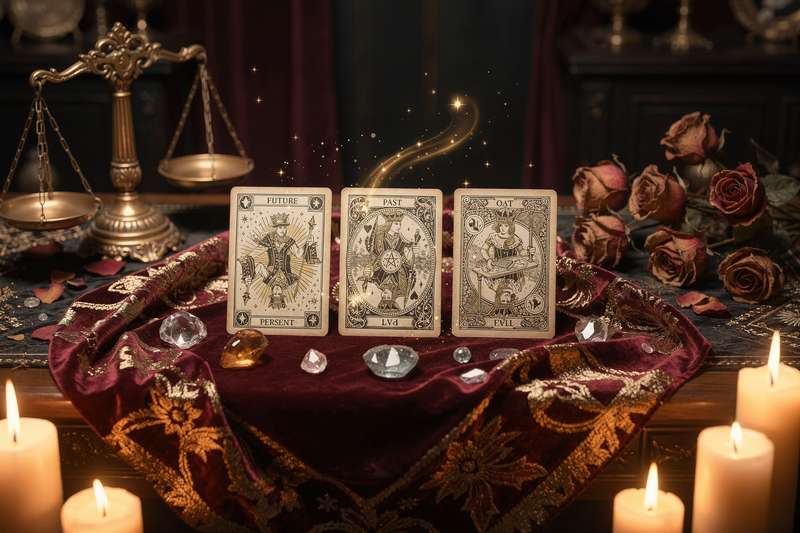
This is the workhorse of cartomancy spreads. Three cards give you enough information to understand your situation’s arc without overwhelming complexity. You’ll see where you’ve been, where you stand now, and where momentum is carrying you.
How to set it up: Shuffle while thinking about your situation. Draw three cards and lay them left to right. The first card represents your past—influences, lessons, and foundation. The second card is your present—current energies and where you genuinely stand. The third card shows your future—likely outcome and direction if things continue as they are.
This spread answers questions like “Why did my last relationship end and what does the next chapter hold?” or “Where am I in my career journey?” You get narrative flow rather than scattered fragments. The three cards naturally create a story your intuition can follow.
The Five-Card Spread: Deeper Context
When you need more nuance than three cards provide, five cards offer richer texture while staying manageable. This spread works beautifully for relationship situations, career decisions, or when you’re trying to understand a complex pattern in your life.
Layout options: Arrange your five cards in an X pattern with one in the center, or lay them in a horizontal line. The center or middle position represents the core situation. The cards around it show supporting influences, challenges, resources, and outcomes. Some readers assign: the situation itself, what you desire, what blocks you, what helps you, and the likely result.
This spread serves you well when you’re considering a major life choice. It holds enough detail to feel substantial, yet the number remains manageable as you’re learning.
The Seven-Card Spread: Weekly Guidance
Many readers use a seven-card spread for weekly check-ins, assigning each card to a day. This gives you personal guidance to carry through your week, helping you prepare for what’s coming and understand the energy each day holds.
How to arrange it: Shuffle and draw seven cards, laying them in a line from Monday through Sunday (or in any order that feels right to you). Each card becomes your daily guidance—what to pay attention to, what support is available, and what themes are active. Some days show you active energy; others invite quieter reflection.
You might draw a Hearts card on Wednesday, suggesting emotional connection or conversation. A Diamonds card on Friday could point toward financial news or material progress. This spread becomes your personal oracle throughout the week.
Preparing Yourself for Readings
Your state of mind shapes your reading’s quality. Before you shuffle, create a centered space—nothing elaborate, just a few moments of quiet. Clear your mind of distractions and focus genuinely on your question. What are you really asking? What do you genuinely want to understand?
Avoid readings when you’re emotionally dysregulated, exhausted, or in a negative spiral. You can read for others in these states, but your own readings benefit from relative calm. Energy isn’t magic here; it’s simply that clarity requires some mental space. The cards speak clearest when you’re genuinely listening.
Shuffle however feels natural to you. Some readers riffle shuffle; others cut and spread. There’s no wrong method. What matters is that shuffling becomes your signal to the universe and yourself: “I’m ready to receive guidance.”
Building Your Interpretation Skills
Learning cartomancy meanings is less about rote memorization and more about developing recognition. Each time you read, you strengthen the connection between card and meaning. Over time, you won’t need to think—you’ll simply know what a card represents in your life.
Keep a reading journal. Write down your cards, their meanings, your interpretation, and what actually happened. Over weeks and months, you’ll see patterns. You’ll notice that certain cards consistently appear before specific life events. Your intuition becomes sharper because you have evidence of accuracy.
Don’t worry if you misinterpret cards initially. There are no reading mistakes, only learning. Each “wrong” interpretation teaches you something about how you process information and what your subconscious is trying to tell you.
Common Mistakes to Avoid
The biggest mistake is asking yes-or-no questions when you actually need nuance. A simple question like “Will I get the job?” limits what the cards can show you. Better to ask, “What does the job situation hold for me?” This opens space for the cards to reveal timing, obstacles, opportunities—the full picture.
Avoid reading obsessively about the same question. One reading gives you current energy. Reading repeatedly within days just creates confusion. If you truly need another reading, wait at least a week. Give the universe time to unfold what the cards revealed.
Don’t dismiss cards you dislike. Spade cards aren’t punishments; they’re invitations to look at challenges honestly. Diamonds aren’t guarantees; they’re pointers toward practical matters. Every card brings necessary information.
Developing Your Practice
Start with spreads that feel comfortable. Many people begin with single cards, move to three-card spreads, then expand to five or seven. There’s no rush. Your practice deepens through repetition with fewer cards before moving to more complex layouts.
Read for yourself regularly but not obsessively. A weekly reading keeps you connected to the deck without encouraging dependence. Some readers read daily; others monthly. What matters is consistency—returning to the cards enough that they become a familiar language.
Eventually, you might offer readings to trusted friends. Reading for others strengthens your skills considerably because you’re interpreting cards without the emotional investment you bring to personal readings. You think more clearly.
FAQ
What’s the difference between cartomancy spreads and tarot spreads?
Tarot spreads often rely on reverse positions and upright meanings that shift interpretation significantly. Cartomancy spreads tend to be simpler, with straightforward meanings. Cartomancy cards carry more literal associations, making layouts easier for beginners. You can actually use similar spread patterns (three-card, five-card, etc.) with either deck, but cartomancy’s interpretation stays more grounded.
Can I use any regular playing card deck for cartomancy?
Yes, absolutely. Any standard 52-card deck works. You don’t need special cards or expensive decks. Some readers prefer vintage decks or beautiful designs simply because they enjoy handling them, but the cards themselves function identically. What matters is your connection to the deck, not its price or appearance.
How do I know if my cartomancy reading is accurate?
Keep a journal and track your readings over time. You’ll notice patterns—certain cards appearing before specific events, your interpretations proving accurate in retrospect. Accuracy often becomes clear weeks or months later when real-world events confirm the cards’ messages. Trust the process and give time for validation.
Is cartomancy better for beginners than tarot?
Many beginners find cartomancy more approachable because it requires less interpretive work. The card meanings are more defined, and you work with fewer cards total. However, some people connect naturally with tarot’s imagery. The best divination system is whichever one you’ll actually use consistently.