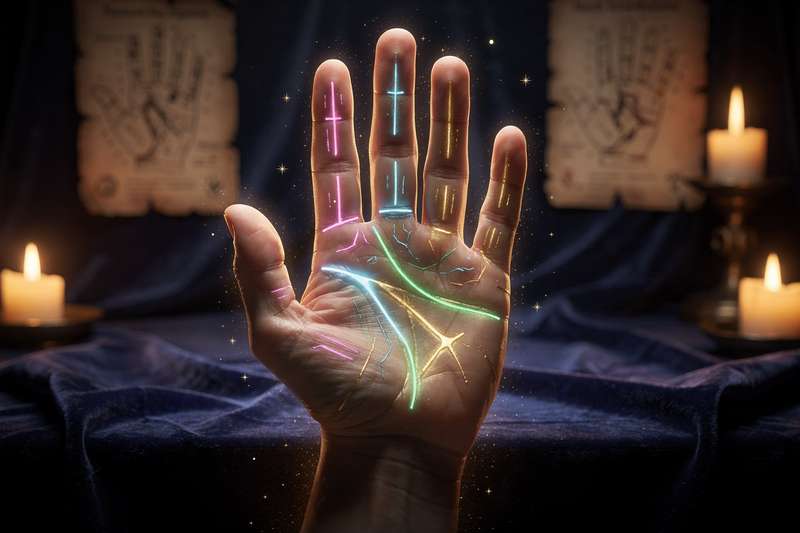
What Palm Reading Is and Why It Matters
Your hands hold a personal story. The lines, shapes, and patterns on your palms can reveal surprising truths about who you are, how you move through the world, and what might unfold ahead. Palm reading—or palmistry—is an ancient art that interprets these physical features as windows into your character, circumstances, and potential.
This isn’t about predicting your future with absolute certainty. Instead, think of palm reading as a mirror that reflects your inner landscape. It’s a tool for self-understanding, a conversation between you and the symbolic language written across your skin. Many spiritual seekers find that learning to read their own palms deepens their intuition and self-awareness.
A Brief History of Palmistry
Palmistry’s roots reach back to ancient India, where practitioners studied hands as reflections of health and destiny. From there, the practice traveled eastward to China and westward to Europe, adapting to each culture while maintaining its core wisdom. By the Victorian era, palmistry had become fashionable in London society, with renowned practitioners like Cheiro (William John Warner) consulting famous clients seeking insight into their lives.
Even Carl Jung, the influential psychologist, recognized palmistry’s value as a tool for understanding the psyche. Today, palm readers work across every continent, integrating ancient knowledge with modern interpretations. What was once considered exotic is now recognized as a legitimate practice for personal reflection and spiritual growth.
How to Identify the Five Main Lines
When you examine your palm, you’ll notice several creases and lines. Don’t be overwhelmed—there are five primary lines that form the foundation of palm reading. Learning these lines is your gateway to understanding what your hands are telling you.
The Life Line: Your Vitality and Personal Power
The life line is perhaps the most well-known line in palmistry, partly because of popular culture myths about its length predicting lifespan. Let’s clear this up immediately: a short life line does not mean a short life. This is pure fiction.
Your life line actually starts near the base of your thumb and curves around it, extending downward toward your wrist. It represents your energy, resilience, physical health, and how fully you experience living.
- A long, deep line suggests robust vitality, strong resilience, and a life rich with experiences and adventures.
- A fainter or shorter line may indicate that you tire easily and benefit from regular rest and self-care.
- A broken or interrupted line can signal major life transitions, significant changes, or periods when you need to be especially mindful of your wellbeing.
- A double life line (sometimes called a sister line running parallel) is considered a protective marker, suggesting extra support during challenging times.
The Head Line: Your Mind and Communication
Your head line begins near your thumb (close to where your life line starts) and travels horizontally across the center of your palm. This line reveals how you think, learn, communicate, and access your memory.
- A long, straight line indicates a logical, analytical mind with excellent memory and clear thinking.
- A curved line suggests creative thinking, imagination, and an intuitive approach to problem-solving.
- A line that curves sharply downward can point to pessimistic tendencies or a mind that dwells on worries.
- A broken or fragmented line may reflect mental tension, scattered thinking, or significant shifts in how you perceive the world.
- A faint line sometimes indicates difficulty concentrating or memory challenges.
The Heart Line: Your Emotional Life
Located above the head line and running horizontally across the upper part of your palm, the heart line is associated with your emotional nature, romantic life, and the physical health of your heart. This is the line many people are curious about, as it speaks to love and connection.
- A line that curves upward toward your fingers reveals emotional sensitivity and romantic idealism.
- A straight line suggests you’re more guided by logic than feeling—you lead with your head in matters of the heart.
- A long line can indicate deep commitment and lasting emotional bonds.
- A broken or interrupted line may suggest emotional wounds, relationship transitions, or a pattern of multiple connections.
- A deep, pronounced line points to emotional depth and devotion.
- A faint line might indicate emotional guardedness or difficulty accessing your feelings.
The Fate Line: Your Life Purpose and Direction
The fate line runs vertically up the center of your palm toward your middle finger. Unlike the other main lines, not everyone has a clearly marked fate line—and that’s perfectly normal. This line relates to your sense of purpose, career path, and the role destiny appears to play in your life direction.
- A long, clear fate line suggests you have a strong sense of purpose or calling, possibly in your career or life mission.
- A broken or fragmented line can indicate career changes, shifts in direction, or a less linear path to your goals.
- A faint or absent fate line doesn’t mean you lack purpose—it may simply mean your life unfolds more organically, with less predetermined structure.
The Sun Line: Success and Recognition
Also called the Apollo line, the sun line runs vertically from the base of your palm toward your ring finger. This line relates to creativity, success, happiness, and how brightly you shine in the world.
- A clear, deep sun line suggests natural talent, recognition, and success in creative or public endeavors.
- A faint or absent line doesn’t diminish your potential—it may simply mean your success comes through quieter channels.
Reading Line Qualities: What to Look For
The meaning of each line isn’t determined by its presence alone. You’ll want to examine the quality and characteristics of every line you find. Ask yourself these questions as you study your palm:
- Is the line deep and pronounced, or faint and subtle?
- Is it long, short, or somewhere in between?
- Does it run straight, curve, or take an irregular path?
- Are there breaks, islands, or intersections with other lines?
- Does the line appear on both hands or just one?
Deep lines generally suggest strong expression of that line’s qualities. Faint lines might indicate less developed or less obvious traits. Breaks can signal transitions or challenges. The more time you spend examining your own hands and those of trusted friends, the more nuanced your reading becomes.
Common Mistakes Beginners Make
As you start learning palm reading, watch out for these typical pitfalls:
- Relying on line length alone. Remember that a short life line has nothing to do with longevity. Always consider the overall quality of the line.
- Over-interpreting single elements. One broken line doesn’t define your entire future. Consider all lines together for a complete picture.
- Forgetting about the non-dominant hand. Many palmists look at both hands—the dominant hand shows what you’re actively creating, while the non-dominant hand reveals your natural tendencies and inherited traits.
- Ignoring hand shape and mounts. Lines are important, but the overall shape of your hand and the fleshy mounds beneath your fingers (called mounts) also contribute to a full reading.
- Making absolute predictions. Palm reading offers insight and reflection, not deterministic prophecy. You always have agency in shaping your path.
How to Practice Palm Reading
Start with yourself. Spend time each week examining your own hands. Get comfortable locating the five main lines. Notice how your lines compare to descriptions you’ve read. Draw sketches or take photos of your palm to track changes over time—yes, lines can shift as your life circumstances evolve.
Once you’re confident with your own hands, ask friends if you can read theirs. Approach it playfully and with genuine curiosity. Ask questions: “Do you feel like you have a strong sense of purpose?” or “Would you describe yourself as more emotional or logical?” Listen to their responses and notice how they align with what you’re reading in their palms. This feedback is invaluable for developing your intuitive abilities.
Consider keeping a palm reading journal. Write down your observations about each person’s lines and what those lines suggest. Over time, you’ll develop your own interpretive style and build confidence in your readings.
Integrating Your Reading Into Daily Life
A palm reading isn’t meant to be a one-time curiosity. Use what you discover to inform your self-understanding. If your head line curves strongly downward, you might consciously practice positive self-talk to counteract pessimistic spirals. If your life line is fainter, you might prioritize rest and recovery without guilt. If your heart line is short and straight, you can appreciate that you’re someone who thinks before feeling—and that’s a strength, not a flaw.
Palm reading becomes most powerful when you view it as a conversation with yourself about who you are and who you’re becoming. Your hands literally carry the marks of your journey. Learning to read them is a form of self-love and self-knowledge.
FAQ
Can palm reading predict the future?
Palm reading offers insight into your tendencies, strengths, and potential directions, but it doesn’t predict the future with certainty. Think of it as reading the energy and patterns you’re currently embodying. Your choices, growth, and circumstances can shift what unfolds ahead.
Does a short life line mean I’ll die young?
No. This is a common misconception that needs to be dispelled. Your life line indicates stamina, vitality, and life force—not lifespan. Many people with short life lines live long, full lives.
Should I read my left or right hand?
Many palmists examine both hands. Your dominant hand (usually the right for right-handed people) reflects what you’re actively creating and consciously working with. Your non-dominant hand reveals your natural inheritance and subconscious patterns. For the clearest picture, read both.
What if I can’t find a particular line on my palm?
Not everyone has every line clearly marked, and that’s perfectly okay. A missing fate line, for example, doesn’t indicate a lack of purpose. It may simply mean your life unfolds more organically without a predetermined track. Missing or faint lines provide their own valuable information about how you navigate life.