The pentacle and pentagram are two of the most recognizable symbols in witchcraft and modern Paganism — and two of the most misunderstood. Whether you have spotted one on a piece of jewelry, an altar cloth, or a book cover and felt an unexplained pull toward it, you are not alone. These five-pointed star symbols carry thousands of years of spiritual history, and many witches, Wiccans, and spiritual seekers feel an almost instinctive connection to their energy. This guide will walk you through exactly what these symbols mean, how they differ, how they have been used across traditions, and — most importantly — how you can begin working with them in your own practice today, whatever path you walk.
What Is the Pentacle and What Is the Pentagram?
The pentagram is a five-pointed star drawn with a single continuous line, with one point facing upward. The word comes from Greek roots meaning “five lines.” It is one of the oldest spiritual symbols on Earth, appearing in ancient Babylonian, Egyptian, Greek, Pythagorean, and Mayan contexts — long before it was ever associated with witchcraft.
The pentacle is closely related but carries a subtle distinction. Most practitioners understand it as a pentagram enclosed within a circle. The enclosing circle is not decorative — it represents unity, wholeness, and the interconnection of all the elements. Some traditions also use “pentacle” to refer specifically to a physical object (a disc, tile, coin, or piece of jewelry) bearing the star symbol, distinguishing it from a drawn diagram.
Both symbols represent the five classical elements: earth, air, fire, water, and spirit (also called aether or ether). Each point of the star corresponds to one element, with the topmost point typically representing spirit — the animating force that oversees and elevates the physical world.
“The pentacle is not a symbol of darkness. It is a map of the self — five elements, one circle, one whole being.”
A common myth worth addressing directly: the inverted pentagram (point facing downward) is not inherently evil. In some traditions, it is simply associated with the second degree of initiation or with more earth-focused, materialist energy. Its association with dark or Satanic imagery comes primarily from 19th-century ceremonial magic writings and later pop culture — not from witchcraft itself.
Types of Pentacle and Pentagram Use Across Traditions
One of the beautiful things about these symbols is that they appear across many different spiritual paths. Here is how various practitioners work with them:
- Wiccan practitioners — In Wicca, the pentacle is one of the four primary altar tools, representing the element of earth. It is often a physical disc placed on the altar and used to consecrate other tools, charge objects, or ground energy during ritual.
- Eclectic witches — Many eclectic practitioners wear or display the pentagram as a general symbol of their spiritual path and their connection to elemental balance, without adhering to any one tradition’s rulebook.
- Kitchen and hearth witches — The pentacle appears in the home as a protective symbol, carved into candles, drawn in flour before baking, or hung near the front door to guard the household.
- Ceremonial magicians — In Western ceremonial magic, the pentagram is central to specific rituals (such as the Lesser Banishing Ritual of the Pentagram), where it is drawn in the air as a gesture of protection and elemental invocation.
- Hedge witches and solitary practitioners — Many solo witches simply carry or wear a pentacle as a talisman for personal protection and as a quiet declaration of their connection to nature and spirit.
- Neo-Pagan traditions — Outside of Wicca, many Pagan paths honor the pentacle as a symbol of the sacred feminine, natural cycles, and the unity of all living things.
How to Start Working with the Pentacle and Pentagram: Step by Step
You do not need to belong to a specific tradition to begin working with these symbols. Here is a practical path forward.
Step 1: Learn the Elemental Correspondences
Before you do anything else, spend time getting to know what each point represents. Earth (lower left) — stability, the body, abundance. Air (upper left) — thought, communication, breath. Fire (lower right) — will, passion, transformation. Water (upper right) — emotion, intuition, healing. Spirit (top point) — the divine, the self, consciousness.
Write these out in a journal. Sit with each element and notice where it shows up in your daily life. This is not just memorization — it is the foundation of everything else you will do with this symbol.
Step 2: Choose Your First Pentacle Object
You do not need anything expensive. A wooden disc from a craft store, a flat piece of clay you shape yourself, a coin-sized piece of cardstock you draw on with intention — all of these work. If you do want to purchase a ready-made pentacle, look for one made from a material that resonates with you: wood for earth energy, silver for lunar and water energy, copper for fire and Venus energy.
Step 3: Cleanse and Consecrate Your Symbol
Before using any spiritual tool, clear it of any energy it may have picked up before reaching you. You can pass it through incense smoke, leave it in moonlight overnight, bury it in a small dish of salt for a few hours, or simply hold it in both hands and breathe your intention into it. State clearly — aloud or in your mind — that this object is cleansed and ready to serve your highest good.
Consecration is the next step: dedicating the object to its purpose. Hold it to your heart, call on whichever deity, guide, or higher power you work with (or simply call on the elements themselves), and declare your intention for the tool.
Step 4: Place It on Your Altar or Sacred Space
The pentacle traditionally sits at the center of the altar in Wiccan practice, acting as a focal point and a surface upon which you place offerings, candles, or other items to charge them. If you do not have a formal altar, a windowsill, a small shelf, or a dedicated corner of your desk works perfectly well.
Step 5: Use It to Charge Other Objects
One of the most practical uses of a physical pentacle disc is charging. Place a crystal, a piece of jewelry, a written intention, or an herb pouch on top of your pentacle and leave it there during a meditation, a ritual, or overnight. The elemental energy of the symbol helps align whatever rests upon it with your intention.
Step 6: Draw the Pentagram in Ritual
You can also work with the pentagram as a drawn or visualized symbol. In protective work, trace a five-pointed star in the air before you — starting from the lower left point and moving upward to the top — using your dominant hand, a wand, or an athame. Visualize it glowing in a color that represents your intention (blue or white for protection, green for healing, gold for spiritual power).
This gesture appears across many traditions and can be adapted to your own practice. Some witches draw pentagrams at each of the four cardinal directions before casting a circle.
Step 7: Wear It as a Talisman
A pentacle worn close to the body acts as a continuous reminder of your connection to the elements and your spiritual path. Many practitioners wear one daily, setting an intention each morning when they put it on. You might say something simple like: “I carry the five elements with me. I am grounded, inspired, passionate, feeling, and whole.”
Step 8: Incorporate It Into Spellwork
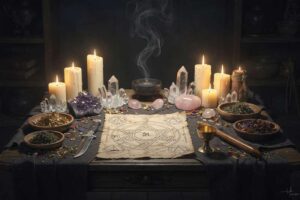
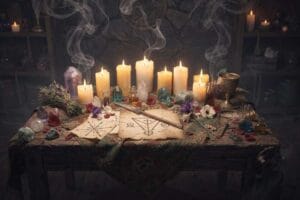
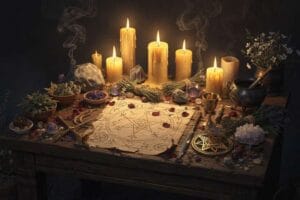
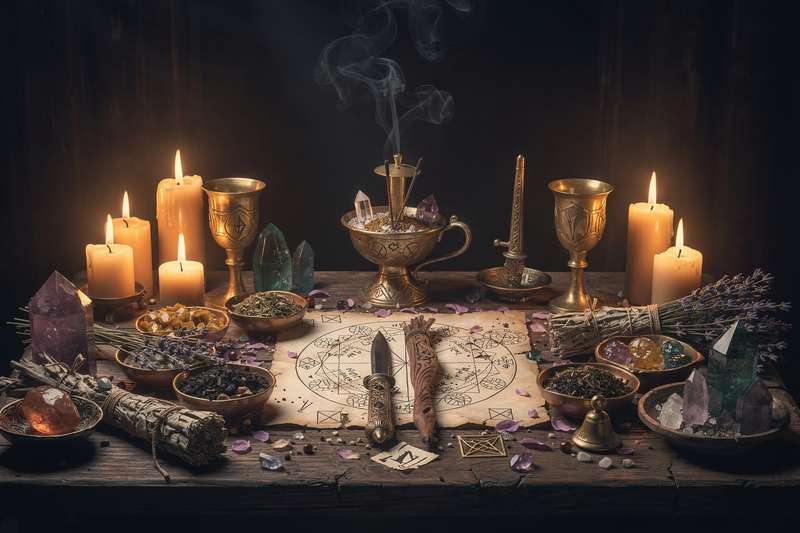
Draw a pentagram on a piece of paper and write your intention in the center. Place candles at each point and light them one at a time, naming the element as you go. This is a simple but deeply effective elemental spell structure that witches of all experience levels use.
Step 9: Meditate With the Symbol
Hold your pentacle during meditation or simply gaze at a drawn pentagram. As you breathe, move your awareness through each point — feeling into each element within your own body and life. This practice builds a genuine relationship with the symbol rather than just an intellectual understanding of it.
Essential Tools and Supplies for Pentacle Work
Getting started does not require a large budget. Here are the basics:
- A pentacle disc — wood, clay, metal, or drawn on paper. Your choice.
- Candles — one for each element (green or brown for earth, yellow for air, red for fire, blue for water, white for spirit) or simply a single white candle to represent all.
- Incense or herbs — for cleansing. Rosemary, sage, mugwort, and frankincense are all traditional choices.
- Crystals — black tourmaline for protection and grounding, clear quartz to amplify intention, and amethyst for spiritual clarity pair beautifully with pentacle work.
- A journal — to record your elemental meditations, spellwork results, and growing relationship with these symbols.
- Salt — for cleansing and as a physical representation of the earth element.
Ethics and Best Practices
Witchcraft, regardless of tradition, is generally built on the principle of thoughtful, intentional action. A few guidelines to keep in mind as you work with the pentacle and pentagram:
Intent matters. These symbols carry the energy you bring to them. Approach your practice with clarity about what you want and why.
Respect other traditions. The pentacle and pentagram appear in many spiritual systems with their own nuanced meanings. If you study a specific tradition’s use of the symbol, honor its context.
Do not work magic intended to harm, control, or manipulate others. Most ethical practitioners follow some version of the principle that actions return to their source, and magic used to harm others ultimately harms the caster as well.
Consent in shared ritual. If you are incorporating someone else’s name or energy into your pentacle work, consider whether they would welcome it. Protective work for others is generally considered positive; binding or influencing someone without their knowledge is ethically complex.
Common Beginner Mistakes to Avoid
- Confusing fear with discernment. The pentacle is not a dangerous symbol. If you feel fear around it, examine where that feeling comes from — cultural conditioning, not the symbol itself.
- Skipping the cleansing step. Any object you bring into your practice absorbs energy from its environment. Cleanse before you consecrate.
- Treating it as purely decorative. A pentacle on your wall is lovely, but the real work happens when you engage with it intentionally and regularly.
- Memorizing without feeling. Knowing that “air = upper left point” is useful. But sensing air energy in your own life — in a conversation, a new idea, a change of direction — is where the magic actually lives.
- Comparing your practice to others’. Some witches have elaborately carved pentacles; others draw one in pencil on a sticky note. Neither is more powerful than the other. Your intention is what counts.
- Expecting instant results. Working with elemental symbols is cumulative. The more you engage, the more you notice — and the more the practice deepens.
How to Build Your Practice Over Time
Start simple and let your relationship with the pentacle grow naturally. In your first month, focus on learning the elements and cleansing your chosen object. In your second month, try one elemental meditation per week, spending time with each of the five points. By the third month, you might incorporate the pentacle into a full new moon or full moon ritual.
Over time, you will develop your own intuitive sense of when and how to use this symbol. You might start drawing pentagrams in the corners of important letters, charging your morning coffee mug on your pentacle disc, or incorporating elemental invocations into your daily routine. There is no finish line here — only a deepening connection.
Final Thoughts
The pentacle and pentagram are not relics of a distant, mysterious past. They are living symbols that thousands of practitioners work with every single day — in apartments, in gardens, in city kitchens, and on quiet hillsides. They are maps of the self, reminders of balance, and tools for intentional living. Wherever you are on your path — curious beginner, experienced solitary, or somewhere in between — these symbols are available to you. Carry them with awareness, work with them with respect, and let them reflect back to you what you already know: that you are made of all five elements, and you are whole.
Frequently Asked Questions
What is the difference between a pentacle and a pentagram?
A pentagram is the five-pointed star symbol itself, drawn as a continuous line. A pentacle is most commonly understood as a pentagram enclosed within a circle, which represents unity and elemental balance. Some practitioners also use “pentacle” specifically to mean a physical object — like a disc or tile — bearing the star, as opposed to a drawn image.
Is the pentacle a Satanic symbol?
No. The pentacle is a symbol used in Wicca, modern Paganism, and many other spiritual traditions to represent the five elements and their harmony. Its association with Satanism comes from 19th-century occult literature and later pop culture, not from witchcraft. The Church of Satan adopted an inverted pentagram, but this does not reflect the symbol’s meaning within Wiccan or Pagan practice.
Which way should the pentagram point — up or down?
An upright pentagram (single point facing up) represents spirit ruling over matter and is the most common orientation in Wicca and modern Paganism. An inverted pentagram (point facing down) has different associations depending on tradition — in some systems it represents second-degree initiation or a focus on earthly energy, rather than anything negative. Context and tradition matter when interpreting orientation.
Can I use a pentacle if I am not Wiccan?
Absolutely. While the pentacle is central to Wiccan practice, it is used by eclectic witches, solitary practitioners, hedge witches, kitchen witches, and many others who feel drawn to its elemental symbolism. You do not need to follow any specific tradition to work with this symbol meaningfully and respectfully.