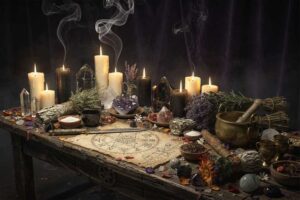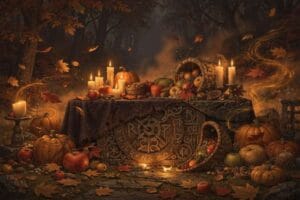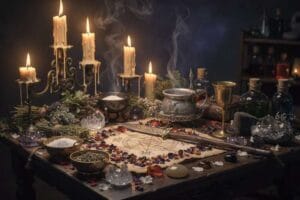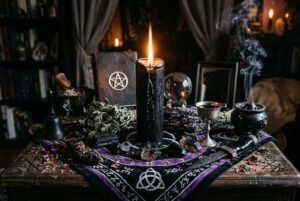
Brujería — Latin American witchcraft — is one of the most powerful, layered, and deeply human magical traditions on earth. More people than ever are feeling drawn to it: through ancestry, through curiosity, through a longing for magic that is rooted in the land, the body, and the community. Whether you carry Latin roots in your blood or you simply feel the pull of this tradition’s extraordinary wisdom, this guide will help you understand what brujería truly is, where it comes from, which parts are open to you, and how to step into this world with genuine respect. There is no single “brujería” — there is a living constellation of practices shaped by centuries of survival, resilience, and sacred knowledge. That complexity is exactly what makes it so profound.
What Is Brujería? Understanding the Core Tradition
Brujería is the Spanish word for witchcraft, but calling it simply “witchcraft” barely scratches the surface. It is an umbrella term for a wide family of Latin American magical and spiritual practices that emerged from the collision — and ultimately the creative fusion — of three great cultural streams: Indigenous American traditions, African diaspora spirituality, and European (primarily Spanish and Portuguese) folk magic and Catholicism.
This blending, known as syncretism, was not always peaceful. It was forged in the crucible of colonization, enslavement, and forced conversion. Indigenous and African peoples preserved their sacred knowledge by adapting it, disguising it, and weaving it into new forms. What emerged is something neither purely Indigenous, nor African, nor European — it is distinctly Latin American, and it carries the fingerprints of every ancestor who refused to let their magic die.
One important myth to set aside immediately: brujería is not dark, evil, or demonic. Pop culture has caricatured it for centuries. In reality, brujas and brujos are healers, protectors, diviners, and community guardians.
The Three Roots of Latin American Witchcraft
To understand brujería practice, you need to understand where it comes from. These three roots show up, in different proportions, across every regional tradition.
Indigenous Traditions
Hundreds of distinct Indigenous nations — Aztec, Maya, Inca, Zapotec, Quechua, and many more — each brought their own cosmologies, plant medicine knowledge, divination systems, and spiritual practices. Many of these traditions are closed practices, meaning they belong exclusively to those specific Indigenous communities and are not available to outsiders. Respecting this boundary is non-negotiable.
African Diaspora Spirituality
Enslaved Africans brought the sacred traditions of the Yoruba, Kongo, Fon, and many other peoples across the Atlantic. These traditions evolved into distinct religions — Santería (Cuba), Candomblé (Brazil), Vodou (Haiti), Palo Mayombe, and others. These are also closed, initiatory religions. They require formal initiation and years of commitment within the community. They are not available to practitioners outside those traditions, regardless of how attracted you feel to them.
European Folk Magic and Catholicism
Spanish and Portuguese colonizers brought their own folk magic, herbalism, Moorish influences, and Catholic devotional practices. Catholic saints became layered with older spiritual meanings. Prayers, candles, and sacred imagery were woven into magical work. This is the most open strand of brujería’s roots, particularly if you already have a relationship with Catholic tradition or European folk magic.
Regional Traditions Within Latin American Witchcraft
Brujería looks different depending on where you are. Here are some of the major regional expressions — and a clear note on which are open versus closed.
Mexico and Central America
Mexican brujería blends Indigenous (especially Aztec and Maya) cosmology with Spanish Catholicism and some African influence. Curanderismo — a system of folk healing using herbs, prayer, ritual, and energy work — is one of the most accessible branches for respectful outsiders, though it should ideally be learned from a trained curandera or curandero. Día de los Muertos traditions, Santa Muerte devotion, and Catholic folk magic also belong to this region.
The Caribbean
Caribbean traditions are heavily shaped by African diaspora spirituality. Santería in Cuba, Vodou in Haiti, Espiritismo in Puerto Rico, and Obeah in Jamaica and Trinidad are all distinct systems. Most of these are closed or require formal initiation. Espiritismo — a spiritist tradition blending Kardecist spiritualism with African and Catholic elements — has somewhat more flexibility, but still deserves careful, community-guided approach.
South America
Brazil hosts Candomblé and Umbanda (closed or complex initiatory systems), alongside closed Indigenous Amazonian practices. In the Andean regions of Peru, Bolivia, and Ecuador, Indigenous cosmology, Pachamama (Earth Mother) reverence, and Catholic syncretism blend into practices that largely belong to specific Andean Indigenous peoples. Approaching these traditions always requires guidance from people within those communities.
How to Begin Respectfully: A Step-by-Step Approach
If you feel called to brujería, the path forward is less about performing rituals and more about building genuine understanding. Here is how to begin with integrity.
Step 1: Get Honest About What You’re Actually Drawn To
“Brujería” is too broad to be a starting point. Sit down and ask yourself: What specifically calls to you? Is it the herbalism? The ancestor work? The candle magic? The connection to land and season? The more specific you get, the more clearly you can find a path that is genuinely open to you — and avoid accidentally stepping into closed territory.
Step 2: Learn the History Before the Practice
Read about the colonial history of Latin America. Understand how and why syncretism happened. This is not optional background reading — it is the foundation of the practice. When you know that these traditions were preserved under violent suppression, you will approach every prayer, every herb, and every symbol with the reverence it deserves. Seek out books and resources by Latin American scholars and practitioners, not by outside interpreters.
Step 3: Identify What Is Open and What Is Closed
Closed practices include all Indigenous-specific spiritual ceremonies, and all initiatory African diaspora religions (Santería, Candomblé, Vodou, Palo Mayombe, etc.). These are not available to you without initiation and community membership, full stop. More accessible paths include Catholic folk magic (especially if you are Catholic), general herbal knowledge with proper attribution, and some elements of curanderismo — when learned from a qualified practitioner.
Step 4: Find Latin American Teachers and Community
If you want to learn folk healing, learn from a curandera or curandero. If you want to understand a specific regional tradition, seek out practitioners from that region. Follow Latin American brujas, herbalists, and spiritual teachers on social media, read their books, attend their classes, and pay them fairly for their knowledge. Community-rooted knowledge cannot be absorbed from a book alone — genuine relationship with living teachers is where real learning takes root.
Step 5: Start with What Is Universal — Ancestor Veneration
One of the most beautiful and broadly accessible elements of brujería’s world is ancestor work. Setting up a simple altar with photographs of your own ancestors, a glass of water, a white candle, and flowers is a practice that crosses many traditions. Speak to your ancestors. Thank them. Ask for their guidance. This does not appropriate any specific tradition — it honors the universal human practice of remembering those who came before.
Step 6: Work with Plants and Herbs Respectfully
Herbal knowledge is central to Latin American folk magic and curanderismo. Many herbs — rue (ruda), rosemary, basil, copal, epazote — have deep cultural significance in Latin American traditions. You can work with these plants respectfully by acknowledging their cultural origins, learning how they are traditionally used, sourcing them ethically (ideally from Latin American-owned suppliers), and never claiming expertise you haven’t earned.
Step 7: Use Candle Magic as a Starting Point
Candle magic is one of the most widely shared and accessible elements of Latin American folk magic. Colored candles, prayer candles (veladores or vigil candles), and intention-setting with flame are practices you can begin gently. Choose candle colors with intentionality — white for purification and peace, red for protection and strength, green for abundance, purple for spiritual connection. Pair your candle work with sincere prayer or spoken intention.
Step 8: Keep a Spiritual Journal
Write down everything. Record the prayers you speak, the herbs you work with, the dreams you have, the synchronicities you notice. A spiritual journal is your most important tool as a beginner because it makes your practice conscious and traceable. Over time, patterns will emerge that tell you where your practice wants to go.
Step 9: Give Back to the Communities You Learn From
Actively support Latin American practitioners, herbalists, and spiritual teachers. Buy their books, attend their workshops, share their work. If you are not Latin American yourself, be transparent about that when you speak about what you’ve learned. Never present yourself as an authority on traditions that aren’t yours by heritage, and never profit from teaching practices that belong to specific communities.
Essential Tools and Supplies for Respectful Practice
If you are building a practice inspired by Latin American folk magic traditions, these are foundational items to gather thoughtfully:
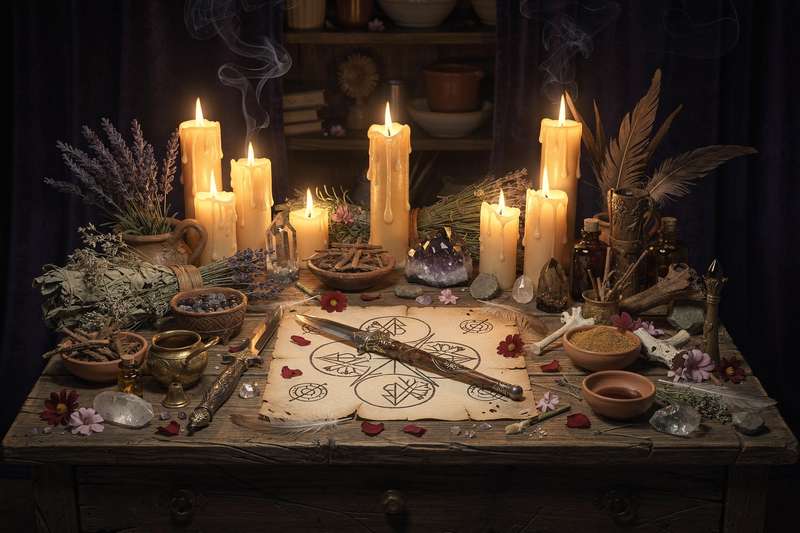
- Candles: White, red, and green vigil candles are workhorses of folk magic.
- Copal or sage: Copal resin is traditional to Mesoamerican ceremony — source it ethically from Latin American suppliers.
- Herbs: Rue, rosemary, basil, and chamomile appear across many traditions for protection, healing, and clearing.
- A glass of water: Used in spiritist practice as a portal for spirit communication and offering.
- Crystals: Black tourmaline and obsidian for protection; rose quartz for love and compassion; clear quartz as an amplifier.
- Catholic imagery: If this resonates with you, prayer cards, rosaries, and saint candles are integral to Latin folk magic’s Catholic layer.
- A journal: Non-negotiable for any beginner.
Ethics and Best Practices in Brujería
Ethics in brujería are not a checklist — they are a relationship with responsibility. A few core principles to carry always:
- Respect closed traditions: No curiosity, however genuine, justifies appropriating an initiatory or culturally closed practice.
- Work with intention, not performance: Magic done for aesthetic reasons without sincere intention is hollow at best and harmful at worst.
- Do not harm: The principle of not using magic to manipulate, harm, or coerce others applies here as it does in every ethical magical tradition.
- Credit your sources: Always acknowledge the cultural origins of what you practice and the teachers who guided you.
- Consent matters: Do not perform workings on behalf of others without their knowledge and agreement.
Common Beginner Mistakes to Avoid
- Claiming the “bruja” identity without cultural connection: The word carries specific cultural weight. Using it as a trendy label without genuine relationship to Latin American tradition is a form of appropriation.
- Treating brujería as a single unified system: It is not. Conflating Mexican curanderismo with Cuban Santería with Andean Indigenous practice is like treating all of European spirituality as one thing.
- Attempting to practice closed traditions from books alone: Santería, Vodou, Candomblé, and Indigenous ceremonies require initiation, community, and lineage — not just information.
- Ignoring the Catholic syncretism: Many Latin American folk practices are inseparable from their Catholic layer. Stripping that out to make them “more pagan” distorts them entirely.
- Learning only from non-Latin sources: If your understanding of brujería comes entirely from non-Latin authors and influencers, seek out Latin American voices directly.
- Moving too fast: There is no shortcut. The most powerful practitioners in any tradition have years — often decades — of patient study behind them.
How to Build Your Practice Over Time
Real spiritual practice is not built in a weekend. It grows slowly, like a root system beneath the soil — invisible for a long time, and then suddenly, unmistakably strong.
Give yourself at least a year before you call yourself anything. In that year, read widely, journal consistently, build your ancestor altar, and work with plants and candles quietly. Find at least one Latin American teacher to learn from directly. Let the tradition surprise you. Let it correct you. Let it reveal, gradually, which specific path within this broad world is genuinely calling your name.
Progress in spiritual practice is not measured by how many rituals you’ve performed — it is measured by how much your inner life has changed, how much clearer your intentions have become, and how much more respectfully you move through the world.
Final Thoughts
Brujería is not a trend. It is not an aesthetic. It is a vast, living body of knowledge that survived colonization, enslavement, and erasure because the people who held it refused to let it die. Approaching it with that understanding — with humility, with genuine curiosity, and with respect for both the open pathways and the closed ones — is the only worthy way to begin. The magic is real. So is the responsibility that comes with it.
Frequently Asked Questions About Brujería
Can anyone practice brujería, or is it only for Latin Americans?
Parts of Latin American folk magic — such as candle work, herbal traditions, and ancestor veneration — can be approached respectfully by anyone willing to learn the cultural context, acknowledge origins, and learn from Latin American teachers. However, closed practices like Santería, Vodou, Candomblé, and specific Indigenous ceremonies require initiation and community membership, regardless of your background.
What is the difference between brujería and curanderismo?
Curanderismo is a specific Mexican folk healing tradition focused on physical, emotional, and spiritual healing using herbs, prayer, ritual, and energy work. Brujería is a broader umbrella term for Latin American witchcraft generally. A curandera or curandero is a healer; a bruja or brujo may work across a wider range of magical intentions beyond healing.
Is brujería connected to Satanism or devil worship?
No. This association is a product of Catholic colonial propaganda used to demonize Indigenous and African spiritual practices. Brujería and related traditions are rooted in ancestral reverence, nature connection, healing, and protection — not devil worship. The misconception has caused enormous harm to Latin American communities and practitioners.
How is brujería different from Wicca or European witchcraft?
Wicca is a modern religious tradition codified in mid-20th century Britain, drawing primarily on European folk magic, ceremonial magic, and nature religion. Brujería is a family of Latin American traditions with roots in Indigenous American, African, and Iberian cultures — it predates Wicca by centuries and carries a very different cultural, historical, and spiritual context. Both are valid paths, but they are not interchangeable.