Every year, as October draws to a close and the nights grow longer, something stirs in the air: a stillness, a sense that the world between the living and the dead has grown unusually close. This is the essence of Samhain, one of the most powerful and beloved sabbats in the Pagan and Wiccan Wheel of the Year. Whether you are completely new to witchcraft, following a Wiccan path, or simply curious about the spiritual roots of Halloween, Samhain offers a profound invitation: to honor those who came before, to release what no longer serves you, and to stand at the threshold between the old year and the new. More people are drawn to Samhain each season — not as a costume party, but as a genuine spiritual practice rooted in ancient wisdom and personal meaning.
What Is Samhain? The Core Meaning of This Sacred Festival
Samhain (pronounced SAH-win or SOW-en) is an ancient Celtic festival that marks the end of the harvest season and the beginning of winter. Observed on the night of October 31st through November 1st, it sits directly opposite Beltane on the wheel of the year — the two festivals together forming the great hinge points of the Celtic calendar. At Samhain, the boundary between the physical world and the spirit world was believed to be at its most permeable, allowing the souls of the deceased to move freely among the living.
A common myth is that Samhain is simply “Pagan Halloween” or that it is primarily about fear and darkness. In truth, it is a festival of remembrance, gratitude, and transition. The darkness of this season was never meant to terrify — it was a sacred darkness, like the fertile soil from which new life eventually grows. Modern Pagans, Wiccans, hedge witches, kitchen witches, and eclectic practitioners of all kinds celebrate Samhain as a time to honor ancestors, reflect on the year past, and prepare the spirit for the quieter months ahead.
Paths and Styles: How Different Witches Celebrate Samhain
One of the beautiful things about Samhain is that it speaks to nearly every spiritual tradition within the broader witchcraft community. There is no single “correct” way to observe it. Here are some of the most common approaches:
- Wiccan practitioners often follow the formal structure of the Wheel of the Year, marking Samhain as the third and final harvest festival and the Witch’s New Year. Rituals may include casting a sacred circle, calling in the quarters, and performing guided ceremonies to honor the Goddess as she enters her Crone phase.
- Celtic reconstructionists draw more directly from pre-Christian Irish, Scottish, and Welsh traditions — focusing on ancestral veneration, fire ceremonies, and the folklore surrounding the spirit world without the Wiccan ritual framework.
- Eclectic witches blend whatever resonates — perhaps an ancestor altar combined with tarot readings and their own original prayers. There are no rules here, only intention.
- Kitchen and hearth witches may focus on the domestic magic of the season: cooking traditional foods, brewing herbal teas, lighting candles at the dinner table, and leaving a symbolic place setting for beloved ancestors.
- Hedge witches may use Samhain as an especially potent time for journeywork, dreamwork, and divination, when the boundary between worlds feels particularly open to communication with guides and spirits.
How to Celebrate Samhain: A Step-by-Step Guide for Beginners
You do not need years of experience, an elaborate altar, or a coven to celebrate Samhain meaningfully. These steps are designed to be adapted to your path, your home, and your level of practice.
Step 1 — Learn the Lore (Even a Little)
Before you light a single candle, spend some time connecting with the history and meaning of this festival. Read about Celtic traditions, the mythology of the spirit world, and how this holy day has been observed across cultures and centuries. Understanding the why behind a practice roots it in something deeper than aesthetics. You do not need to become a scholar — even an hour of reading will enrich everything you do at Samhain.
Step 2 — Cleanse Your Space
Samhain is a threshold time, and thresholds deserve a clean welcome. Before your ritual or observance, physically tidy your home or sacred space, then cleanse it energetically. You might burn dried herbs like rosemary or mugwort, use a sound cleansing with a singing bowl or bell, or simply open windows and visualize stale energy moving out. This creates a clear, welcoming environment — both for your own focus and for any ancestors you intend to honor.
Step 3 — Build an Ancestor Altar
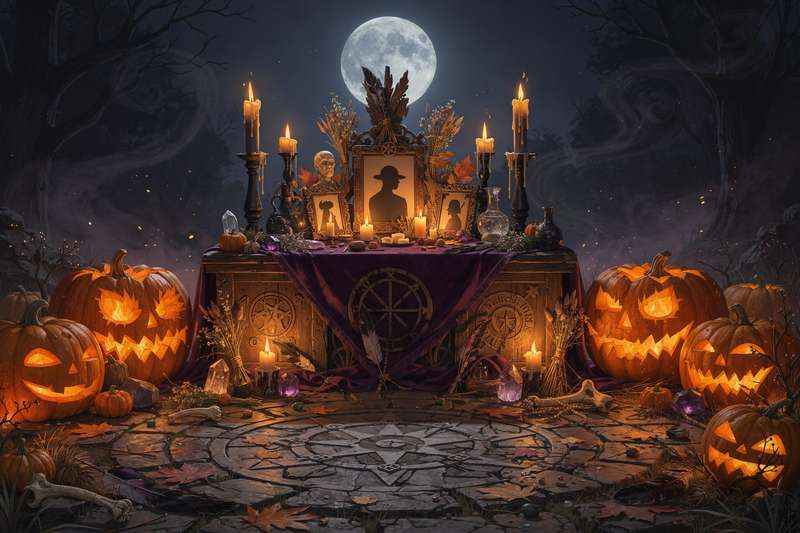
This is the heart of most Samhain celebrations. Set up a small dedicated surface — a shelf, a windowsill, or a corner of your table — and place photographs or mementos of loved ones who have passed. Add items they loved in life: a favorite food, a small object they cherished, a flower they grew. You might also include symbols of ancestors you never met — an old map of a homeland, a cultural artifact, or simply a candle lit in their honor. This altar is not morbid; it is an act of love.
Step 4 — Light a Candle for the Dead
One of the oldest Samhain customs involves fire as a beacon and a protection. Light a candle — black, white, or orange are traditional choices — and speak aloud the names of those you wish to remember. You can say something simple: “I remember you. I honor you. You are not forgotten.” Allow yourself to feel whatever arises. Grief, gratitude, warmth — all of it is welcome here.
Step 5 — Set a Dumb Supper or Feast
A beloved folk tradition connected to Samhain involves setting a place at the table for the deceased and eating a meal in their honor. You might cook dishes that were meaningful to your loved ones, or seasonal foods like root vegetables, apples, pumpkin, and warm spiced drinks. Some practitioners eat part of the meal in complete silence as a form of meditation and receptivity. Others simply raise a glass and share memories aloud. Both approaches carry deep meaning.
Step 6 — Perform Divination
Because this night is regarded as one of the most spiritually open times of year, it is also considered one of the most powerful for divination. Pull a tarot spread focused on the year ahead, cast runes, scry with a candle flame or a dark mirror, or simply journal with open-ended questions and see what surfaces. You do not need to seek dramatic visions — sometimes the most meaningful insights come as quiet knowings or unexpected patterns in what you draw.
Step 7 — Release What No Longer Serves You
Samhain is the Witch’s New Year, and like any new year, it calls for releasing the old before stepping into the new. Write down anything you wish to leave behind — a habit, a belief, a relationship pattern, a grief you are ready to begin moving through. You can burn the paper safely in a fireproof dish, bury it in the earth, or tear it up and compost it. As you release it, state your intention clearly: “I release this. It served its purpose. I am ready to move forward.”
Step 8 — Spend Time in Nature
If you are able, go outside on or around Samhain — especially at dusk or after dark. Notice the bare trees, the cold air, the smell of decay that precedes winter. This is not something grim; it is the natural world modeling the truth that endings are part of the cycle. You might collect fallen leaves, acorns, or seed pods as altar decorations or spell ingredients. Even a brief walk outdoors can ground the ritual energy of the season into your body.
Step 9 — Close Your Practice Intentionally
However you choose to celebrate, close your Samhain practice with intention. Thank any ancestors, spirits, or deities you invoked. Extinguish candles mindfully. If you cast a circle, close it. Ground your energy — eat something, place your hands on the earth or floor, take a few deep breaths. Closing deliberately honors the work you did and helps you return fully to ordinary awareness.
Essential Tools and Supplies for Samhain
You do not need a large budget or a specialty witchcraft store to celebrate Samhain. These are the basics that many practitioners find useful:
- Candles: Black (banishing, protection, honoring death), white (purity, spirit connection), and orange (harvest, transformation). Even a single tealight is enough.
- Crystals: Black obsidian and black tourmaline are powerful protective stones for this liminal time. Labradorite supports intuition and spirit-facing work. Smoky quartz helps with grounding after deep spiritual work.
- Herbs: Mugwort (for divination and dreamwork), rosemary (for remembrance), sage, and dried apple or pomegranate (sacred harvest symbols).
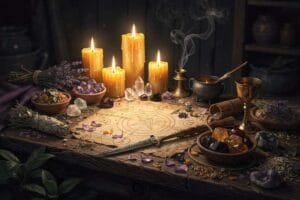
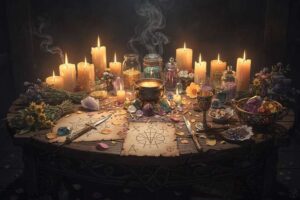
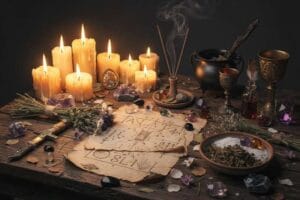
- Altar items: Ancestor photographs, seasonal produce (apples, gourds, corn), a small cauldron or fireproof dish for burning, and a journal for reflections and divination records.
- Tarot or oracle cards: A deck you connect with for Samhain readings. The Death card, interestingly, carries the energy of transformation — perfectly suited to this season.
Ethics and Best Practices for Samhain Ritual
Samhain involves working with ancestors and potentially with spirits — and this calls for a grounded, respectful approach. A few guiding principles worth keeping in mind:
- Consent matters. When inviting ancestral energy, be clear about who you are calling in. You can specify “only those who wish me well and come in love.” You are allowed to set energetic boundaries.
- Cultural respect. Samhain is rooted in Celtic traditions, but it has also been shaped by many hands over centuries. Be thoughtful about which specific cultural practices you adopt — especially those from living traditions that belong to specific communities.
- Grief is sacred. If ancestor work brings up deep emotion, honor it. Samhain is not a performance — it is a genuine encounter with loss, love, and memory. Take care of yourself before and after.
- Intent is the foundation. Whatever form your Samhain practice takes, clarity of intention is what gives it power and meaning.
Common Beginner Mistakes to Avoid
- Skipping the closing. Opening sacred space without properly closing it can leave you feeling ungrounded or scattered. Always close what you open.
- Inviting spirits without boundaries. Being too open-ended in spirit invocations — calling in “anyone who wants to come” — is energetically risky. Be specific about who you welcome.
- Treating it like Halloween only. There is nothing wrong with enjoying costumes and candy, but if you want a genuine Samhain practice, give it its own dedicated time and space separate from party energy.
- Buying every tool at once. You do not need a full altar setup to have a powerful Samhain. Start with what you have — a candle, a photograph, an open heart.
- Expecting dramatic results. A spiritually open night does not mean you will see ghosts. Many practitioners find Samhain brings subtle shifts — a vivid dream, an unexpected memory, a feeling of peace. Trust the quiet magic.
- Ignoring your own grief. If there are losses you have been avoiding, Samhain has a way of bringing them to the surface. Go gently with yourself, and consider journaling or speaking with someone you trust.
How to Build Your Samhain Practice Over Time
Your first Samhain does not have to be elaborate or perfect. Light one candle. Speak one name. That is enough. Over time, you may find your practice deepening naturally — more ancestors recognized, more rituals tried, more traditions woven in from your own heritage or spiritual lineage. Keep a seasonal journal and revisit it each year. Notice what felt meaningful and what fell flat. Your Samhain practice will deepen in its own time. The wheel turns again every year, and each return brings a new layer of understanding.
Final Thoughts
Samhain is not a holiday for one type of witch or one type of person. It belongs to anyone willing to pause, look honestly at the cycle of life and death, and honor what — and who — has come before. Whether you build an elaborate ancestor altar or simply sit quietly with a candle and a memory, you are participating in something ancient, meaningful, and alive. The ancestors are listening. You are not alone.
Frequently Asked Questions About Samhain
What is the correct way to pronounce Samhain?
Samhain is pronounced SAH-win or SOW-en (rhymes with “cow-en”), derived from Old Irish. The “mh” in Irish produces a “w” sound, which is why the spelling looks so different from how it is spoken. You may also hear SAV-en in some Scottish Gaelic traditions, where the pronunciation reflects a distinct regional dialect rather than the standard Old Irish form.
Is Samhain the same as Halloween?
They share roots but are not the same thing. Samhain is an ancient Celtic festival that influenced the Christian feast of All Hallows’ Eve, which eventually evolved into the secular Halloween most people celebrate today. Samhain as practiced in modern Paganism is a spiritual observance focused on ancestral honor, divination, and seasonal transition — quite different from costume parties and candy.
Do I have to be Wiccan to celebrate Samhain?
Absolutely not. While Samhain is one of the eight Wiccan sabbats, it is celebrated by practitioners across many paths — Celtic reconstructionists, eclectic witches, hedge witches, kitchen witches, and spiritual-but-not-religious individuals. You do not need to belong to any specific tradition to observe this festival in a way that is meaningful to you.
Is it safe to work with ancestors and spirits at Samhain?
When approached with clear intention and proper grounding and closing practices, ancestral work is considered safe and deeply meaningful by most practitioners. Setting energetic boundaries — specifying that you welcome only those who come in love and goodwill — is a standard practice that adds an important layer of protection. Always close sacred space intentionally after any spirit work.