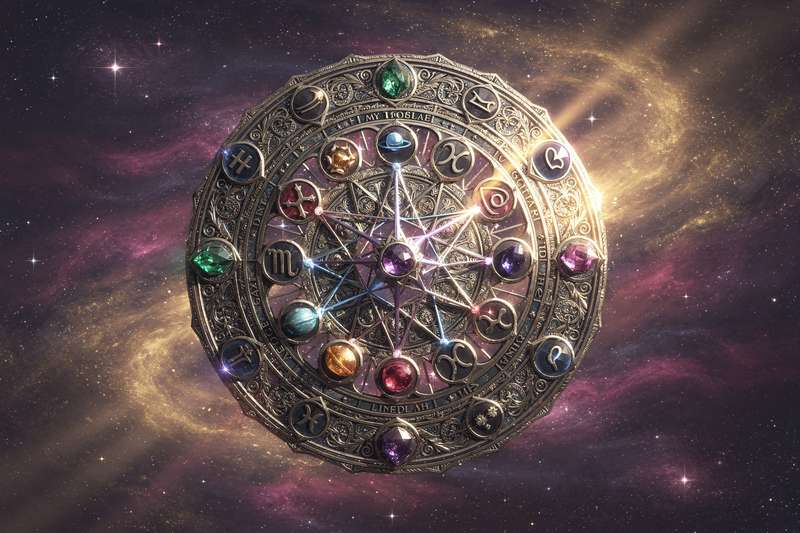
What Are Astrology Aspects?
When you look at your birth chart, you’re viewing a snapshot of where every planet was positioned at the exact moment you were born. But here’s what makes astrology truly rich and meaningful: it’s not just about where the planets sit individually. It’s about how they relate to each other.
Astrology aspects are the geometric angles formed between two or more planets in your chart. Think of them as conversations happening between different parts of your personality, different life areas, and different energetic forces within you. These angles tell you whether those conversations flow easily or create friction—and both matter.
You can also experience aspects in real-time as the planets move across the sky. These transiting aspects (planets forming angles to your natal planets) often mark important turning points, challenges, and opportunities in your life.
How Aspects Work: The Basics
Aspects are measured in degrees. The circle of the zodiac contains 360 degrees, and different degree separations between planets create different types of aspects. Each aspect type has its own quality and feel.
Here’s what you need to know: some aspects feel naturally supportive and flowing. Others feel tense and demanding. Neither is inherently “bad”—they simply create different experiences. The flowing aspects make things feel easier, sometimes so easy that you might not grow as much as you could. The challenging aspects push you, stretch you, and build your character through effort and problem-solving.
A balanced chart has a healthy mix of both. The easy aspects give you confidence and natural gifts. The hard aspects give you motivation to overcome obstacles and develop resilience.
The Major Aspects You Need to Know
Conjunction (0 degrees)
Two planets are in conjunction when they occupy the same degree of the zodiac. This is the most intense aspect—the planets merge their energies completely. A conjunction acts like a spotlight, amplifying both planetary energies. If Venus and Mars are conjunct, your desires and values intertwine powerfully. If Mercury and Saturn are conjunct, your mind has serious, focused qualities. Conjunctions can feel overwhelming because there’s no separation, but they create undeniable power and focus.
Trine (120 degrees)
A trine is the golden child of aspects. When planets are 120 degrees apart, they’re in compatible zodiac elements (fire with fire, earth with earth, air with air, water with water). Trines flow effortlessly. Things come naturally. If you have Sun trine Jupiter, you likely attract good fortune and feel confident about your path. Trines are gifts, but use them intentionally—they’re easy enough to take for granted.
Sextile (60 degrees)
Sextiles are gentler than trines but still supportive. Planets in sextile are 60 degrees apart, often in compatible but complementary elements. A sextile requires a little more effort than a trine, but opportunities still come relatively easily. You might need to open a door, but it swings open smoothly once you do. Sextiles offer gifts that reward small actions and awareness.
Square (90 degrees)
Squares create tension. Two planets at right angles (90 degrees) don’t naturally understand each other. This aspect is challenging, sometimes frustrating. But squares are also your greatest teachers. They force growth. If Mars squares Saturn in your chart, you battle between wanting to act quickly and needing to move carefully—but this internal friction develops incredible discipline and strategy. Many highly accomplished people have strong squares because the planets refuse to cooperate without conscious effort.
Opposition (180 degrees)
Oppositions place planets directly across from each other on the zodiac wheel. Like a square, this is a challenging aspect, but it operates differently. Instead of friction, you experience polarity. The planets want opposite things. If Venus opposes Pluto, you swing between wanting light, comfortable relationships and feeling drawn into intense, transformative connections. Oppositions aren’t about one planet being right and one wrong—they’re about integrating two opposing truths within yourself.
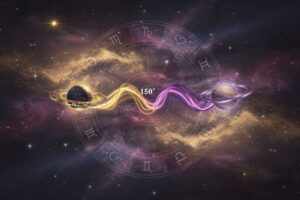
Quincunx (150 degrees)
This is the aspect of adjustment. Planets in quincunx don’t naturally blend, and they’re not in complementary positions either. You feel a need to constantly tweak and adjust. A quincunx can feel like mild irritation—something’s not quite right, so you keep refining and improving. This aspect develops your ability to adapt and perfect things, though it can also bring a sense of restlessness.
Semi-square (45 degrees) and Sesquiquadrate (135 degrees)
These are minor aspects that bring subtle friction and irritation. Think of them as gentle reminders that two planetary energies aren’t naturally aligned. They’re not major obstacles, but they might create small annoyances or areas where you need patience with yourself.
Soft Aspects vs. Hard Aspects
Astrologers divide aspects into two categories:
- Soft aspects (conjunction, trine, sextile): These feel easy and flowing. Energy moves smoothly between the planets. Life tends to cooperate. Soft aspects give you natural talents and favorable circumstances.
- Hard aspects (square, opposition, quincunx): These create tension, friction, or polarity. Energy doesn’t flow automatically; you have to consciously work with it. Hard aspects develop character, resilience, and motivation.
If your chart is full of soft aspects, you might struggle because things come too easily—you haven’t developed the grit to push through real challenges. If your chart is dominated by hard aspects, you’re constantly working, and rest might feel unfamiliar. The ideal is balance: enough ease to feel supported, enough challenge to grow.
How to Read Aspects in Your Birth Chart
When you obtain your birth chart, you’ll see aspects listed in a table (called an aspects grid) or marked with lines and symbols on the chart wheel itself. Different colored lines indicate different aspect types: red for hard aspects, blue for soft aspects (the color system varies by source).
To interpret your aspects, follow these steps:
- Identify the planets involved. What does each planet represent? (Sun = core identity, Moon = emotions, Mercury = communication, Venus = love and values, Mars = action and desire, etc.)
- Note the aspect type. Is it supportive, challenging, or neutral?
- Consider the zodiac signs. What signs are the planets in? This adds nuance. A Mars square Saturn feels different if Mars is in fiery Aries versus earthy Capricorn.
- Look at the orb. Aspects have “orbs”—acceptable degree ranges where they still count as aspects. A trine is usually considered operative within 6-8 degrees of exact. The tighter the orb (closer to exact), the stronger the aspect’s influence.
- Connect it to your life. How does this aspect show up in your actual experience? Hard aspects often appear as recurring internal conflicts or external obstacles. Soft aspects appear as natural talents or fortunate circumstances.
Transiting Aspects: Timing Life Changes
Beyond your natal chart, planets continue moving. When a transiting planet forms an aspect to one of your natal planets, it activates that natal planet. This is how astrology helps you understand timing.
If Jupiter (planet of expansion and opportunity) forms a trine to your natal Sun, you’re in a period of increased confidence and favorable circumstances. If Saturn (planet of limitation and hard lessons) forms a square to your natal Venus, you might face relationship challenges that require maturity and commitment. Tracking transits helps you understand why certain periods feel easier or harder.
Practical Tips for Working With Your Aspects
Understanding your aspects isn’t about accepting limitation or passively waiting for good transits. It’s about working with the energies you have:
- Use soft aspects intentionally. Don’t let natural talent go undeveloped. Channel trine and sextile energies into meaningful pursuits.
- Befriend hard aspects. They’re not punishments—they’re your internal motivators and character builders. Ask yourself: what is this square or opposition trying to teach me?
- Watch for aspect patterns. If you have multiple squares, you’re someone who thrives with challenges. If you have multiple trines, you might need to actively seek growth.
- Track significant transits. When Jupiter, Saturn, or other slow-moving planets form major aspects to your natal planets, pay attention. These are chapters of your life story.
FAQ
What’s the difference between a trine and a sextile?
Both are soft, supportive aspects, but trines (120 degrees) feel more effortless and natural, while sextiles (60 degrees) require a little initiative. A trine is like a gift handed to you; a sextile is an opportunity that rewards your action. Trines often feel passive; sextiles feel more actively lucky.
Are hard aspects bad?
No. Hard aspects are challenging, but challenges build character. Squares and oppositions often appear in the charts of highly driven, accomplished people. They create internal pressure that motivates growth. Without them, you might lack drive. The key is learning to work with them consciously rather than feeling victimized by them.
How do orbs affect aspect interpretation?
An orb is the acceptable margin of error for an aspect. A tight orb (exact or within 1-2 degrees) means the aspect is very strong and active in your life. A loose orb (at the outer edge of the acceptable range, like 7-8 degrees) means the aspect is present but subtler. Generally, tighter orbs equal stronger influence.
Can I change my aspects?
Your natal chart aspects are fixed—they don’t change. However, you can change how you work with them. Hard aspects become less destructive when you understand them and work consciously with their energy. Soft aspects become more valuable when you actively develop them. Your awareness transforms how aspects play out in your life.