Your birth chart is like a cosmic snapshot—a precise map of where every planet was positioned at the exact moment you entered the world. Unlike generic horoscopes, your birth chart is uniquely yours. It reveals your core personality, emotional patterns, relationship style, career strengths, and the areas of life where you’re meant to grow. Learning how to read a birth chart is one of the most empowering spiritual practices you can adopt, and the good news is that anyone can do it.
What Is a Birth Chart?
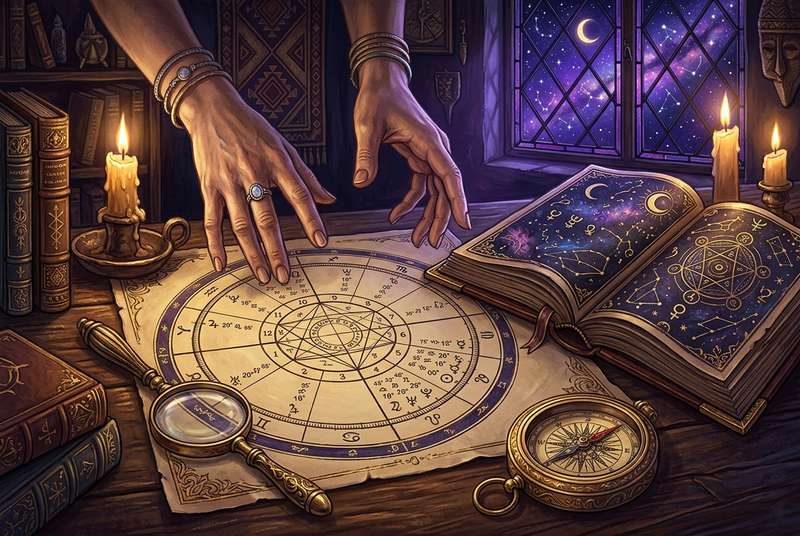
A birth chart (also called a natal chart) is an astrological map calculated from three essential pieces of information: your date of birth, your exact time of birth, and your location of birth. These details allow astrologers to determine where all the planets were positioned relative to Earth at the moment of your birth.
Think of it this way: if your life were a film, the planets would be the actors, and the zodiac signs would be the roles they’re playing. Your birth chart shows you the entire cast and their costumes, giving you insight into how these archetypal energies express themselves through your personality and life circumstances.
The birth chart has three main layers: the planets (which represent different aspects of your nature), the zodiac signs (which describe how those planets express themselves), and the houses (which show the life areas where this energy manifests). Understanding each layer helps you see the complete picture of who you are.
Getting Your Birth Chart: What You’ll Need
Before you can read your birth chart, you need to generate one. Thanks to modern astrology websites, this is quick and free. You’ll need:
- Your birth date (month, day, and year)
- Your birth time (as exact as possible—ideally to the minute)
- Your birth location (city and state or country)
If you don’t have your exact birth time, check your birth certificate first. In the U.S., you can contact your state’s Office of Vital Records for a copy. Family members might also remember or have documented the time. Without your exact birth time, you’ll miss accurate information about your rising sign and house placements, but you can still learn plenty from your planetary positions and zodiac signs.
If you can’t locate your birth time anywhere, use noon (12:00 PM) as a placeholder—it’s better than guessing randomly. Many astrologers can also help you estimate your birth time using a technique called rectification, which looks at major life events to narrow down the window.
Understanding the Planets in Your Birth Chart
In astrology, each planet represents a different facet of your personality and experience. Here’s what each one governs:
- The Sun: Your core identity, ego, and life purpose—the central “you”
- The Moon: Your inner emotional world, instinctive needs, and how you process feelings
- Mercury: How you think, communicate, and process information
- Venus: Your romantic nature, aesthetic preferences, and what you value
- Mars: Your drive, courage, sexuality, and how you pursue what you want
- Jupiter: Your optimism, luck, expansion, and where you take risks
- Saturn: Where you develop discipline, face limitations, and build lasting structures
- Uranus: Your rebellious side, innovation, and where you break the rules
- Neptune: Your spiritual intuition, imagination, and idealism
- Pluto: Your capacity for transformation, power, and psychological depth
- The Lunar Nodes: The soul themes you’re meant to develop and release in this lifetime
- Your Rising Sign (Ascendant): The mask you wear, your outward personality, and first impression
Each of these planetary energies shows up in your chart in a specific zodiac sign, which adds layers of nuance to how that energy expresses through you.
Discovering Your Zodiac Signs: The Costumes Your Planets Wear
The zodiac signs modify how each planet expresses itself. If you have Venus (planet of romance) in fiery Aries, you might fall in love quickly and passionately. That same Venus in steady Taurus would prefer slow-building, committed relationships. The sign changes the flavor entirely.
As you learn to read your birth chart, pay attention to which zodiac sign each planet occupies. You’ll notice patterns: maybe you have several planets in water signs (Cancer, Scorpio, Pisces), suggesting emotional depth, or multiple earth signs (Taurus, Virgo, Capricorn), indicating practicality and grounding.
The 12 zodiac signs are grouped into four elements and three qualities:
- Elements: Fire (passionate, bold), Earth (practical, grounded), Air (intellectual, communicative), Water (emotional, intuitive)
- Qualities: Cardinal (initiating, leading), Fixed (stable, committed), Mutable (adaptable, communicative)
Aries is cardinal fire (initiating boldness). Taurus is fixed earth (stable groundedness). Learning these patterns helps you understand why certain planetary placements resonate with your lived experience.
The 12 Houses: Where Life Happens
While planets show what energies you carry and zodiac signs show how they express, houses show where in your life these energies manifest. The 12 houses map onto different life domains:
- 1st House: Self, appearance, how others see you
- 2nd House: Money, values, self-worth
- 3rd House: Communication, siblings, short trips, learning
- 4th House: Home, family, roots, your private self
- 5th House: Creativity, romance, self-expression, children
- 6th House: Health, work, daily routines, service
- 7th House: Partnerships, marriage, close relationships
- 8th House: Intimacy, shared resources, transformation, psychology
- 9th House: Higher learning, travel, philosophy, spirituality
- 10th House: Career, public reputation, achievements, authority
- 11th House: Friendship, community, hopes, networks
- 12th House: Spirituality, unconscious patterns, solitude, hidden strengths
If you have Venus in the 7th house, relationships are a major life focus. If Mars is in your 10th house, your career is where you channel your drive and ambition. The planets in specific houses show you which life areas get the most attention from the universe—and from you.
Reading Aspects: How Your Planets Talk to Each Other
Aspects are angles between planets in your chart. They show how different parts of your personality cooperate or create friction. The main aspects are:
- Conjunction (0°): Planets blend together, amplifying each other’s energy
- Sextile (60°): A supportive, harmonious angle—these energies work well together
- Square (90°): Tension and challenge—these planets push you to grow
- Trine (120°): Flow and ease—natural talent and grace in combining these energies
- Opposition (180°): Polarity and awareness—you feel the pull of opposing forces
Don’t fear challenging aspects like squares and oppositions. They’re not “bad”—they’re sources of motivation and depth. A Moon-Mars square might create emotional intensity, but it also fuels passion and the drive to transform pain into purpose.
How to Work With Your Birth Chart Knowledge
Once you understand your chart, you can use it as a tool for self-awareness and intentional living. Here are practical ways to work with this information:
Journal About Your Placements
Write about each planet and house placement. Ask yourself: “Do these descriptions feel true to my experience? Where do I recognize these patterns in my behavior, relationships, or choices?” This reflective work deepens your understanding and anchors the abstract astrological language to your actual life.
Use Your Chart for Life Planning
Your 10th house shows natural career strengths. Your 5th house reveals where creativity lives. Your 7th and 8th houses illuminate relationship patterns. By understanding these, you can make choices aligned with your astrological strengths rather than against them.
Recognize Your Emotional Needs
Your Moon sign shows what you actually need to feel secure, which might be different from what your Sun sign wants to achieve. A Leo Sun might crave recognition, but a Cancer Moon needs private, intimate connection. Honoring both needs creates balance.
Track Transits and Progressions
Your birth chart is static, but the planets keep moving. Current planetary positions (called transits) activate different parts of your chart throughout your life, bringing opportunities and challenges. Learning to track these helps you understand timing in your life.
Common Misconceptions About Birth Charts
- “My chart predicts my future.” Your birth chart shows tendencies and themes, not fixed destiny. You have agency in how these energies unfold.
- “I’m just my Sun sign.” Your Sun is only one piece. Your Moon, Rising sign, Venus, Mars, and house placements are equally important to who you are.
- “I need to know exact aspects to learn from my chart.” Understanding the basic placements—planets, signs, and houses—gives you 80% of the value. Aspects add nuance but aren’t required for beginners.
- “Challenging aspects mean I’m unlucky.” Squares and oppositions create friction, yes, but friction creates momentum. Some of your greatest strengths come from difficult placements.
- “My birth time doesn’t matter much.” Your exact birth time determines your Rising sign and house cusps, which are foundational. It’s worth the effort to find.
- “Astrology contradicts free will.” Your chart describes your archetypal patterns and potential, but how you express them is entirely your choice.
Final Thoughts: You Are Your Own Astrologer
Learning how to read your birth chart is an act of self-respect. You’re taking time to understand yourself on a deeper level, beyond the surface personality. You’re recognizing that you contain multitudes—rebel and builder, dreamer and doer, warrior and sage—and that all these parts are yours to integrate.
Your birth chart doesn’t define you. It reflects you. It’s a mirror you can look into to understand your strengths, honor your emotional needs, and work consciously with the energies you were born with. The more you study your chart, the more you’ll see yourself clearly—not as fixed or limited, but as a complex, capable person with specific gifts to offer the world.
Start by generating your chart, identifying your Sun, Moon, and Rising sign, and noticing which planets fall into which houses. From there, the universe of self-knowledge unfolds. There’s no rush, no right way to interpret it. Your chart is a lifelong companion in understanding yourself.
FAQ
What’s the difference between a birth chart and a natal chart?
They’re the same thing. “Birth chart” and “natal chart” are used interchangeably in astrology. Both refer to the astrological snapshot of planetary positions at your moment of birth.
Can I read my birth chart if I don’t know my birth time?
Yes, but with limitations. Without your exact birth time, you won’t have an accurate Rising sign or house placements. However, you can still interpret your Sun sign, Moon sign, and the zodiac signs of all your planets, which gives you substantial insight.
Why is my Sun sign different from what I thought?
Sun signs don’t change daily—they shift approximately every 30 days. If you were born on a sign cusp (the last or first day of a sign), confirm your time of birth, as the Sun’s exact position depends on the hour.
Are challenging aspects in my birth chart bad?
No. Squares and oppositions create tension, which motivates growth and depth. Many people with difficult aspects develop remarkable resilience and wisdom. These aspects aren’t punishments—they’re invitations to mature.