What Are Rune Spreads and Why They Matter
When you pick up your rune stones for the first time, you might wonder: where do I even start? Unlike drawing a single rune for quick guidance, rune spreads give you a structured framework to ask deeper questions and receive multi-layered answers. Think of a spread as a conversation with the ancient wisdom embedded in these symbols—each position holds specific meaning, and together they create a complete picture of your situation.
Rune spreads transform your reading from a simple yes-or-no moment into genuine insight. They slow you down, anchor your intention, and give your intuition room to speak. Whether you’re wrestling with a major life decision or seeking clarity on what’s already unfolding, the right spread can be your compass.
A Brief History of Runes and Their Power
Runes are far more than decorative symbols. They’re letters from ancient Germanic, Norse, and Anglo-Saxon alphabets, originally carved into wood, stone, and metal centuries ago. What makes them special for divination is their origin story: according to Norse legend, Odin himself discovered these symbols through great sacrifice and spiritual endurance, receiving them as divine knowledge rather than creating them himself.
The Elder Futhark—the most commonly used rune set—contains 24 symbols dating back to around 150 CE. Roman historian Tacitus documented Germanic peoples using carved wooden staves for divination, proving that reading runes is an authentic practice with deep roots. Before Latin alphabets replaced them in the late Middle Ages, runes carried both practical writing function and magical significance. Today, when you cast runes, you’re tapping into centuries of accumulated spiritual knowledge.
Before You Begin: Preparing Your Space and Mind
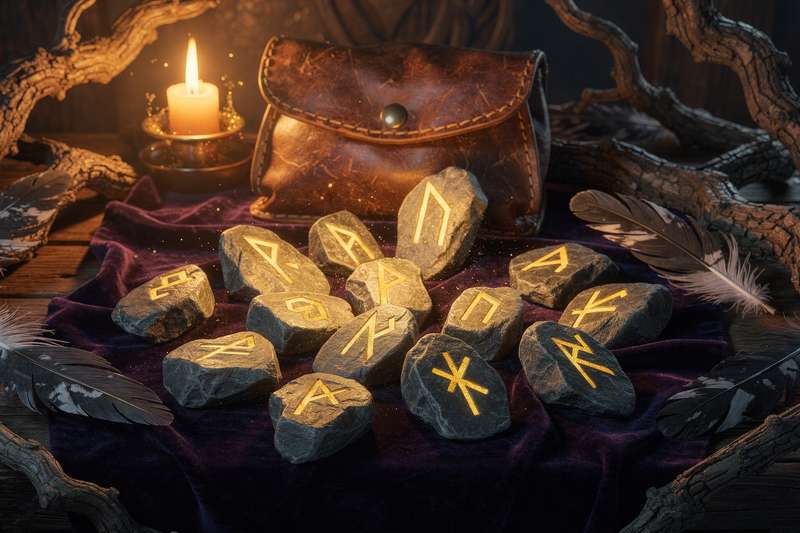
The quality of your reading depends heavily on how you show up for it. Find a quiet corner where interruptions won’t pull your attention away. Light a candle, burn incense, or lay out a rune cloth—whatever creates a sense of sacred space for you. These small rituals aren’t superstition; they signal to your mind and spirit that something meaningful is happening.
Take several deep breaths and center yourself. Set your runes aside for a moment and clear away mental clutter. When you’re ready, hold your question clearly in your mind. Don’t overthink it—just let the issue sit with you. This focused intention is what activates the runes’ reflective power. Shuffle your runes thoroughly, mixing the stones with your hands or swirling them in a bag. Then draw them one at a time, placing each according to your chosen spread layout.
The Three-Rune Spread: Your Gateway to Deeper Reading
The three-rune spread is ideal when you’re ready to move beyond a single rune but aren’t yet comfortable with complex layouts. You’ll draw three stones and place them in a line from left to right. This spread works beautifully because it offers enough detail to be truly helpful without overwhelming you with information.
Three-Rune Spread: Problem & Solution Layout
This version is perfect when you’re facing a specific challenge and need practical guidance.
- Position 1 (Left): The core issue—the broad situation or problem you’re examining. This rune reveals what’s really at stake.
- Position 2 (Center): The obstacle or complicating factor. This is often where you’re getting stuck or what you haven’t yet considered.
- Position 3 (Right): The solution or action to take. This rune suggests a path forward or something within your power to change.
Example: You’re questioning whether to leave your job. Your first rune might show stagnation, the second reveals fear of the unknown, and the third suggests trusting your instincts. Together, they give you permission and direction.
Three-Rune Spread: Past-Present-Future Layout
This classic timeline approach helps you understand how you arrived at this moment and where you’re heading.
- Position 1 (Left): The past—energy or patterns that brought you here. This might be something holding you back, or wisdom you’ve gained.
- Position 2 (Center): The present—what’s happening right now. This is often an opportunity or challenge you’re actively facing today.
- Position 3 (Right): The future—a possible outcome or direction you’re moving toward based on current energy.
Remember: runes don’t predict fixed futures. They show you potential outcomes based on your current path, giving you room to make different choices if that knowledge serves you.
The Five-Rune Spread: Adding Dimension to Your Reading
Once you’re comfortable with three-rune spreads, the five-rune cross takes you to the next level. You’ll arrange five stones in a cross pattern: one in the center, then one to the left, top, bottom, and right. This layout gives you depth while remaining manageable and intuitive.
The beauty of the five-rune cross is its flexibility. You can use the same past-present-future framework as your three-rune spread, but the additional two positions provide nuance that changes everything.
Five-Rune Cross: Complete Layout Guide
- Center: The heart of the matter—the core energy or central issue you’re examining.
- Left: Past influences or what brought you to this point.
- Right: Future direction or potential outcomes.
- Top: Action items or things within your influence. These are steps you can take or energy to cultivate.
- Bottom: Obstacles, distractions, or time-wasters. What’s draining your energy or holding you back.
This spread excels when you want both the big picture (center, left, right) and practical guidance (top, bottom). You’re not just seeing what’s happening—you’re learning what to do about it and what to avoid.
The Celtic Cross: The Master Layout for Complex Situations
The Celtic cross is the most elaborate spread covered here, traditionally using ten stones arranged in a specific pattern. If you’re facing a complicated situation with many moving parts, or if you want the most comprehensive view possible, this spread delivers.
While each position in a Celtic cross carries distinct meaning, the layout can feel intricate at first. Many readers use a printed guide beside them as they learn. The reward is depth: you’ll understand not just what’s happening, but why, what influences are at play, and what the ultimate outcome might be if things continue as they are.
If you’re new to rune reading, you might save the Celtic cross for later. Master the three-rune and five-rune spreads first. Build your confidence and your knowledge of the rune meanings. Then, when you’re ready, the Celtic cross will feel less intimidating and far more rewarding.
Reading and Interpreting Your Runes
Once your runes are laid out, interpretation comes next. Each rune carries multiple meanings—some readers work with upright and reversed meanings, though this is optional. Spend time with each stone. What feelings arise? What memories or thoughts come to mind? Your intuition often picks up on meaning before your rational mind catches up.
Don’t rush to look up meanings in a guidebook. Sit with the symbols first. Notice colors, textures, which runes are calling to you. Then, cross-reference with your rune guide to deepen understanding. The combination of your gut response plus traditional meanings creates the fullest picture.
Pay attention to how the runes relate to one another. Do they seem to conflict? Support each other? Create a story? Your reading is never just five isolated symbols—it’s a unified message with themes and flow.
Common Mistakes and How to Avoid Them
New rune readers often make a few predictable missteps. You might overthink a reading, frantically searching for a meaning that “makes sense” rather than trusting what actually came up. Remember: the runes that appear are the ones you need to see, even if they’re unexpected.
Another mistake is treating rune readings as fixed predictions rather than reflections of current energy. “This rune says I’m doomed” is not how divination works. Runes show you patterns and possibilities. You always have agency. They’re mirrors, not crystal balls.
Don’t memorize meanings so rigidly that you lose intuitive connection. Yes, learn the traditional meanings—they’re valuable. But also trust your own sense of what a symbol represents. A rune might mean something slightly different to you than it does in a book, and that’s okay.
How to Practice: Building Your Rune Reading Skills
The fastest way to get comfortable with rune spreads is through consistent practice. Many experienced readers began by drawing a single rune each morning, using it to guide their day. This built familiarity with meanings and strengthened intuitive connection.
Once single runes feel natural, pull three-rune spreads several times a week on real questions you’re facing. Don’t worry about being “right”—focus on learning how the symbols speak to you. Keep a rune journal. Write down which runes appeared, your interpretation, and what actually unfolded. Over weeks and months, you’ll see patterns in how the runes communicate with you personally.
When you’re ready, try the five-rune cross. Give yourself permission to use a reference guide while you learn. This isn’t cheating; it’s smart practice. The meanings will gradually move from intellectual knowledge to intuitive knowing.
FAQ
Can runes predict the future?
Runes don’t predict fixed futures, but they offer clarity on current energy and potential outcomes. Think of them as showing you the trajectory you’re on right now—which means you have power to change direction if that information serves you better.
Do I need to use upright and reversed meanings in my spreads?
No. Many beginners find reversed meanings overwhelming. Start with upright meanings only. As you gain confidence, you can experiment with reversals if they resonate with you. There’s no single “correct” way to read runes.
How often should I do rune readings?
There’s no hard rule. Some people read daily, others monthly. Trust your intuition. If a reading feels complete and you’ve received your answer, wait before asking again. Constant readings can muddy clarity rather than sharpen it.
What’s the difference between rune stones and a rune deck?
Rune stones are physical objects you hold and feel, while rune decks are cards with rune symbols printed on them. Choose whatever medium you’re drawn to. Some readers prefer one; others alternate. Your comfort matters more than the format.