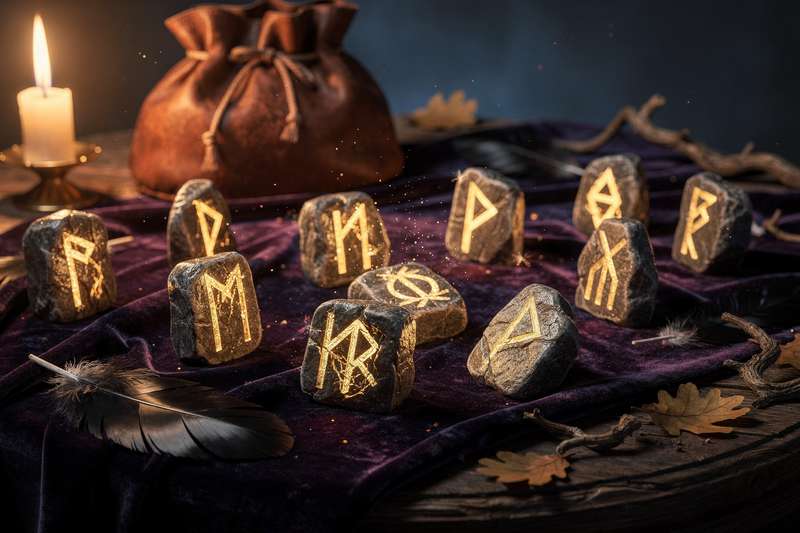
What Is Rune Casting?
Rune casting is an ancient practice of using symbolic stones or cards to gain insight into your current situation and the choices available to you. Unlike fortune-telling that claims to predict a fixed future, rune casting works differently. It’s a mirror held up to your present circumstances, revealing patterns, obstacles, and possibilities that exist right now.
When you cast runes, you’re tapping into your own intuition while working with symbols that carry centuries of meaning. The runes don’t tell you what will happen—they show you what could happen based on the path you’re currently walking. This is empowering because it means you retain complete agency over your decisions and direction.
Think of rune casting as a ritual that creates space for clarity. In our busy lives, we rarely pause long enough to listen to our inner wisdom. A rune reading forces you to slow down, center your energy, and ask yourself honest questions about what you truly want and what might be holding you back.
The Ancient History of Runes
The runes you work with today have roots stretching back over two thousand years. The Futhark alphabet originated in Germanic and Scandinavian regions, where these symbols were far more than just letters—they were considered sacred knowledge.
According to Norse mythology, Odin himself discovered the runes through intense spiritual effort and sacrifice. Rather than being human inventions, the runes were understood as eternal forces that existed before mankind. Once revealed, they became a bridge between the divine realm and human consciousness, allowing people to access wisdom beyond ordinary understanding.
Roman historian Tacitus documented the Germanic peoples’ use of carved wooden staves for divination, confirming that rune casting was a respected spiritual practice among Northern European cultures. When Latin letters eventually replaced the runes for everyday writing, the runes didn’t disappear—they remained alive within spiritual traditions, passed down through generations and preserved by those who recognized their deeper power.
Today, when you hold a rune stone in your palm, you’re holding something that connects you to this lineage of seekers and wisdom-keepers.
What You’ll Need to Get Started
Beginning your rune casting practice requires very little. Here’s what we recommend:
- A rune set: You can purchase a traditional set of 24 Elder Futhark runes carved from stone, wood, or clay. Some modern practitioners also use rune cards. Choose whichever format calls to you—your intuition matters in this selection.
- A rune bag or pouch: A small cloth bag keeps your runes protected and contained during shuffling. This is optional but helpful if you like to reach in and draw intuitively.
- A casting cloth: A small piece of cloth (linen, silk, or cotton) gives you a defined space for your reading and protects your runes from getting lost. A scarf or handkerchief works perfectly.
- A quiet space: You don’t need anything elaborate—a corner of your bedroom, your kitchen table, or even a spot in nature works beautifully.
- Optional sacred items: A candle, incense, or crystals can help you set intention, but they’re not required. Use them if they help you feel more present and grounded.
How to Cast Runes: Step-by-Step
Step 1: Prepare Your Space and Yourself
Find a quiet place where you won’t be interrupted. This isn’t about elaborate ritual—it’s about creating an environment where you can concentrate. If you like, light a candle or burn some incense to shift the energy. The act of preparation signals to your mind and spirit that something meaningful is about to happen.
Take a few deep breaths. Set down your phone and any mental checklists about what you need to do later. Your only job right now is to be present.
Step 2: Hold Your Intention
Before you touch your runes, clarify what you’re asking. Your question doesn’t need to be elaborate. It could be “What do I need to know right now?” or something more specific like “What’s blocking my creativity in my work?” The clearer your intention, the more directly the runes can speak to your situation.
State your question silently or aloud, then hold it in your mind as you reach for your runes.
Step 3: Shuffle and Draw
Mix your runes thoroughly. If you’re using a bag, reach in and swirl the stones around with your hand. If you have loose runes, spread them face-down on your cloth and mix them with your hands. There’s no “correct” way to shuffle—just do it in whatever way feels natural.
When you’re ready, draw out the number of runes your chosen spread requires, one at a time. Place each rune in its designated position according to your spread.
Step 4: Interpret Your Reading
Once your runes are placed, spend time with what you’ve drawn. Look at the traditional meanings of each rune, but also notice your emotional response. What feelings arise when you see each stone? How do the runes relate to your question?
The most powerful readings happen when you combine the rune’s traditional meaning with your own intuitive knowing.
Popular Rune Spreads for Beginners
The Single Rune Draw
This is your starting point. One rune offers focused guidance and is perfect for daily readings, quick insights, or yes/no questions.
How to use it: Draw one rune and sit with its meaning. Each morning, you might ask “What energy should I focus on today?” and let a single rune be your answer. This practice helps you learn the meanings of all 24 runes relatively quickly.
Best for: New practitioners, daily guidance, moment-to-moment questions.
The Three-Rune Spread
This simple yet powerful layout gives you more depth than a single rune while remaining easy to interpret.
Layout: Draw three runes and place them in a line from left to right.
Interpretation Option 1 (Problem & Solution):
- Rune 1 (Left): Overview of the situation or challenge
- Rune 2 (Center): What’s in the way or what needs attention
- Rune 3 (Right): The path forward or action to consider
Interpretation Option 2 (Past, Present, Future):
- Rune 1 (Left): What led you here—patterns, influences, or energy from your past
- Rune 2 (Center): Your current situation, opportunity, or challenge
- Rune 3 (Right): The direction you’re heading or the likely outcome
Best for: Understanding situations, seeing how circumstances may unfold, gaining clarity on current challenges.
The Five-Rune Cross
When you’re ready to work with more complexity, the five-rune cross gives you a fuller picture, especially helpful for major decisions.
Layout: Place five runes in a cross pattern—one in the center, then one to the left, top, bottom, and right (or however directional placement feels natural to you).
Interpretation:
- Center Rune: The core issue or the heart of the matter
- Left Rune: What’s behind you or past influences
- Top Rune: Actions you can take or opportunities available
- Bottom Rune: What’s blocking progress or foundation challenges
- Right Rune: Helpful influences or what’s supporting you
Best for: Complex situations, major life decisions, understanding all dimensions of a challenge.
The Seven-Rune Horseshoe
This spread is excellent when you want a comprehensive view that shows the full arc of a situation.
Layout: Arrange seven runes in a horseshoe or arc shape, numbered 1 through 7 from left to right.
Interpretation:
- Rune 1: The past and foundation
- Rune 2: Current energies or obstacles
- Rune 3: Hidden influences or factors you might not be aware of
- Rune 4: What surrounds you—the environment and context
- Rune 5: The near future or immediate outcome
- Rune 6: External factors affecting the situation
- Rune 7: The final outcome or where this is heading
Best for: Big-picture questions, relationships, career transitions, comprehensive life guidance.
Tips for Accurate Rune Readings
Learn the meanings gradually. You don’t need to memorize all 24 rune meanings before you start casting. Begin with spreads that use fewer runes, and let your knowledge grow naturally as you practice.
Trust your gut feeling. Rune meanings in books are starting points, not rules. If a rune speaks to you differently in a particular reading, honor that intuitive hit. Your subconscious mind often understands the message before your conscious mind catches up.
Read the story, not isolated symbols. Look at how the runes relate to each other, not just their individual meanings. If you draw Fehu (abundance) followed by Hagalaz (disruption), the story is different than if those runes were reversed.
Stay grounded about what runes can do. Runes offer insight and reflection, not certainty. They show you what’s possible based on your current path, but you retain the power to make different choices.
Practice regularly. Like any tool, rune casting becomes richer with consistent use. Even five minutes of daily single-rune draws build your familiarity and skill over time.
Common Mistakes to Avoid
Over-interpreting reversed runes: Not all practitioners consider reversed runes, and many find that upright runes work beautifully on their own. If you’re just starting out, focus on the upright meanings first. You can explore reversals later if that feels right to you.
Expecting predictions instead of guidance: Runes show you what’s at play, not what’s written in stone. They’re most useful when you approach them as a reflection tool rather than a prediction device.
Asking the same question over and over. If you ask about your love life three times in one day, you’re not deepening your insight—you’re just looking for the answer you want. Give yourself time between readings so you can actually process and act on the guidance.
Forgetting to quiet your mind. If you approach rune casting while stressed or distracted, your reading will reflect that scattered energy. The best readings happen when you’re genuinely present.
FAQ
Do I need to cleanse my runes before using them?
Many practitioners like to cleanse their runes when they first receive them and periodically afterward. You can do this by placing them in moonlight, burying them in soil, passing them through smoke, or simply holding them with the intention of clearing any stagnant energy. This is optional—some readers never cleanse and have wonderful results. Do what feels right to you.
What’s the difference between rune casting and tarot reading?
While both are divination tools, runes and tarot work differently. Tarot has 78 cards organized into major and minor arcana with complex systems of interpretation. Runes are simpler—24 symbols with more direct meanings. Many practitioners use both. Runes tend to be more straightforward and faster for quick guidance, while tarot offers more layered storytelling.
Can I use runes for yes or no questions?
Yes, though runes work best when you frame questions more openly. You could ask “What do I need to know about this decision?” rather than “Should I do this?” That said, many readers have learned to interpret particular runes as yes or no answers. Experiment and see what system feels natural to you.
How often should I cast runes?
There’s no fixed rule. Some people read once a day, others once a week. The key is that you give yourself time to act on the guidance before casting again on the same question. Constant recasting about the same issue often means you’re avoiding taking action. Trust what you’ve learned and give it space to unfold.
What if I draw a rune that seems negative?
Runes like Hagalaz (disruption) or Thurisaz (conflict) aren’t bad omens—they’re information. They’re telling you that something challenging is present or approaching, which is valuable awareness. You can then make conscious choices about how to work with that energy. Some of the most transformative readings include runes that initially feel uncomfortable.
Can I make my own runes?
Absolutely. Many experienced practitioners carve or paint their own runes on stones, wood, or ceramic tiles. The process of creating them can actually deepen your connection to the symbols. If you’re just starting out, a purchased set might be easier, but there’s no rule against making your own whenever you feel called to do so.