What Is the Quincunx Aspect?
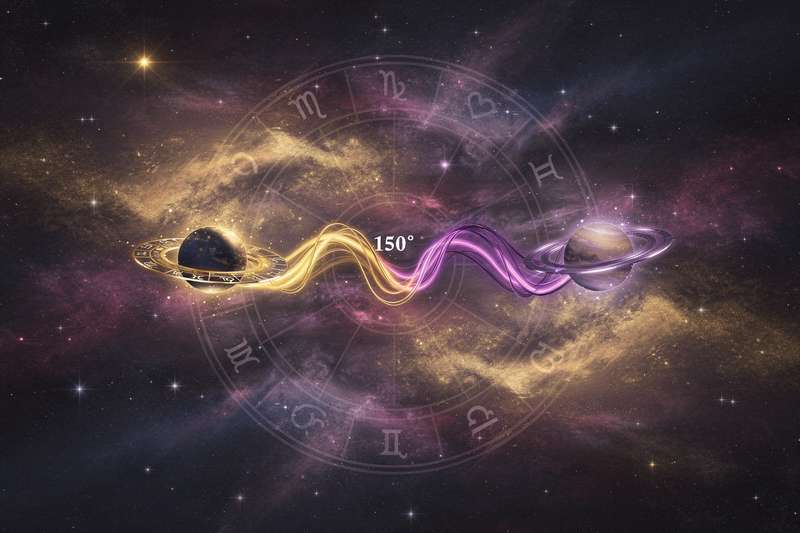
The quincunx (also called the inconjunct) is one of astrology’s most misunderstood aspects. It occurs when two planets or points in your birth chart sit 150 degrees apart—exactly five zodiac signs away from each other. At first glance, this angle seems strange, awkward even. But that’s precisely where its power lies.
You might notice that the quincunx doesn’t fit neatly into the major aspect categories. It’s not a harmonious trine (120°), not a challenging square (90°), and not a tension-filled opposition (180°). Instead, it occupies its own peculiar territory—one that demands your attention and creativity.
If you’re just beginning to explore your birth chart, you may have overlooked quincunxes entirely. Many astrology basics skip over this aspect, but that’s changing. Modern astrologers increasingly recognize the quincunx as a hidden catalyst for transformation and growth.
The Geometry and Energy of 150°
Understanding the math behind the quincunx helps you grasp its energy. The zodiac wheel contains 360 degrees, divided into twelve signs of 30 degrees each. A quincunx spans 150 degrees—five signs—making it mathematically awkward and asymmetrical. This asymmetry is intentional and meaningful.
The two planets or points involved in a quincunx share almost nothing in common. They don’t sit in compatible elements (fire, earth, air, water), they don’t share the same modality (cardinal, fixed, mutable), and they barely understand each other’s language. Yet they must coexist in your chart, forcing integration and adjustment.
This creates what astrologers call “restlessness”—a subtle but persistent impulse to make things work despite the obvious friction. You feel the discomfort, and you can’t ignore it. That friction becomes your greatest teacher.
How the Quincunx Functions in Your Birth Chart
When you have a quincunx in your natal chart, you’re dealing with two different planetary energies that don’t naturally cooperate. Think of it like having two brilliant colleagues who work in completely different departments and speak different professional languages. They both have valuable expertise, but getting them to collaborate requires effort, creativity, and willingness.
The quincunx doesn’t create obvious conflict like a square does. Instead, it produces low-level tension—the kind that nags at you. You might feel slightly out of sync, as if you’re adjusting your approach constantly. This constant micro-adjustment is where growth happens.
Unlike a trine (which flows easily) or a square (which creates dramatic tension), the quincunx operates quietly. You may not even realize you’re dealing with one until you study your chart intentionally. But once you recognize it, patterns suddenly become clear.
The Challenge: Living With Incompatibility
Your quincunx aspects highlight areas of internal conflict that demand reconciliation. Let’s say you have Mercury (communication, intellect) quincunx Mars (action, assertiveness). You likely struggle between thinking things through carefully and wanting to act immediately. You’re not naturally indecisive—both functions are strong in you. But they pull in different directions.
This creates a peculiar frustration. Others might notice that you sometimes seem hesitant when you’re actually just coordinating two competing impulses. You understand both perspectives deeply because you literally contain both energies.
Many people with strong quincunxes describe feeling “off” or “misaligned” in certain life areas. You might feel like you’re faking it, even when you’re performing well. This is because the two energies don’t naturally harmonize—you’re manually orchestrating a marriage between opposites.
The challenge isn’t that you’re broken or unbalanced. The challenge is that you’re complex in a way that demands ongoing attention and conscious integration.
The Gift: Flexibility and Adaptability
Here’s where the quincunx transforms from frustration into superpower. Because you must constantly adjust and recalibrate, you develop remarkable flexibility. You learn to switch between different modes of operating. You become adept at code-switching, perspective-shifting, and finding creative solutions that wouldn’t occur to people with more straightforward planetary placements.
Your quincunx teaches you resilience through repeated micro-adjustments. You don’t break when the pressure comes because you’ve been practicing flexibility all along. You’ve trained yourself to find the middle path, to honor both sides of an internal paradox, and to extract value from tension.
Many highly successful people have significant quincunxes in their charts. The very trait that makes them feel awkward internally gives them the ability to excel in complex environments that require constant adaptation. You become the person who can manage multiple perspectives, mediate between opposing viewpoints, and innovate when conventional approaches fail.
Your quincunx also gifts you with sophisticated self-awareness. Because the two energies don’t merge automatically, you must examine them consciously. This leads to deeper understanding of your own motivations, blind spots, and capabilities.
Common Quincunx Pairings and Their Meanings
Sun Quincunx Moon: Your conscious identity and emotional nature operate on different wavelengths. You feel divided between who you project and who you are internally. Growth comes when you recognize both expressions as authentic parts of yourself.
Venus Quincunx Mars: Your approach to love and desire feels complicated. You oscillate between receptive and assertive, between merging and maintaining independence. Relationships teach you to honor both needs.
Mercury Quincunx Jupiter: Your intellect and intuition speak different languages. You might struggle between detailed analysis and big-picture vision. The gift is eventually learning to use both simultaneously.
Saturn Quincunx Uranus: Tradition and innovation war within you. You value both structure and freedom but rarely find them in the same place. Your challenge is creating personal systems that honor both needs.
Moon Quincunx Pluto: Your emotional depth and need for transformation create internal pressure. You feel things intensely and want to change constantly. Integration means allowing yourself to grow without losing your emotional foundation.
Working With Your Quincunx: Practical Strategies
Name the paradox. Start by clearly identifying what the two energies represent. Don’t try to merge them prematurely. First, acknowledge that you contain both, and both are valid.
Find the third way. The quincunx often resolves through a creative solution that transcends both original options. Ask yourself: “What would honor both of these needs simultaneously?” The answer often involves thinking differently than you normally do.
Practice conscious switching. Instead of fighting the oscillation, practice deliberately moving between the two modes. Notice when you’re operating from one perspective, then consciously access the other. This flexibility strengthens over time.
Examine your self-judgment. Many quincunx aspects create internal criticism. You judge yourself for being inconsistent or contradictory when you’re actually just complex. Practice self-compassion as you navigate your internal multiplicity.
Use your adaptability intentionally. Your quincunx taught you flexibility. Recognize situations where this skill is your competitive advantage. Lean into complexity rather than avoiding it.
Track patterns. Keep notes about when you feel most harmonious and when you feel most fragmented. You’ll discover that both states offer information. The fragmentation often precedes breakthrough.
Transits and Progressions Involving Your Quincunx
When transiting planets aspect your natal quincunx, the tension often intensifies temporarily. You might feel more restless, more indecisive, or more aware of the internal friction. This isn’t punishment—it’s an invitation to deepen your integration work.
Progressions to your quincunx aspects suggest evolving ways of handling the internal conflict. As you mature, your approach to managing the two energies becomes more sophisticated. What felt impossible at twenty might feel natural at forty.
These transits and progressions are excellent times to reassess how you’re working with your quincunx. Have you found new creative solutions? Have you discovered unexpected strengths? Have you learned to trust your complexity?
Quincunx in Synastry and Relationships
When your planets form quincunxes with another person’s planets, the relationship carries constant adjustment energy. This isn’t necessarily negative—it depends on whether both people are willing to do the integration work.
A quincunx between your Venus and their Mars, for example, means your approach to love won’t naturally match their approach to desire. But this creates opportunity for growth. You both learn things the other couldn’t teach alone.
These relationships feel less fated and more actively chosen. You must continually choose to find middle ground. This can strengthen bonds because you’re not coasting on natural compatibility—you’re actively building understanding.
FAQ
Is the quincunx aspect negative?
No. The quincunx isn’t inherently negative, though it can feel uncomfortable. It creates tension that demands resolution, but that tension is generative. Many people with quincunxes develop exceptional capabilities precisely because they learned to work with the friction.
How tight does an orb need to be for a quincunx to matter?
Most astrologers use an orb of 1-2 degrees for quincunxes, though some extend to 3 degrees. Closer orbs create stronger effects. If your quincunx is within 1 degree, you definitely feel it. Wider orbs are gentler but still significant.
What’s the difference between a quincunx and an inconjunct?
These terms are used interchangeably in astrology. Both refer to the 150-degree aspect. Some astrologers prefer “quincunx” because “inconjunct” implies that the planets are simply unrelated, when in fact they’re actively asking you to coordinate them.
Can you have multiple quincunxes in your chart?
Absolutely. Some people have many quincunxes, making them naturally gifted at managing complexity and contradiction. Others have none or very few. Multiple quincunxes suggest that your life path involves learning to integrate different energies and perspectives at deep levels.
Does the quincunx become easier to manage over time?
Yes. As you age and gain self-awareness, your quincunx aspects generally feel less jarring. You develop practical strategies and recognize patterns. The tension doesn’t disappear, but you stop resisting it and start using it intentionally.