The solitary witch path is one of the most personal, powerful, and freely expressive forms of magical practice available today. More people than ever are choosing to practice witchcraft alone — without covens, hierarchies, or prescribed traditions — and finding that solitude brings clarity rather than limitation. When there is no one else setting the rules, you become the authority on your own spiritual life. Your rituals fit your schedule. Your altar reflects your soul. Your magic grows exactly as fast as you do. Whether you are just beginning to feel the pull toward witchcraft or you have been quietly practicing for years without a name for it, this guide offers grounded, practical steps to build a solo practice that is entirely, beautifully yours.
What Is Solitary Witchcraft?
A solitary witch is someone who practices magic independently, outside of any formal group, coven, or tradition. Rather than following a set curriculum handed down by an initiated elder, solitary witches self-direct their learning through books, personal experience, observation, and intuition. They develop their own relationships with the divine — whether that means working with specific deities, spirits, nature, or no external beings at all.
One common myth worth addressing immediately: solitary practice is not a beginner stage you graduate out of. Many experienced, skilled practitioners deliberately choose this path for life. Another myth is that working alone makes your magic weaker. In reality, when every element of a ritual is deeply personal and intentional, it can be extraordinarily potent. Solitary witchcraft is not a lesser version of group work — it is simply a different, equally valid way of walking a magical path.
Common Types of Solitary Witch Practice
Solitary witchcraft is not one single thing. It is a broad umbrella covering many different styles and focuses. Here are some of the most common paths you might explore or blend:
- Eclectic Witch: Draws from multiple traditions — Wicca, folk magic, ceremonial magic, herbalism — and builds a personal practice that combines what resonates most. This is probably the most common solitary approach.
- Kitchen Witch: Centers magic in the home, especially in cooking, cleaning, and everyday domestic life. Herbs, food, and hearth become the primary magical tools.
- Hedge Witch: Focuses on the boundary between the everyday world and the spirit world. Shadow work, dreamwork, trance, and spirit communication are central practices.
- Green Witch: Works closely with plants, trees, the land, and the cycles of nature. Herbalism, wildcrafting, and seasonal awareness guide this path.
- Secular Witch: Practices magic without any devotional or spiritual component — viewing spellwork through a psychological or energetic lens rather than a religious one.
- Traditional Wiccan (Solitary): Follows Wiccan principles and the Wheel of the Year as a solo practitioner, often using books by Gerald Gardner, Doreen Valiente, or Scott Cunningham as guides.
You do not have to choose just one. Many solitary witches blend elements freely, and your practice may shift and evolve over time.
How to Start Your Solitary Witch Practice: Step by Step
There is no single correct way to begin. But having a clear starting sequence helps you build momentum without feeling overwhelmed. Work through these steps at whatever pace feels natural.
Step 1: Get Honest About Why You Are Here
Before you buy a single candle or crack open a book, spend some time reflecting on what draws you to witchcraft. Is it a connection to nature? A desire to feel more agency in your life? Curiosity about divination or energy work? Spiritual longing? There are no wrong answers, but knowing your “why” will help you choose a direction that genuinely fits you rather than one that just looks appealing online.
Write your thoughts in a journal. This first entry may become one of the most meaningful pages you ever write.
Step 2: Study Before You Cast
Read widely before you commit to any single system. Explore books on Wicca, folk magic, herbalism, divination, and elemental correspondences. Sample different authors — Scott Cunningham’s accessible Wiccan guides, Paul Huson’s traditional approach, Starhawk’s earth-centered spirituality, Arin Murphy-Hiscock’s practical kitchen and green witch titles. No one book holds all the truth, and reading broadly protects you from adopting one author’s opinions as absolute law.
Online communities on Reddit (r/witchcraft, r/pagan), Discord servers, and YouTube channels can also supplement your reading and offer real-world perspectives from practicing witches across traditions.
Step 3: Create or Consecrate a Sacred Space
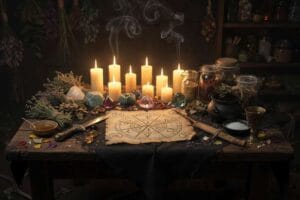
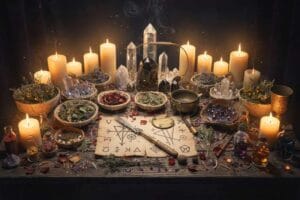
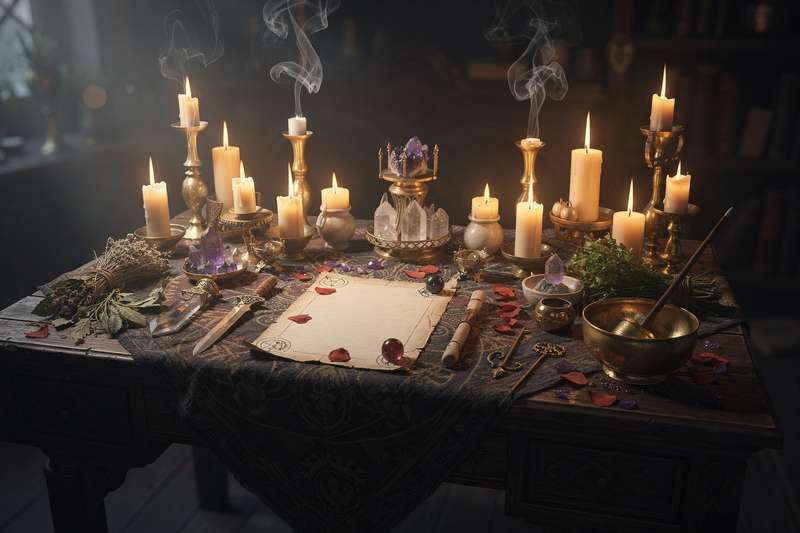
You do not need a dedicated room. An altar can be a single shelf, a windowsill, or even a box you open when you practice and close afterward. What matters is intention. Clear the space energetically — through smoke cleansing, sound (a bell or singing bowl), or simply visualizing bright light sweeping the area clean. Then arrange items that feel meaningful: a candle, a stone, a small plant, an image of something sacred to you.
This space becomes the physical anchor for your practice. Tending it regularly — refreshing offerings, lighting candles, cleaning the surface — is itself a form of magic.
Step 4: Establish a Consistent Daily Practice
Even five minutes a day builds more magical skill than an elaborate ritual once a month. Consider a simple morning ritual: light a candle, take three deep grounding breaths, state one clear intention for the day, and blow the candle out. In the evening, spend a few minutes reflecting on what you noticed. Did anything unusual happen? Did your intention show up in any form?
Consistency teaches you to notice subtle shifts in your energy, your environment, and your intuition — which is the real foundation of magical sensitivity.
Step 5: Start a Grimoire or Book of Shadows
A grimoire is your personal magical record. It can be a hand-bound journal, a simple composition notebook, a digital document, or a loose-leaf binder — whatever format you will actually use. Record spells you try, rituals you design, symbols that catch your attention, dreams, divination results, and your own reflections on what works and what does not.
Over time, this document becomes an invaluable resource that no book you could buy will ever replicate, because it is written entirely from your lived experience.
Step 6: Learn the Wheel of the Year
The Wheel of the Year gives your practice a natural rhythm and prevents the drift that comes from having no structure. The eight sabbats — Samhain, Yule, Imbolc, Ostara, Beltane, Litha, Lammas, and Mabon — mark seasonal turning points that have been observed by earth-centered cultures for centuries. You do not have to celebrate all eight, and your celebrations can be as simple as lighting a candle and sitting with the season’s energy.
Moon phases offer additional rhythm: new moons for setting intentions, full moons for gratitude and completion, waning moons for release. Following these cycles connects you to something larger than your daily routine.
Step 7: Try a Self-Dedication or Self-Initiation Ritual
When you feel ready — and only when you feel ready — consider performing a self-dedication ritual to formally commit to your path. This is entirely optional, but many solitary witches find it powerfully meaningful. A basic self-dedication might include a ritual bath with salt and herbs, a quiet meditation, a written statement of your intention to walk this path, and a simple blessing of yourself with water or oil.
Choose a personally significant time: your birthday, a new moon, a sabbat, or any date that holds meaning for you. There is no governing body to report to — this ritual is entirely between you and whatever you hold sacred.
Step 8: Practice Divination Regularly
Divination tools — tarot cards, oracle decks, runes, pendulums, or scrying mirrors — are not just for predicting the future. They are remarkable tools for self-reflection, accessing intuition, and deepening your relationship with your inner wisdom. Pull a single tarot card each morning and sit with its imagery. Keep a rune in your pocket and notice what situations arise during the day that echo its meaning.
Regular divination practice sharpens your intuitive senses, which directly strengthens every other area of your magical work.
Step 9: Connect With Community (on Your Own Terms)
Being a solitary witch does not require isolation. Many solo practitioners maintain warm connections with online communities, attend occasional public rituals or pagan festivals, or simply have one or two magical friends they can speak openly with. You decide how much community you want and in what form. The key is that your practice remains yours — no group consensus, no hierarchy, no pressure to conform.
Essential Tools and Supplies for Solitary Practice
You need far less than most beginner shopping lists suggest. Start simple:
- Candles: Probably the single most versatile magical tool. White candles work for almost any purpose.
- A journal: Your grimoire. Non-negotiable.
- Herbs: Rosemary, lavender, and sage cover an enormous range of magical needs and are widely available.
- Crystals: Clear quartz amplifies intention and can stand in for any other stone. Add amethyst for intuition and black tourmaline for protection when you are ready.
- A divination tool: Whatever calls to you — tarot, oracle, runes, or a simple pendulum.
- An altar cloth or tray: Defines your sacred space without requiring permanent real estate.
- Incense or a cleansing herb bundle: For energetic cleansing of your space.
Resist the urge to over-purchase at the start. Tools gain power through consistent use, not through their price tags.
Ethics and Best Practices in Solitary Witchcraft
Without a coven to hold you accountable, your ethical framework is entirely self-developed — which makes it all the more important to think it through consciously.
Most witches, across traditions, hold some version of the principle that magic intended to harm, control, or manipulate another person without their consent creates energetic consequences for the caster. Whether you frame this as the Wiccan Threefold Law, karma, or simple energetic cause and effect, the core wisdom is the same: act with integrity.
Beyond harm avoidance, consider cultural respect. Some practices, symbols, and materials are sacred to specific indigenous or closed traditions. Educating yourself about what is freely shared versus what is culturally appropriative shows respect for the people those traditions belong to. Your practice will be richer for being built on genuine understanding rather than aesthetic borrowing.
Common Beginner Mistakes to Avoid
- Buying everything at once: A cluttered altar full of tools you have no relationship with is less powerful than one meaningful candle. Build slowly.
- Treating spells as instant vending machines: Magic works with probability and energy — it rarely produces overnight miracles. Patience and mundane action (alongside your spellwork) are essential.
- Dismissing your experiences as “just imagination”: Intuitive impressions, symbolic dreams, and felt sensations during ritual are data. Record them and watch for patterns over time.
- Copying rituals word-for-word without personalizing them: A script someone else wrote carries their energy, not yours. Adapt everything to your own voice.
- Comparing your practice to curated social media content: Aesthetic witchcraft accounts are not a standard to meet. Your private, imperfect, genuine practice is more powerful than any beautifully photographed altar.
- Giving up after one “failed” spell: Spellwork is a skill. It develops over time, through repetition, reflection, and refinement. Document your work and learn from it.
How to Build Your Practice Over Time
Growth in solitary witchcraft is rarely linear. There will be periods of deep engagement and periods of quiet. Both are normal and both have value. Trust the seasons of your own practice the same way you trust the seasons of the year.
After your first few months, consider deepening one specific area — herbalism, astrology, a particular divination system, candle magic, or elemental work — rather than constantly expanding the breadth of what you do. Depth creates mastery. As your confidence grows, you may find yourself writing your own spells, designing original rituals, and discovering that your personal gnosis is just as valid as anything in any published book. That realization — that you are your own authority — is the heart of the solitary path.
Final Thoughts
Walking the solitary witch path is an act of courage and creativity. You are choosing to trust yourself: your intuition, your experiences, your judgment, and your connection to the sacred as you understand it. That trust, cultivated through consistent practice and honest reflection, is itself a form of magic. Begin where you are. Use what you have. Show up for your practice, even imperfectly, and watch what grows.
Frequently Asked Questions
Can a beginner practice witchcraft alone without a teacher?
Absolutely. Most modern witches are self-taught, and there is an abundance of books, online communities, and other resources available to support independent learning. Starting alone often means your practice develops more authentically, shaped by your own experiences rather than someone else’s framework.
Do solitary witches need to be initiated?
No. Initiation is a requirement only within specific traditions, such as some Wiccan lineages. Solitary witches can perform their own self-dedication ritual when they feel ready, or skip formal initiation entirely. Your commitment to your path is what matters, not a ceremony.
How do I know if my spells are actually working?
Keep a detailed record of every spell or ritual you perform, including your intention, the method, the timing, and what happens in the days and weeks that follow. Patterns emerge over time. Magic often works subtly — through coincidence, shifted perspective, or gradual change — rather than through dramatic, immediate results.
Is solitary witchcraft safe to practice alone?
Yes, when approached thoughtfully. Basic safety practices include learning what you are working with before using it (especially herbs, fire, and unfamiliar spiritual beings), maintaining clear ethical boundaries, and grounding yourself thoroughly after energy work. Starting simple and building gradually is always wiser than rushing into advanced practices without a foundation.