What Are Lenormand Cards?
Lenormand cards offer you a straightforward, no-nonsense approach to divination. Unlike their more complex cousin tarot, this 36-card system speaks directly to your practical concerns. Born from traditional European card games, Lenormand readings cut through psychological layers and get straight to the point—answering the questions that matter most to you right now.
You’ll find that Lenormand feels grounded and direct. Where tarot asks “why” something is happening, Lenormand answers “how” it will unfold. This makes it perfect if you’re seeking clarity about everyday situations: career decisions, relationship dynamics, financial moves, or timing questions.
How Lenormand Differs from Tarot
Both are powerful divination tools, but they operate differently. Tarot’s 78 cards dive deep into emotional complexity and spiritual lessons. Lenormand’s 36 cards focus on straightforward outcomes and practical guidance.
With tarot, you might spend time contemplating multiple layers of meaning. With Lenormand, you get direct answers. A card means essentially what it shows—the Rider brings news, the Mountain represents obstacles, the Clover suggests small blessings. This doesn’t make Lenormand less spiritual; it makes it more accessible for quick, clear readings.
Another key difference: Lenormand readings gain power through card pairs and combinations. A single card tells you something, but two or three cards together create a more nuanced picture. This is where the real magic happens.
The 36 Lenormand Cards Explained
Each card in the deck carries its own signature meaning. Learning these is your foundation. Here’s how the cards break down:
Cards 1-9: The Beginnings
- The Rider (1) — News, messages, movement, a person coming toward you
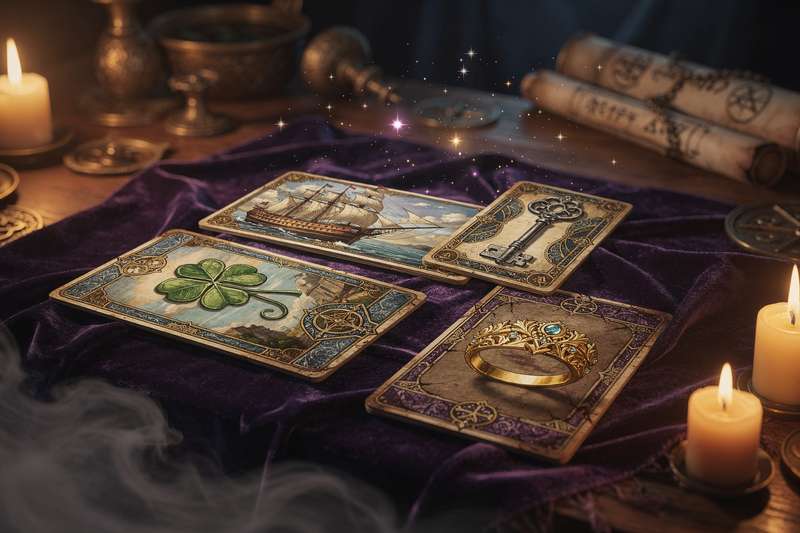
- The Clover (2) — Small luck, contentment, brief happiness, minor blessings
- The Ship (3) — Travel, change, progress, movement over distance
- The House (4) — Home, family, stability, foundations, property
- The Tree (5) — Growth, health, roots, slow development, strength
- The Clouds (6) — Confusion, uncertainty, temporary obscurity, lack of clarity
- The Snake (7) — Complications, delays, feminine energy, a woman, deception
- The Coffin (8) — Endings, closure, loss, transformation, what must be released
- The Bouquet (9) — Joy, happiness, gifts, positive news, celebration
Cards 10-18: The Middle Path
- The Whip (10) — Arguments, conflict, tension, friction, need for action
- The Whip (11) — Punishment, consequences, learning through difficulty
- The Birds (12) — Communication, gossip, discussion, nervous energy
- The Child (13) — Innocence, new beginnings, youth, vulnerability, freshness
- The Fox (14) — Cunning, strategy, deception, intelligence, caution needed
- The Bear (15) — Authority, strength, power, a dominant person, weight
- The Stars (16) — Hope, clarity, guidance, spiritual direction, inspiration
- The Stork (17) — Movement, change, journeys, transformation, shifts
- The Dog (18) — Loyalty, friendship, protection, a faithful person, devotion
Cards 19-27: The Turning Point
- The Tower (19) — Authority, institutions, isolation, distance, power structures
- The Garden (20) — Public space, gatherings, social situations, visibility
- The Mountain (21) — Obstacles, challenges, delays, something blocking your path
- The Crossroads (22) — Choices, decisions, options, multiple paths forward
- The Mice (23) — Losses, depletion, small worries, gradual decline
- The Heart (24) — Love, affection, emotion, passion, what you care about
- The Ring (25) — Cycles, commitments, bonds, agreements, repetition
- The Book (26) — Secrets, hidden knowledge, learning, mysteries, research
- The Letter (27) — Messages, documents, communications, written word
Cards 28-36: The Completion
- The Man (28) — A male figure, masculine energy, the querent if male
- The Woman (29) — A female figure, feminine energy, the querent if female
- The Lily (30) — Peace, harmony, rest, calm, maturity, sexual union
- The Sun (31) — Success, happiness, positive outcome, clarity, vitality
- The Moon (32) — Emotions, intuition, cycles, dreams, feminine power
- The Key (33) — Solutions, certainty, unlocking, answers, affirmation
- The Fish (34) — Abundance, flowing, movement through emotions, trade
- The Anchor (35) — Stability, security, grounding, solid foundations
- The Cross (36) — Fate, karma, burdens, suffering, what must be borne
Understanding Card Combinations
This is where your Lenormand practice becomes truly powerful. Two cards create a conversation. Three cards tell a story. You’re not just reading isolated meanings—you’re watching how energy flows between them.
For example, the Mountain (obstacle) next to the Key (solution) tells you the answer exists. The Sun (success) next to the Clouds (confusion) suggests clarity is coming but not yet here. The Ring (commitment) next to the Heart (love) points to a deep romantic bond.
As you practice, you’ll develop intuition about these pairings. Trust what feels true. Your inner knowing matters more than memorizing combinations.
Getting Started with Your First Reading
You don’t need elaborate rituals to begin. Here’s what works:
Choose Your Spread
Start simple. A three-card reading answers: What do I need to know? A five-card spread can address a specific situation with beginning, middle, and outcome. Some readers use the traditional Grand Tableau (all 36 cards), but save that for when you’re more experienced.
Set Your Intention
Hold your question clearly as you shuffle. What do you genuinely want to understand? Keep it specific. “What should I know about my job situation?” works better than “Tell me everything.”
Shuffle and Lay Cards
Shuffle however feels natural. Some readers shuffle like playing cards; others spread the deck on a cloth and gather them slowly. There’s no wrong way. Lay your cards face-down, then flip them one by one.
Read the Story
Look at your cards as a narrative. What’s the first card saying? How does the second respond? What does the third conclude? Don’t overthink—let your intuition speak.
Tips for Accurate Lenormand Readings
Notice card position: Some readers assign meaning to whether cards appear upright or reversed. Others read all cards as inherent messages. Choose what resonates with you.
Consider nearby cards: A card’s meaning can shift based on its neighbors. The Snake near the Heart might point to complicated love; near the Mountain, it could mean deception about obstacles.
Trust your gut: If a card interpretation doesn’t feel right in your reading, follow your instinct instead. You’re the expert on your own intuition.
Keep a journal: Record your readings and outcomes. Over time, you’ll see patterns in how you interpret cards and where your accuracy shines.
Practice regularly: Like any skill, Lenormand improves with repetition. Even one card a day strengthens your connection.
Combining Lenormand with Other Divination Tools
Many readers blend Lenormand with tarot for richer readings. A tarot card can deepen Lenormand’s direct answers. You might pull a tarot card to explore the emotional layer beneath a Lenormand reading’s practical guidance.
Some readers also incorporate runes, oracle cards, or numerology alongside Lenormand. The goal is creating a more complete picture that serves both your practical and spiritual needs.
Which Lenormand Deck Should You Choose?
Many beautiful decks exist. The traditional Petit Lenormand stays closest to the original system. Modern decks add artistic flair while keeping core meanings intact.
Choose a deck that speaks to you visually. Your hands will touch these cards frequently—you want imagery that inspires and resonates. Some readers prefer classic illustrations; others love contemporary art. Neither is better. Your intuition knows which deck is yours.
Common Beginner Mistakes to Avoid
Don’t force meanings. If a card doesn’t fit your interpretation, step back. Sometimes your reading simply isn’t complete yet, or you need more cards for clarity.
Avoid reading when emotionally overwhelmed. You bring energy to every reading. If you’re in crisis mode, wait until you’re calm enough to receive clear guidance.
Don’t read the same question repeatedly in hope of a better answer. Lenormand speaks truth. If you ask the same question multiple times in one day, you’re resisting the message, not seeking deeper wisdom.
Deepening Your Lenormand Practice
Once you’re comfortable with basic readings, explore the Grand Tableau. This 36-card spread uses all cards, positioned in a grid. It takes practice but offers profound insight into complex situations.
Study card combinations in books dedicated to Lenormand. Join online communities of Lenormand readers. These connections accelerate your learning and expose you to interpretations you might not discover alone.
Most importantly, read for yourself constantly. Your own questions create the best learning opportunities. Each reading teaches you something new about both the cards and yourself.
FAQ
Can I read Lenormand cards for other people?
Absolutely. Many readers offer Lenormand readings professionally. The key is getting clear permission and understanding that you’re offering guidance, not predictions set in stone. The person you’re reading for always has free will to change outcomes.
Do I need to be “psychic” to read Lenormand accurately?
No. Lenormand is learnable through practice and study. You don’t need special gifts—just willingness to pay attention to patterns and trust your intuition as it develops. Many successful Lenormand readers began as complete beginners.
What’s the difference between Lenormand and oracle cards?
Oracle cards are typically more free-form, with whatever meanings a deck creator chooses. Lenormand has a standardized system—the same 36 cards with consistent interpretations across most decks. This makes Lenormand more structured and potentially easier to learn.
Can Lenormand cards predict the future?
Lenormand shows likely outcomes based on current energy and trajectory. It’s not about fixed fate; it’s about understanding where you’re heading if nothing changes. The real value is using that information to make conscious choices.
Should I reverse cards when they appear upside-down?
This is personal preference. Some readers read all cards as upright; others assign shadow meanings to reversed cards. Try both approaches and see which feels more intuitive to you.