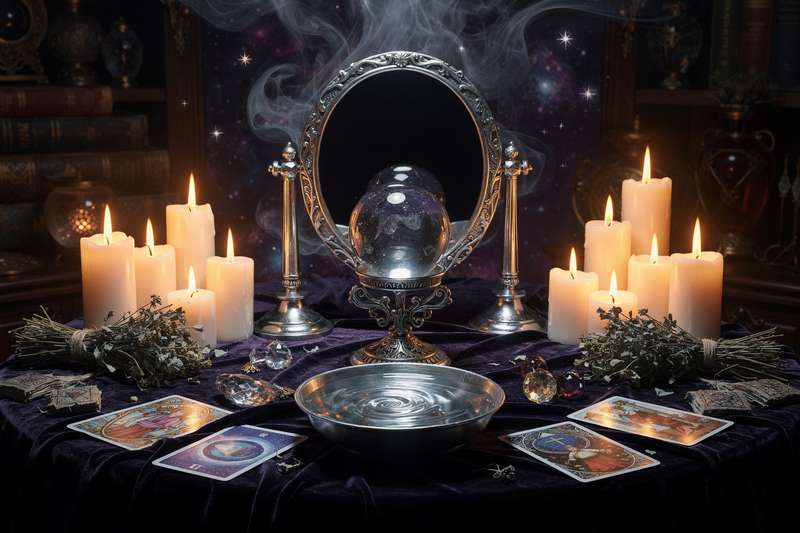
What Is Scrying?
Scrying is an ancient divination practice that awakens your natural ability to perceive beyond the five senses—what’s traditionally called “second sight.” The word itself comes from the Old English term “descry,” meaning to reveal or make out dimly. Rather than predicting a fixed future, scrying helps you tune into deeper layers of knowing about your current situation, hidden patterns, and authentic direction.
You might picture a fortune teller gazing into a crystal ball, but scrying is far more nuanced and personal than that stereotype suggests. It’s a practice of conscious revelation—a way to access your intuitive wisdom and connect with the messages your soul is trying to send you.
Think of scrying as a form of psychoanalysis that works through symbol and image rather than words. When you’re struggling to find meaning, direction, or clarity, scrying can illuminate your core needs, dreams, and the truth you already carry within.
A Brief History of Scrying
Scrying appears in some of humanity’s oldest spiritual traditions. Ancient Egypt, Greece, and Rome all used reflective surfaces and water gazing as part of their sacred practices. The Egyptians connected scrying to the goddess Hathor, who presided over mirrors and inner sight. Greek oracles, including the famous Oracle of Delphi, employed scrying techniques to deliver their prophecies.
The practice appears in Persian texts dating back to the 10th century, and nearly every culture has developed its own form—from Native American smoke observation to Islamic mystical traditions. During the Middle Ages in Europe, figures like John Dee, the renowned mathematician and occultist at Queen Elizabeth I’s court, famously used black obsidian mirrors for scrying, seeking guidance from higher realms of consciousness.
When Christianity gained dominance in medieval Europe, scrying was condemned as “devil’s work” and suppressed. Today, it has evolved primarily as a pagan and spiritual practice, though you don’t need to identify with any particular belief system to benefit from it. Scrying is a universal human capacity—your birthright as a conscious being.
Types of Scrying You Can Practice
One of the beautiful aspects of scrying is its flexibility. You can work with whatever medium calls to you. Here are the most accessible methods:
- Water Scrying (Hydromancy): Gaze into a bowl of still water, preferably natural rainwater or mineral water. This method is deeply symbolic since water represents consciousness itself.
- Crystal Scrying: Use a crystal ball, clear quartz sphere, or any polished crystal object as your focal point. Quartz is particularly valued for its amplifying and clarifying properties.
- Mirror Scrying (Catoptromancy): Perhaps the most accessible method, this involves softening your gaze as you look into a mirror. Images and scenes gradually emerge from the reflective surface.
- Fire Scrying: Possibly the oldest form, this involves watching flames—from a candle, oil lamp, or bonfire—for visions and messages within the movement and colors.
- Smoke Scrying: As smoke rises and dances, you interpret the shapes and patterns it creates, reading spiritual messages in its ethereal movements.
- Cloud Gazing: Observe the shapes clouds form across the sky, interpreting their images and symbolism for guidance and special knowledge.
- Oil Scrying: Pour oil into a dish or onto a reflective surface and observe the light playing across it, reading the patterns that emerge.
- Wax Scrying: Drip melted wax onto water and interpret the images or symbols formed as it cools and hardens.
- Eye Gazing (Soul Gazing): This intimate form involves looking deeply into another person’s eyes and reading the reflections and subtle messages you receive.
Tools You Need to Get Started
The beautiful truth about scrying is that you likely already have everything you need at home. Here’s what’s helpful to gather:
- A bowl—dark-colored (black, navy, or natural wood) works best as it reduces glare and helps you concentrate
- Water—natural rainwater, mineral water, or filtered tap water
- A focal point—a crystal, stone, small object, or even a coin to place in the center of your bowl
- Candles (1-2)—to create the right lighting and atmosphere
- A quiet, dark space—ideally a room at night or a dimly lit corner of your home
- Optional: incense, sage, or sound tools for clearing the energy of your space beforehand
You don’t need expensive tools or rare ingredients. A simple bowl from a thrift store, tap water, and a candle are completely sufficient. The most important tool is your own receptivity and intention.
Step-by-Step Guide to Water Scrying
Water scrying is ideal for beginners because it’s gentle, affordable, and deeply intuitive. Follow these steps to begin your practice:
Step 1: Prepare Your Water
Fill your dark bowl with water. You can collect rainwater outdoors if possible—it carries natural energy and feels more alive. Mineral water or filtered tap water work just as well. Fill the bowl about three-quarters full and let it settle so the surface is completely still and reflective.
Step 2: Create Your Sacred Space
Choose a quiet location where you won’t be disturbed for 15-20 minutes. This can be indoors or outdoors. Clear the energy of your space if you feel called to do so—you might burn incense, use a singing bowl, clap your hands, visualize white light, or simply set a clear intention to release any stagnant energy. This preparatory step helps you enter the practice with clarity and focus.
Step 3: Arrange Your Focal Point
Place a crystal, stone, or small object in the center of your bowl. This gives your eyes a resting point and anchors your attention. Clear quartz is traditional and beautiful, but any object that resonates with you is perfect.
Step 4: Light Your Candles
Position 1-2 candles on either side of your bowl so their light reflects off the water’s surface. You want enough illumination to see the water and any shapes that form, but dim enough to feel mystical and conducive to seeing beyond ordinary sight. The interplay of candlelight and water is essential to the practice.
Step 5: Enter a Receptive State
Sit comfortably before your bowl. Take several deep breaths. This is where you shift from your everyday thinking mind into a trance-like state—an altered state of consciousness that every culture has used for spiritual purposes. You’re not forcing this; you’re simply allowing it.
Focus gently on your breath or listen to music that helps you relax (tribal drumming, ambient soundscapes, or nature sounds work beautifully). Let your shoulders drop. Release any tension in your jaw and forehead. You’re aiming for a state of relaxed awareness—not asleep, but not rigidly alert either.
Step 6: Soften Your Gaze
Look at the center of the water, but don’t stare with intense focus. Let your eyes relax and unfocus slightly. You’re not looking *at* the water so much as looking *through* it. This soft focus is crucial—it quiets the analytical mind and opens your intuitive sight.
Keep your gaze steady but gentle. You may notice the water seems to shimmer or shift. You might see colors, shadows, shapes, or entire scenes beginning to form. Some people see images immediately; others take several sessions before visions appear. Both are completely normal.
Step 7: Interpret What You Receive
As images or symbols emerge, don’t overthink them. Notice what you see and trust your first impression. Ask yourself: What does this image mean to me? What emotion or knowing does it bring up? How does it relate to my current life situation or question?
Scrying is deeply personal. The same symbol might mean something different for you than it does for someone else. Trust your intuition and the wisdom that surfaces. You can journal about your scrying experience afterward to understand the messages more fully.
Step 8: Close Your Practice Mindfully
When you feel complete (usually 15-20 minutes is enough), gently close your eyes. Take a few deep breaths. Visualize yourself returning fully to normal waking consciousness. Thank the experience and any guidance you received. Extinguish your candles safely. Ground yourself by having something to eat or drink before moving on with your day.
Common Mistakes to Avoid
Trying too hard: Scrying happens in a state of relaxed receptivity, not forced concentration. If you’re tensing your body or squinting, you’re working against yourself. Let it be easy.
Expecting Hollywood visions: You don’t need technicolor movies playing in your bowl. Subtle impressions, fleeting shapes, color shifts, and feelings are all valid forms of scrying. Some people see with their inner eye rather than their physical eyes—that’s equally valid.
Skipping energy clearing: While not absolutely necessary, taking a moment to clear your space helps remove mental clutter and creates a fresh canvas for insight. It doesn’t need to be elaborate—intention matters most.
Not giving yourself time: Your first few sessions are about acclimating to the practice. It may take 3-5 sessions before you see clear images. Be patient and gentle with yourself.
Questioning what you receive: The analytical mind loves to dismiss subtle messages as “just your imagination.” During scrying, release that skepticism. You can evaluate the guidance afterward. In the moment, trust what appears.
How to Build Your Scrying Practice
Start with consistency rather than intensity. A 15-minute session once or twice a week is more effective than an occasional marathon scrying session. Your intuition responds to regular, devoted practice.
Keep a scrying journal. Write down the date, your question or intention, what you saw, and what it meant to you. Over time, you’ll notice patterns in your personal symbolic language and how accurate your scrying becomes.
Experiment with different methods. You might fall in love with water scrying, or you might find fire gazing speaks to you more powerfully. Try crystal scrying or mirror scrying. Notice which method helps you slip most naturally into that receptive state.
Remember that scrying isn’t about entertainment or impressing yourself with dramatic visions. It’s a genuine tool for self-understanding and accessing your soul’s wisdom. The most valuable scrying session might show you something quiet and simple that shifts your entire perspective on a situation.
You’re not learning to see the future. You’re awakening the sight you already possess—the ability to perceive the deeper currents flowing beneath surface reality. This is your second sight, your birthright, and it’s waiting for you to awaken it.
FAQ
Is scrying the same as fortune telling?
No. Fortune telling often focuses on predicting a fixed future, while scrying reveals hidden truths about your present situation, patterns, and authentic direction. Scrying is about illuminating what’s already true rather than forecasting what hasn’t happened yet. The future is always fluid and shaped by your choices, so scrying works with present-moment wisdom instead.
What if I don’t see anything during scrying?
Seeing vivid images isn’t required for successful scrying. You might receive impressions, feelings, colors, symbols, or a sudden knowing instead. Some people are visual scriers; others are intuitive or empathic scriers. All forms are legitimate. Give yourself at least 3-5 sessions before deciding the practice isn’t working for you—your intuitive sight needs time to develop.
Can I scry without special tools or crystals?
Absolutely. A bowl of water and a candle are completely sufficient. You don’t need expensive crystals, rare incense, or elaborate setups. Your own consciousness is the most important tool. Many experienced scryers work with the simplest materials because they prefer to focus entirely on the intuitive experience rather than the tools.
Is scrying safe to practice?
Scrying is a gentle practice that simply opens your intuitive awareness—it’s not a doorway to negative forces unless you approach it with fear or negative intention. Set a clear, positive intention before you begin. If you feel uncomfortable at any point, open your eyes and ground yourself. You’re always in control. Regular practice actually strengthens your intuitive boundaries and discernment.
How often should I practice scrying?
Once or twice weekly for 15-20 minutes is ideal for building skill and consistency. More frequent sessions won’t necessarily deepen your practice; consistency matters more than duration. Some experienced scryers practice daily, while others find weekly sessions are perfect for their lives. Listen to what feels sustainable and nourishing for you.