What Is Samhain Sabbat?
Samhain sabbat is the most sacred festival in the witchcraft tradition—a time of profound spiritual power and transformation. For centuries, witches and pagans have gathered on the night of October 31st into November 1st to honor this holy day, which marks the end of the harvest season and the beginning of the new witchcraft year. Unlike conventional New Year celebrations, Samhain invites you into the liminal space between worlds, where the boundary between the living and the dead becomes gossamer-thin, and communication with your ancestors flows naturally.
If you’re new to the craft, understanding Samhain sabbat is essential. It’s not merely a spooky holiday—it’s a sacred gateway, a moment of deep introspection, and a time to acknowledge the cycles of death and rebirth that define existence itself. Whether you practice solitary witchcraft or gather with a coven, Samhain offers profound opportunities for spiritual growth and ancestral connection.
When Is Samhain Sabbat Celebrated?
Samhain sabbat falls on October 31st through November 1st, marking the transition from autumn into the darker half of the year. In the ancient Celtic tradition, Samhain was celebrated as the new year—not on January 1st, but on this sacred night when summer’s end was honored and the winter season began.
You may wonder: why does Samhain sabbat span two days? This reflects the ancient Celtic practice of marking holy days from sunset to sunset. The power of Samhain sabbat begins as dusk falls on October 31st and continues through the following day. Many witches choose to observe this sabbat for the entire weekend, giving themselves ample time for rituals, ancestor work, and spiritual reflection.
History & Origins of Samhain Sabbat
The roots of Samhain sabbat run deep into Irish and Celtic history, where it was known as Samhain—meaning “summer’s end” in the Old Irish language. The ancient Celts divided their year into two halves: the light half (beginning with Beltane) and the dark half (beginning with Samhain sabbat). This wasn’t a division of seasons we recognize today, but a spiritual partition of the year’s energy.
Archaeological evidence suggests that Celtic peoples gathered at sacred sites during Samhain sabbat to light bonfires, make offerings, and commune with the supernatural realm. They believed that on this night, the boundaries between the physical and spiritual worlds dissolved, allowing spirits of the deceased to walk among the living.
When Christianity spread through Europe, Samhain’s traditions merged with All Hallows’ Eve and All Saints’ Day, creating the Halloween we recognize today. Yet the spiritual essence of Samhain sabbat—its connection to the veil, to ancestral wisdom, and to the mystery of death—has never faded. Modern witches continue to honor these ancient roots while weaving Samhain sabbat into contemporary spiritual practice.
Spiritual Meaning & Symbolism of Samhain Sabbat
At its heart, Samhain sabbat represents transition, death, and rebirth. It’s the third and final harvest—the harvest of souls, some say—and it marks the symbolic death of the old year. For you as a practitioner, this means Samhain sabbat is a time to release what no longer serves you, to honor what has passed, and to plant seeds for the year ahead.
The thinning veil is perhaps the most potent symbol of Samhain sabbat. On this night, you have unprecedented access to ancestral wisdom, spirit guides, and the collective unconscious. Divination becomes clearer, intuition sharpens, and the boundaries between you and the spirit realm grow permeable. This isn’t something to fear—it’s an invitation to deepen your spiritual practice and remember that death is not an ending, but a transformation.
- Death & Rebirth: Samhain sabbat honors the cycle of ending and beginning, teaching you that destruction makes way for creation.
- Ancestral Connection: The veil thins, allowing you to receive guidance and blessings from those who came before.
- Introspection: As nature withdraws inward, Samhain sabbat calls you to reflect on your year and your path forward.
- Magic & Intuition: Psychic abilities peak during Samhain sabbat, making it ideal for divination and spirit communication.
- The Dark Goddess: Samhain sabbat honors the Crone aspect of the Divine Feminine—wisdom, mystery, and the unknown.
Deities & Archetypes of Samhain Sabbat
Samhain sabbat is deeply connected to several powerful deities and archetypal energies. As you prepare your rituals, consider invoking these divine forces:
- Hecate: The goddess of crossroads, magic, and the veil. She guides you through liminal spaces and holds the keys to hidden wisdom.
- The Crone: The wise, ancient aspect of the Triple Goddess. She embodies endings, accumulated knowledge, and the mysteries of death.
- Hades & Persephone: The lord and lady of the underworld, representing the descent into darkness and the promise of return.
- The Morrigan: The Celtic goddess of fate, warfare, and sovereignty. She reminds you of your own power and transformation.
- Samhain Himself: In Celtic tradition, Samhain was personified as a divine figure—the Lord of Samhain, presiding over this sacred night.
Rituals for Samhain Sabbat
Samhain sabbat is made sacred through ritual. Here are concrete practices you can weave into your celebration:
1. Ancestor Altar & Dumb Supper
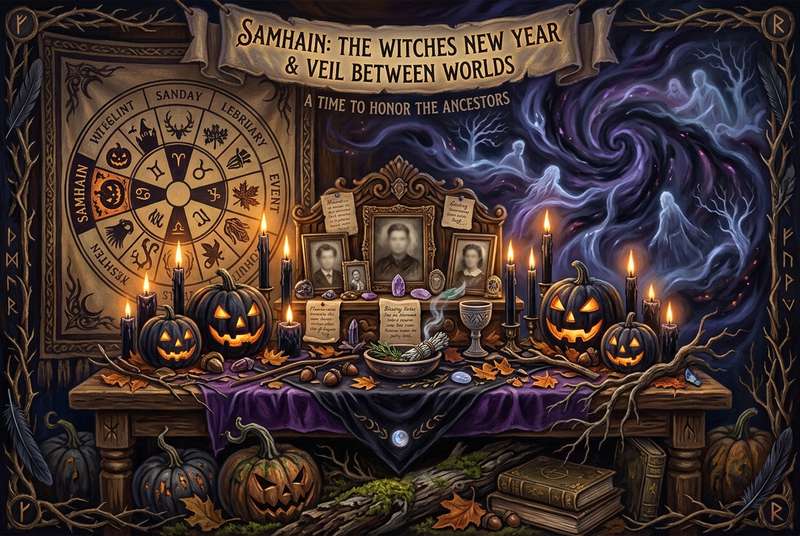
Create a dedicated space honoring those who have passed. Set out photos, candles, and their favorite foods or drinks. Some witches practice a “dumb supper”—a meal where a place is set for deceased loved ones, inviting them to join you in communion. Sit in silence, speak to them, and listen for their wisdom.
2. Divination & Scrying
The veil is thinnest on Samhain sabbat, making it the perfect time for tarot, oracle cards, or scrying. Ask your ancestors and guides to reveal what you need to know for the year ahead. Some witches scry by candlelight into mirrors or bowls of water.
3. Bonfire or Candle Ritual
Light a bonfire (or large candle) and write down what you wish to release—old patterns, grudges, fears. Safely burn these papers, symbolically releasing them to the element of fire. As the smoke rises, visualize your intentions transforming into new possibilities.
4. Samhain Sabbat Walk Through Nature
Take a mindful journey through autumn landscapes. Collect fallen leaves, twigs, and stones. Notice the decay and dormancy—the beauty in endings. These natural items can later adorn your altar or be used in charm bags.
5. Spirit Communication Circle
Gather with fellow witches (or practice alone) in a sacred circle. Light candles and incense, call in protection, then invite spirits and ancestors to communicate. You might use a pendulum, automatic writing, or simply open yourself to impressions and messages.
6. Samhain Sabbat Meditation & Journeying
In deep meditation, journey to the underworld or the realm of spirits. Meet with ancestors, guides, or animal allies. Ask for blessings, wisdom, or healing for the year to come. Return gently, grounding yourself fully before rising.
7. Creating a Samhain Sabbat Charm or Talisman
Craft a protective charm using herbs, stones, and symbols of Samhain sabbat. Infuse it with your intentions for the dark half of the year—courage, wisdom, ancestral protection. Wear or carry it through winter.
Altar Setup for Samhain Sabbat
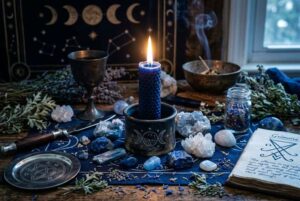
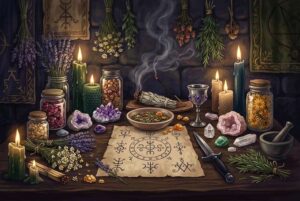
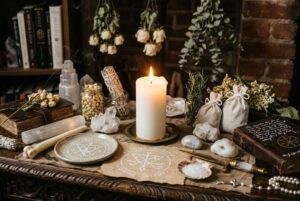
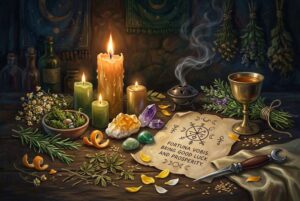
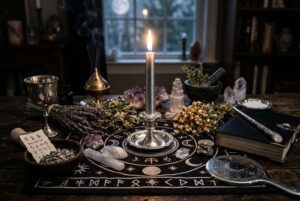
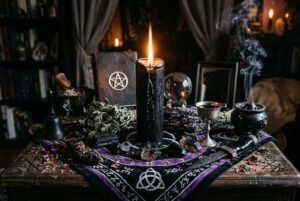
Your Samhain sabbat altar is a sacred focal point for your rituals and intentions. Here’s how to create one:
- Center Focus: A large black or orange candle, or a representation of the God/Goddess (a statue, image, or natural object)
- Ancestor Section: Photos, names written on paper, or personal items of deceased loved ones
- Offerings: Bread, apples, wine, or other traditional foods (see below)
- Candles: Black for the dark half of the year; orange or gold for the harvest light still fading
- Symbols: Acorns, dried leaves, gourds, bones (real or carved), a besom, or a cauldron
- Stones & Crystals: Obsidian, black tourmaline, amethyst, and smoky quartz (see section below)
- Incense: Frankincense, myrrh, or sage to honor the veil and invite spirit presence
- Divination Tools: Tarot deck, runes, scrying mirror, or pendulum
Herbs, Crystals & Colors for Samhain Sabbat
Herbs Associated with Samhain Sabbat:
- Mugwort (enhances divination and spirit communication)
- Wormwood (protects and opens the sight)
- Sage (cleansing and wisdom)
- Rosemary (remembrance and protection)
- Rue (banishing and protection)
- Thyme (courage and ancestral connection)
- Chamomile (calming and dream work)
Crystals & Stones for Samhain Sabbat:
- Black Tourmaline: Grounding and protective during spirit work
- Obsidian: Connects you to deep truth and shields against negativity
- Amethyst: Enhances intuition and opens spiritual channels
- Smoky Quartz: Bridges the physical and spiritual realms
- Labradorite: A stone of magic and the liminal spaces
Colors for Samhain Sabbat:
- Black (the dark, the void, the unknown)
- Orange (harvest light, Jack-o’-lanterns, warmth in darkness)
- Deep Purple (spirituality, the veil, mystery)
- Gold (fading summer, illumination of truth)
- White (spirits, the ancestors, clarity)
Foods Traditional for Samhain Sabbat
Food is a sacred offering on Samhain sabbat. These traditional foods honor the harvest and welcome ancestral spirits:
- Apples: A sacred fruit of the Otherworld; serve plain, baked, or as cider
- Nuts & Seeds: Hazelnuts, walnuts, and pumpkin seeds represent wisdom and protection
- Bread & Grain: Whole grain breads, oatcakes, or barley acknowledge the final harvest
- Root Vegetables: Turnips, potatoes, beets, and squash—grounding and nourishing
- Mushrooms: Associated with the faerie realm and the liminal spaces
- Pomegranate: Seeds symbolize the underworld and Persephone’s descent
- Meat & Bone: If you eat meat, Samhain sabbat is a time to honor the sacrifice and give thanks
- Honey & Sweet Wine: Offerings of sweetness to honor the spirits
Modern Ways to Celebrate Samhain Sabbat
While honoring ancient traditions, Samhain sabbat can be celebrated in ways that fit your contemporary life:
- Create a Samhain Sabbat Vision Board: Gather images and words representing what you wish to release and manifest. This combines reflection with creative expression.
- Ancestor Journal Writing: Write letters to loved ones who have passed, sharing what’s in your heart. Read them aloud at your altar.
- Digital Altar: If space is limited, create a sacred folder on your computer with photos, journal entries, and affirmations for Samhain sabbat.
- Virtual Ritual Circle: Join or host online rituals with witches across the world, honoring the universal connection of Samhain sabbat.
- Samhain Sabbat Playlist: Curate music that moves you—haunting, mystical, powerful—to accompany your rituals and reflection.
- Volunteer or Donate: Honor the cycle of death by supporting causes that help the living—animal rescues, hospice care, or community services.
- Nature Walks & Photography: Document the decay and beauty of late autumn. Share your experience on social media with gratitude for the season.
- Costume as Spiritual Practice: If you dress up for Halloween, choose clothing that embodies an archetype or ancestor—making your costume a form of honoring and embodying those energies.
Closing Thoughts on Samhain Sabbat
Samhain sabbat is a threshold, a sacred pause between what was and what will be. As you approach this holy night, remember that you are part of an ancient lineage of witches, healers, and seekers who have honored this transition for millennia. The veil thins for you, too. Your ancestors are listening. The spirits are near. The magic is potent.
Whether you light candles in solitude, gather with a coven, or simply pause to honor those who came before you, Samhain sabbat invites you home—to the roots of your craft, to the wisdom of the darkness, and to the eternal cycle of transformation that defines all life.
Welcome to the Witches’ New Year. Welcome home.
FAQ
What is the difference between Samhain and Halloween?
Samhain is a sacred witchcraft sabbat and Celtic festival marking summer’s end and the witches’ new year, while Halloween is the modern commercialized holiday. Though both occur on October 31st, Samhain is a spiritual observance focused on ancestral connection and the veil between worlds, whereas Halloween emphasizes costumes and entertainment.
Why is the veil between worlds thin on Samhain?
Ancient Celts believed that Samhain marked a liminal space where spiritual and physical boundaries dissolved, allowing communication with ancestors and the supernatural realm. This tradition persists in modern witchcraft, where practitioners view Samhain as a unique time when the boundary between living and dead becomes permeable for deeper spiritual work.
How do witches celebrate Samhain sabbat?
Witches celebrate Samhain through rituals, ancestor work, spiritual reflection, and bonfire ceremonies that honor the Celtic traditions. Many perform divination, make offerings, and intentionally work with the heightened spiritual energy to mark the end of one year and beginning of another in the witchcraft calendar.
Is Samhain the witches’ new year?
Yes, Samhain marks the witches’ new year in the craft tradition, not January 1st. The ancient Celts celebrated it as the transition from summer’s end into the darker half of the year, establishing it as the sacred beginning of a new cycle in witchcraft.
Can solitary witches celebrate Samhain?
Yes, solitary witches can fully celebrate Samhain with personal rituals and ancestor work. The sabbat offers profound opportunities for spiritual growth and ancestral connection whether practiced alone or with a coven.