There is something quietly magnetic about the athame. If you have ever browsed a witch’s altar online or flipped through a book on Wicca, you have likely spotted it — a dark-handled blade resting beside candles and crystals, carrying an air of quiet intention. The athame, or ritual blade, is one of the most iconic tools in witchcraft, and it is also one of the most misunderstood. Far from being a weapon or a prop for dramatic effect, the athame is a tool of focused will, symbolic power, and energetic direction. Whether you are brand new to your practice or simply curious about adding a ritual blade to your altar, this guide walks you through everything you need to know — what an athame is, how it is used, how to choose one, and how to care for it. No fluff, no gatekeeping — just clear, practical guidance for every kind of witch.
What Is an Athame? The Ritual Blade Explained
An athame (often pronounced ATH-ah-may or ah-THAH-may, depending on your tradition) is a ceremonial dagger used in witchcraft and ceremonial magic. Here is the key thing to understand from the start: the athame is not meant to physically cut anything. No herbs. No cords. No paper. Its entire purpose lives on the energetic and symbolic level — it is an extension of your will, pointing your intention into the world with precision.
Think of it less like a knife and more like a wand in blade form. Where your hand shapes energy, the athame focuses and directs it. Many traditions associate it with the element of Air (intellect, clarity, communication) while others link it to Fire (willpower, action, transformation). Both associations make sense — the athame is about decisive, directed energy, no matter which elemental framework resonates with you.
If you need to physically cut something in a ritual context — herbs, cord, candle wax — that job belongs to the boline, a practical working knife with a white or wooden handle. The athame remains ceremonial, symbolic, and energetically charged.
Common Types of Athames Across Witchcraft Traditions
Athames come in many forms, and the “right” one depends entirely on your path and personal resonance. Here is a look at the most common styles you will encounter:
Traditional Black-Handled Athame
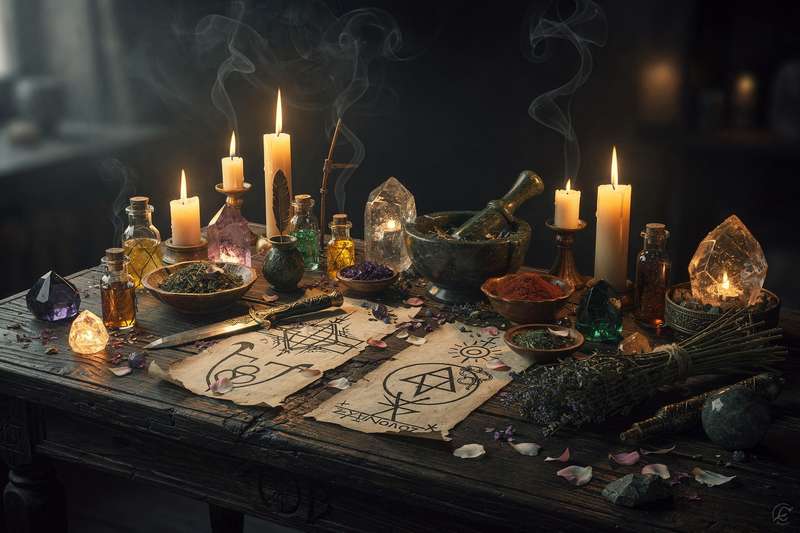
The classic athame most people picture — a double-edged steel blade with a black handle, often associated with Wiccan traditions as described in Gerald Gardner’s foundational writings. The black handle is said to absorb and store magical energy. These are widely available and carry a strong ceremonial aesthetic that many practitioners love.
Wooden or Natural Material Athame
Not all athames are made of metal. Some witches prefer a blade carved entirely from wood — beechwood, oak, and ash are popular choices. A wooden athame cannot physically cut anything, which some practitioners see as a feature, not a flaw. It keeps the tool’s purpose purely symbolic and is a wonderful option for those who prefer natural, earth-based materials.
Antique or Repurposed Blades
Letter openers, antique daggers, and heirloom knives can all serve as athames once they have been cleansed and consecrated for ritual use. The provenance of an object carries energy, and many witches feel a deep connection to objects with history. If something calls to you from a thrift shop or an estate sale, trust that pull.
Crystal or Gemstone-Tipped Blades
Some modern athames feature handles set with crystals or are made from materials like obsidian, selenite, or carved quartz. These blend the directional energy of the blade with the specific properties of the crystal — obsidian for protection and banishing, clear quartz for amplification, selenite for cleansing and spiritual connection.
Your Own Finger or Hand
Yes, truly. Many witches use their index finger — or their whole hand — as their athame. Your body is the most powerful ritual tool you possess. If you do not own a physical blade, or simply prefer not to work with one, pointing your finger with clear intention is a completely valid and effective approach.
How to Use an Athame: Step-by-Step Ritual Guide
Ready to put your athame to work? These are the core ways witches use this tool in practice, presented as concrete steps you can follow today — whether you are using a forged blade or your own finger.
Step 1 — Cleanse Your Athame Before First Use
Before you work with any ritual tool, clear it of any energy it may have picked up from its travels — manufacturing, shipping, handling in a shop, or previous owners. Hold it in smoke from cleansing herbs like rosemary, mugwort, or cedar. You can also leave it under moonlight overnight (a full moon is especially potent), sound-cleanse it with a singing bowl, or bury it briefly in the earth. Set the intention clearly: this tool is cleansed and ready to serve my practice.
Step 2 — Consecrate It to Your Practice
Consecration means formally dedicating your athame as a sacred tool. Hold it in both hands, breathe slowly, and speak your intention aloud. You might say something simple like: “I consecrate this blade to my practice. May it serve only the highest good, directing my will with clarity and focus.” You can also anoint it with a small amount of oil — rosemary, frankincense, or any oil aligned with your intention. This step builds the energetic relationship between you and the tool.
Step 3 — Use It to Cast a Sacred Circle
Casting a circle creates a protected, intentional space for your ritual work. Stand in the center of your chosen space. Hold your athame outward, blade pointing toward the floor or horizon. Walk clockwise (deosil), visualizing a sphere of light expanding around you as you move. Feel or imagine the blade tracing the energetic boundary as you walk. When you return to your starting point, close the circle with a spoken word, a breath, or a simple phrase: “This circle is cast. Only love and truth may enter.”
To close the circle when your ritual is complete, walk counterclockwise (widdershins), consciously releasing the energy you raised back into the earth with gratitude.
Step 4 — Direct Energy During Spellwork
During spells or rituals, you can use your athame to direct energy toward a specific goal. Point it at a candle, a sigil, a crystal, or a symbolic object while visualizing your intention flowing down the blade and into the target. The physical gesture reinforces the mental command — your subconscious mind responds to ritual movement, and that response amplifies your magic.
Step 5 — Trace Symbols and Sigils in the Air
One of the most common uses of an athame is drawing symbols in the air — pentagrams for protection and elemental invocations, runes for specific energies, or your own sigils for focused intention. The blade acts as a literal pointer, leaving an energetic imprint in space. Visualize the symbol glowing as you trace it, and hold that image in your mind’s eye for a few breath cycles before moving on.
Step 6 — Set Energetic Boundaries
An athame is excellent for boundary work. If you feel an energetic intrusion in your space — whether from external sources, stagnant energy, or unwanted influence — you can use your blade to trace a protective line around your home, your body, or a sacred space. Walk the perimeter with the athame held outward and speak your boundary clearly. This is not aggressive — it is self-protective authority.
Step 7 — Cut Energetic Cords
Cord-cutting is a well-known practice for releasing attachments to situations, relationships, or patterns that no longer serve you. With your athame, visualize the cord that connects you to what you wish to release, then make a deliberate cutting motion through it. This works purely on the energetic plane — no physical contact with anyone or anything is involved. Pair it with a spoken release and a grounding practice afterward to fully integrate the work.
Step 8 — Invoke Elements or Call Quarters
In many Wiccan and ceremonial traditions, the athame is used to call in the four elemental quarters at the start of a ritual — pointing to each cardinal direction (East, South, West, North) while invoking Air, Fire, Water, and Earth respectively. If this resonates with your practice, use your blade to point toward each direction as you speak or visualize the elemental energy arriving.
Essential Tools and Supplies for Athame Work
Your athame does not work in isolation — it is part of a broader ritual toolkit. Here are the essentials that pair naturally with it:
- Candles — Probably the most fundamental tool in any witch’s practice. Use them to mark your circle, set intention, and work elemental energy.
- Crystals — Black tourmaline and obsidian are excellent companions for protection work. Clear quartz amplifies whatever intention you set.
- An altar cloth — A dedicated surface, even a simple piece of fabric, signals to your mind that sacred work is beginning.
- Cleansing herbs or incense — Rosemary, frankincense, and cedar are classic choices for clearing and consecrating your space and tools.
- A chalice or bowl — Often paired with the athame in ritual as the complementary receptive vessel to the blade’s projective energy.
- A ritual journal — Track your workings, observations, and the evolution of your relationship with your athame over time. This record becomes genuinely valuable.
Ethics and Best Practices for Athame Use
Working with any ritual tool asks you to consider the energetic and ethical weight of your intentions. A few guiding principles worth keeping front of mind:
Intention matters above all. The athame is a tool for directing your own will — not for overriding the will of others. Using it in workings that target another person without their knowledge or consent raises serious ethical concerns, regardless of your tradition. Most paths hold some version of the principle that magic should not harm, manipulate, or interfere with another’s free will.
Cultural respect. Some athame styles, symbols, and ritual forms draw from specific cultural or spiritual lineages. Approach these with curiosity and respect rather than appropriation. Research before you adopt, and honor the origins of what resonates with you.
Let others choose their own path. Your athame is personal. Do not pressure other practitioners to use one, and do not judge those who work without tools entirely. There is no hierarchy of legitimacy in witchcraft.
Common Beginner Mistakes to Avoid
- Thinking you need one to be a “real” witch. You do not. Intention is always the primary ingredient. Tools are supportive companions, nothing more.
- Buying the most impressive-looking blade rather than the one that resonates. An expensive, ornate athame is not more powerful. The connection matters far more than the price tag.
- Letting others handle it freely. If you have built an energetic relationship with your athame, you may prefer others not touch it. This is not precious — it is intentional care. Trust your instincts on this.
- Skipping cleansing before first use. New tools carry the energy of everyone who handled them before you. Cleanse before you consecrate, always.
- Using it to physically cut things. Even accidentally blurring the line between your athame and a practical knife muddies its energetic purpose. Keep the roles separate.
- Expecting instant dramatic results. Ritual tools deepen your practice over time, not overnight. The relationship you build with your athame grows richer with consistent, intentional use.
How to Build Your Athame Practice Over Time
Like any aspect of witchcraft, your relationship with your athame deepens gradually. Start simple — use it for one purpose, like casting your circle, and do that consistently before adding new uses. As you work with it regularly, you will begin to notice a growing sense of familiarity and responsiveness in the tool. That is real.
Revisit your consecration periodically — especially after major life transitions, after someone else has touched the blade, or if the tool has been unused for a long time. Keep a brief journal entry after significant rituals noting what felt alive or what felt flat. Over months and years, this practice log becomes one of the most valuable records of your growth as a practitioner.
And remember: there is no correct pace. A slow, intentional practice built over years is worth infinitely more than a rushed collection of tools you do not truly know how to use.
Final Thoughts
The athame is not about power over others — it is about authority over yourself. It marks the moment when you decide that your action is deliberate, your focus is clear, and your intention is chosen. Whether your athame is a hand-forged steel blade, a piece of carved beechwood, or simply your own pointed finger, the magic lives in the clarity you bring to it. That clarity, practiced again and again, is the heart of the craft.
Frequently Asked Questions
Does an athame need to be sharp?
No — in fact, many athames are intentionally kept dull or are never sharpened at all. Because the athame works on the energetic level rather than the physical, sharpness is irrelevant to its function. The blade’s purpose is symbolic direction, not cutting.
What is the difference between an athame and a boline?
The athame is a ceremonial blade used to direct energy, cast circles, and work symbolically in ritual — it never physically cuts anything. The boline is the practical working knife in a witch’s toolkit, used for cutting herbs, cords, candles, and other physical materials. They serve completely different roles.
Can I use a regular knife as an athame?
Yes, as long as it has been cleansed, consecrated, and dedicated exclusively to ritual use. The key is that once something becomes your athame, you keep it separate from mundane tasks. A letter opener, a decorative dagger, or even a carved wooden blade can all serve this purpose beautifully.
How do I know which athame is right for me?
The most reliable guide is resonance — how the object feels in your hand and in your energy field. You do not need to spend a lot of money. The right athame tends to feel like it already belongs with you, whether it is a beautifully crafted blade or a simple wooden piece you carved yourself.