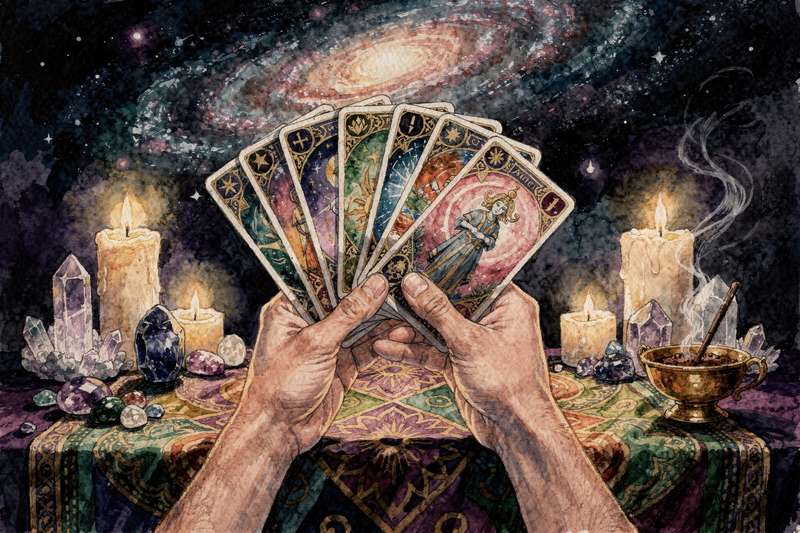
Tarot Court Cards at a Glance
Tarot court cards are one of the most misunderstood parts of the deck — and one of the most rewarding once you crack the code. The 16 court cards (Pages, Knights, Queens, and Kings across the four suits of Wands, Cups, Swords, and Pentacles) sit between the numbered pip cards and the Major Arcana, occupying a unique space that blends personality, archetype, and real-world people. If you have ever pulled a court card and frozen — wondering whether it represents you, someone else, or something else entirely — you are in good company. Almost every tarot student hits this exact wall.
The simplest, most liberating way to approach any court card is this: court cards are aspects of your personality. That single reframe changes everything. Instead of anxiously scanning your social circle trying to identify “who” the Knight of Swords is, you turn inward and ask: what part of me is this card asking me to meet?
Understanding the 16 Court Cards and Their Personality Energies
Each of the 16 court cards carries a layered personality — shaped both by its rank (Page, Knight, Queen, King) and its suit (Wands, Cups, Swords, Pentacles). Think of the rank as the maturity level of the energy, and the suit as its element or domain.
The Four Ranks
- Pages — The student energy. Curious, open, just beginning to explore the qualities of their suit. A Page carries youthful enthusiasm and a willingness to learn, but may lack experience.
- Knights — The action energy. Driven, sometimes impulsive, all-in on a mission. Knights take the suit’s qualities to an extreme — for better or worse.
- Queens — The inward mastery. Queens have fully integrated the energy of their suit and radiate it naturally. They influence through being, not doing.
- Kings — The outward mastery. Kings direct and command the energy of their suit in the external world. They are strategic, authoritative, and goal-oriented.
The Four Suits
- Wands — Fire energy. Passion, creativity, ambition, and inspired action.
- Cups — Water energy. Emotion, intuition, relationships, and the inner life.
- Swords — Air energy. Thought, communication, truth, and conflict.
- Pentacles — Earth energy. The body, money, work, nature, and long-term stability.
When you combine rank and suit, you get a distinct personality. The Queen of Cups, for example, is someone (or a part of you) who has deeply mastered emotional intelligence and leads through empathy. The Knight of Swords is the part of you that charges forward with ideas, sharp and fast, perhaps before fully thinking things through.
Upright Court Card Meaning: The Energy You Are Embodying
An upright court card most often represents an aspect of your personality that is active and available to you right now. The cards are essentially holding up a mirror and saying: this is who you are in this situation, or who you need to become.
Here are the three most common interpretations for an upright court card:
- It is you. You are expressing or need to express this archetype’s qualities in your current situation. If the King of Pentacles appears upright in a reading about your finances, the card is encouraging you to step into disciplined, grounded, long-term financial thinking.
- It is another person. Someone in your life embodies this energy and is either supporting or influencing the situation. This is most common in relationship or external readings.
- It is an energy or approach. Sometimes the court card describes the overall energy or vibe of the situation — not a specific person at all, but a quality the moment calls for.
“Start with this: the court card is an aspect of your personality. Once that lands, everything else opens up.”
Reversed Court Card Meaning: The Shadow Side of the Archetype
When a court card appears reversed, the archetype’s energy is not flowing freely. This can show up in a few different ways:
- Blocked or suppressed energy — You have access to this quality but you are not using it. Perhaps fear, habit, or circumstance is keeping it locked away.
- Overexpressed energy — Too much of the archetype is bleeding into the situation. The Knight of Wands reversed, for instance, may signal recklessness or impulsiveness taken too far.
- Someone showing up at their worst — If the card represents another person, they may be expressing this archetype’s shadow qualities — manipulation, rigidity, emotional unavailability.
The reversed court card is not a verdict — it is a diagnosis. It points to where healing, integration, or course-correction is needed.
Court Cards in Love & Relationships
Love readings are where court cards feel most personal, because they so often describe actual people. If you are asking about a romantic situation, consider all three layers: could this card be your partner? Could it be a quality you need to bring into the relationship? Could it describe how you yourself are showing up (or not showing up) emotionally?
The suit offers the clearest clue in love readings:
- Cups court cards in a love reading almost always carry emotional and relational significance — this is their home territory.
- Wands court cards in love suggest passion, attraction, and spontaneity — but potentially inconsistency.
- Swords court cards may point to honest conversations that need to happen, intellectual connection, or unresolved conflict.
- Pentacles court cards in love speak to reliability, commitment, and building something lasting together.
Court Cards in Career & Finance
In career readings, court cards often describe your professional identity or a key player in your work life. Ask yourself: am I being called to embody this archetype more fully at work? Is there a colleague, mentor, or authority figure who matches this card’s description?
The King or Queen cards showing up in career positions often signal leadership, mastery, or a call to own your expertise. Pages in career readings suggest a learning phase, a new project, or even a literal new job or field. Knights point to fast movement — opportunities arriving quickly, or the need to act decisively.
The Spiritual Dimension of Court Cards
On a spiritual level, the 16 court cards map beautifully to the idea that we each carry many inner selves — what depth psychology calls sub-personalities or archetypes. When a court card appears in a spiritual reading, it is often calling your attention to a part of your inner world that is ready to be seen, honored, or integrated.
The Queen of Swords in a spiritual context, for example, might invite you to cultivate discernment — to cut through illusion with loving clarity. The Page of Pentacles in a spiritual spread might encourage you to approach your practice with beginner’s mind, open and grounded.
Working with court cards spiritually is an excellent complement to shadow work, as each card can reveal both the gifts and the wounds of that particular inner archetype.
How to Read Court Cards in Any Tarot Spread
When a court card lands in your reading, move through this simple sequence:
- Note the suit and rank. What element is at play? What level of maturity does this energy carry?
- Ask: does this feel like me? Sit with the card for a moment. Does this archetype describe how you are currently behaving or feeling in the situation?
- Ask: does this feel like someone else? If the card does not fit you, does it describe someone in the situation — a boss, a partner, a friend?
- Check the surrounding cards. Context is everything in tarot. A King of Cups surrounded by conflict cards may describe someone using emotional intelligence to navigate tension. Surrounded by joyful cards, he might be a loving mentor arriving at the right moment.
- Trust your intuition. The meaning that lands most strongly for you in that moment is almost always the right one.
The more you practice, the more natural this process becomes. Court cards stop being intimidating and start being some of the most insightful cards in the deck — because they speak so directly to the human personalities and energies shaping your situation.
Frequently Asked Questions About Tarot Court Cards
Do tarot court cards always represent a real person?
No — while court cards can represent people in your life, they most commonly reflect an aspect of your own personality or the energy you need to embody in a situation. Context from surrounding cards and your intuition will guide you toward the right interpretation.
How do I know if a court card is me or someone else?
Sit with the card and ask yourself honestly: does this description fit how I am showing up right now? If the qualities feel familiar and personal, it is likely you. If the qualities feel external or remind you strongly of someone specific, it is probably pointing to another person.
What is the difference between a Queen and a King in tarot?
Both Queens and Kings represent full mastery of their suit’s energy, but they express it differently. Queens embody the energy inwardly — they radiate and inspire through presence. Kings direct the energy outwardly — they lead, strategize, and create results in the external world.
Why are court cards so difficult to interpret?
Court cards are challenging because they are more ambiguous than numbered cards — they sit between the concrete and the personal. Unlike The Tower or the Three of Cups, which depict clear events or feelings, court cards describe personalities and archetypes, which require you to apply them to a real human situation. With practice and a simple framework, they become much more intuitive.