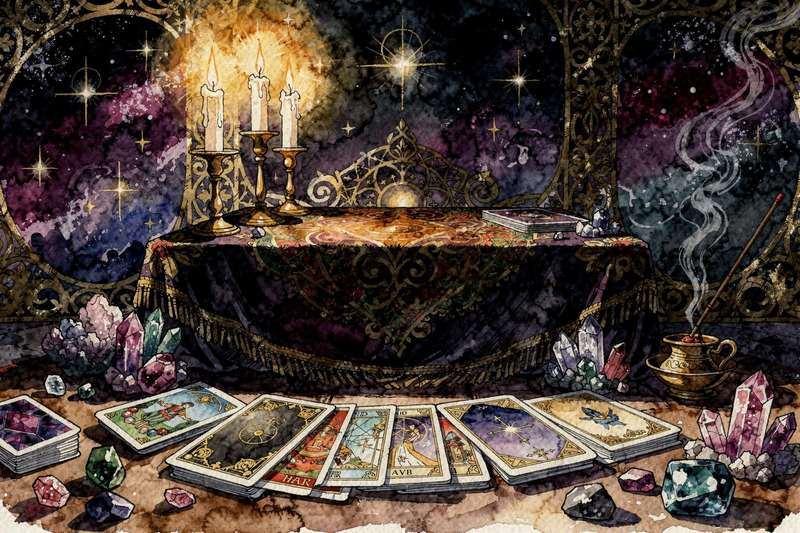
Using Tarot for Decision-Making at a Glance
Making decisions with tarot is one of the most practical — and misunderstood — uses of the cards. This is not about predicting a fixed future or waiting for the universe to hand you a verdict. Tarot for decision-making works because it gives your scattered, overloaded mind a structure: a physical layout on a table, positions that represent specific angles of your situation, and imagery that bypasses your rational defenses and speaks directly to your gut. If you have ever made a pro-and-con list that resolved absolutely nothing, you already understand why a different kind of reflection tool can help.
The foundation of this practice is simple. You already have feelings about your decision. You likely already know which direction pulls at you more strongly. What the cards do is create a moment of honesty — a pause in the rumination loop where something true can surface.
Why Tarot Actually Works for Decisions (It Is Not Magic)
There is no mystical force selecting which card you draw. What makes tarot powerful for decision-making is psychological, not supernatural — and that does not make it any less useful.
- It externalizes your thinking. When a decision lives only inside your head, it is a tangled knot of emotions, assumptions, and half-formed arguments. Laying cards on a table and assigning each position a distinct role — the hidden factor, the likely outcome, the fear beneath the fear — forces those internal tangles into visible, separate elements you can actually examine one at a time.
- It reveals your subconscious preferences. Your emotional reaction to a card tells you far more than its textbook definition ever could. Pull the Ten of Cups in the position of “staying in this relationship” and feel nothing? That absence of feeling is real information. Pull the Tower in the position of “leaving your job” and feel relief rather than dread? Pay close attention to that.
- It surfaces blind spots. A spread position labeled “what I am not seeing” does not magically produce hidden data. But it forces you to sit with the possibility that your current analysis is incomplete — and the card you pull becomes a prompt to look harder at what you have been avoiding.
- It breaks the rumination loop. Overthinking recycles the same arguments in the same order indefinitely. A structured tarot spread interrupts that loop by introducing new angles and images, giving your mind fresh material to work with instead of the same worn grooves.
How to Read Tarot Cards for a Decision: The Core Approach
You do not need a complicated spread to make decisions with tarot. Start with your question framed clearly and specifically. “What should I do about my job?” is too vague. “What am I not acknowledging about staying in this role?” is something a card can genuinely respond to.
A Simple Three-Card Decision Spread
- Card 1 — What supports Option A: Lay this card and sit with your honest reaction before reading any meaning.
- Card 2 — What supports Option B: Again, notice your gut response first.
- Card 3 — What I am not seeing clearly: This is often the most illuminating card of the three.
You can also add a fourth card as a “what my fear is telling me” position, which helps separate genuine intuition from anxiety-driven avoidance.
“The card did not decide anything. It created a moment of honesty.”
Reading Your Reaction, Not Just the Card
When you flip a card, notice what happens in your body before you reach for a guidebook. Do your shoulders drop with recognition? Does a quiet feeling of rightness settle in? Or do you immediately start bargaining — “but reversed it could mean something different”? That bargaining reflex is worth noting. It usually means the card showed you something true that you are not yet ready to accept.
Tarot for Love Decisions
Love decisions are among the hardest because they carry the weight of other people’s feelings, social expectations, and your own deep need for connection. Tarot cuts through this by bringing your private emotional truth to the surface. Whether you are deciding whether to commit to a relationship, end one, or open yourself to a new connection, the cards help you distinguish between what you genuinely feel and what you think you are supposed to feel.
Cards like the Two of Cups, the Lovers, and the Ace of Cups often arise in love decision readings, not as verdicts but as invitations to examine the quality of emotional energy you are actually experiencing in the situation — versus the quality you are hoping will eventually appear.
Tarot for Career and Finance Decisions
Career decisions often involve a collision between financial fear and authentic purpose. Tarot is particularly useful here because a well-placed spread can separate those two forces so you can see which one is truly driving your hesitation. The Five of Pentacles appearing in a “what I fear” position versus an “actual likely outcome” position, for example, tells a very different story each time.
The Ace of Wands, the Eight of Pentacles, and the World are cards that frequently emerge in career decision readings, reflecting themes of creative energy, skilled commitment, and completion. But again — your reaction to these cards matters as much as their traditional meanings.
Tarot for Spiritual Clarity
On a spiritual level, making decisions with tarot is an act of self-trust. You are choosing to believe that your inner wisdom is worth consulting — that the answer is not only “out there” somewhere but is already alive inside you, waiting for a quiet moment and the right question. This practice engages the third-eye chakra, the energy center associated with intuition, discernment, and inner knowing. It also works closely with the heart chakra, particularly when the decisions involve relationships or following your true calling.
Crystals like amethyst and labradorite can deepen your receptivity during a decision-reading session, helping to calm the analytical mind and open the intuitive channels. Lapis lazuli is another supportive stone for moments when truth-telling — especially to yourself — feels difficult.
Making Decisions With Tarot in a Reading: What to Watch For
When you sit down to read tarot for a real decision, a few signs indicate you are using the cards well:
- You feel a clear emotional response to at least one card — recognition, relief, resistance, or unexpected calm.
- You find yourself thinking about the reading hours later, with new thoughts surfacing organically.
- The spread reveals an angle you genuinely had not considered before.
Signs that the reading is not serving you:
- You keep reshuffling because you do not like the cards you pulled.
- You are asking the exact same question for the fifth time this week.
- You feel more confused after the reading than before.
If any of those last three are happening, the issue is not the cards. It is that some part of you is not yet ready to hear the answer — and no spread can fix that. The work then becomes sitting with the discomfort of not-knowing, rather than seeking relief through yet another draw.
Used with honesty and intention, tarot for decision-making is one of the most grounding practices available to you. It asks you to stop outsourcing your clarity and start listening to the part of yourself that already knows.
Frequently Asked Questions
Can tarot actually help you make better decisions?
Tarot helps you make decisions by externalizing your thinking and revealing emotional reactions you may have been suppressing. It does not predict outcomes, but it reliably surfaces the feelings and blind spots that are shaping your choices. Many people find that a single well-framed spread cuts through weeks of circular overthinking.
What is the best tarot spread for making a decision?
A simple three-card decision spread works well for most situations: one card for what supports each option, and one card for what you are not seeing clearly. For more complex decisions, a five or six-card spread can add positions for underlying fears, external influences, and likely energy if you take each path.
Does it matter which tarot deck you use for decision-making readings?
Any tarot deck you feel a genuine connection with will work. The imagery matters most — you want cards whose symbols produce a clear emotional response in you. The Rider-Waite-Smith deck is a reliable starting point because its scenes are rich in human emotion and situation, making gut reactions easier to identify.
What if the tarot card I pull contradicts what I want to hear?
That contradiction is often the most valuable part of the reading. Notice your impulse to dismiss or reinterpret the card — that impulse itself is information about where your resistance lies. Sit with the card for a few minutes before consulting any meaning guide, and ask yourself honestly what feels true about what it is showing you.