What Is the Cold Moon (December)?
The Cold Moon is December’s full moon, and it arrives as winter deepens and the year draws toward its close. This luminous orb hangs low in the winter sky, casting its silvery light across frost-covered landscapes and frozen earth. The Cold Moon isn’t just an astronomical event—it’s a powerful spiritual threshold, inviting you to pause, reflect, and consciously release what has weighed you down throughout the year. As one of the most introspective full moons in the lunar calendar, the Cold Moon offers a sacred opportunity to align with the season’s natural rhythm of stillness and renewal.
Unlike the vibrant energy of spring or summer moons, the Cold Moon calls you inward. Its light is clear and piercing, cutting through illusion and darkness with crystalline clarity. This is the moon of winter solstice preparations, of wrapping yourself in warmth while your spirit journeys inward, and of honoring the darkness as a necessary part of rebirth.
Why Is It Called the Cold Moon? Origins & Folklore
The name “Cold Moon” comes directly from the lived experience of early peoples—particularly Native American and European folk traditions—who watched winter’s grip tighten as December’s full moon rose. December is the month of deepening cold, of shortened daylight, and of nature’s sacred hibernation. Many indigenous cultures recognized this full moon as a marker of survival through harsh conditions, a time when food stores were tested and community bonds were strengthened through shared warmth.
In some traditions, this moon is also called the Long Night Moon or Oak Moon, reflecting different cultural perspectives on winter’s meaning. The name acknowledges both the literal chill in the air and the emotional temperature of the season—the stillness that invites introspection, the silence that allows you to hear your own inner voice, and the darkness that makes transformation possible.
This full moon falls near or during the winter solstice (around December 21), making it deeply connected to one of the year’s most potent astronomical and spiritual events. The coincidence of the full moon and solstice creates a double threshold: the year’s darkest day and the return of light, held together in ceremonial power.
The Spiritual Energy of the Cold Moon (December)
When the Cold Moon rises, you’re invited into a state of profound stillness. This isn’t the restless quiet of waiting—it’s the deep, generative silence of winter, where seeds sleep beneath snow and roots gather strength in darkness. The Cold Moon’s energy supports completion, closure, and the sacred work of letting go.
The spiritual signature of the Cold Moon (December) includes:
- Clarity and Truth-Seeing: The cold, crystalline light of December cuts through confusion and self-deception. Under this moon, you see situations and people as they truly are, not as you wish them to be.
- Introspection and Shadow Work: Winter naturally draws you inward. The Cold Moon amplifies this call, inviting you to face your own shadows, fears, and patterns with compassionate awareness.
- Release and Completion: As the year ends, the Cold Moon asks: What are you ready to release? What cycles need closure? This is the ultimate full moon for letting go.
- Community and Warmth: Paradoxically, the cold exterior of this season intensifies our need for connection. The Cold Moon honors both solitude and the warmth of gathering with your spiritual community.
- Rest and Restoration: This moon supports deep rest, meditation, and the restoration of energy depleted throughout the year. It’s a time to honor your need to slow down and renew.
Themes & Lessons of the Cold Moon (December)
The Cold Moon teaches that darkness and stillness are not punishment—they are gifts. In our modern world of constant stimulation, this moon offers a countercultural invitation: to embrace rest, to sit with silence, and to find power in what appears empty or dormant.
Key themes include:
- Endings as Beginnings: December marks the calendar’s final month, and the Cold Moon marks the year’s final full lunar cycle. This natural ending point is also a threshold to renewal. By consciously closing one cycle, you create sacred space for what wants to be born.
- Patience and Trust: Winter teaches you to trust in rhythms you cannot control. Seeds don’t sprout on your timeline; they sprout when conditions are right. The Cold Moon invites you to develop this same patience and faith in your own unfolding.
- Solitude as Strength: The long nights of winter invite deeper solitude. Rather than resisting this, the Cold Moon asks you to recognize solitude as a source of strength, creativity, and spiritual insight.
- Honoring Cycles: This moon marks the completion of a full lunar year. As you witness this cycle’s close, you’re invited to honor all the seasons you’ve lived through, all the growth and challenge, and to bow with gratitude before beginning again.
5 Powerful Rituals for the Cold Moon (December)
1. Year-End Release Ritual with Cord-Cutting
This ritual helps you consciously sever ties to patterns, people, or situations that no longer serve your highest good.
What You’ll Need: A white or red candle, black thread or cord, pen and paper, a fireproof bowl, matches
Steps:
- Light your candle and sit in a quiet space. Take three deep breaths and set an intention: “Under this Cold Moon, I release what no longer serves me.”
- On paper, write the name(s), pattern(s), or situation(s) you’re releasing. Be specific. (Resentment toward a friend? A job that drained you? A belief about your unworthiness?)
- Wrap the black thread around the paper three times while speaking aloud what you release. Say: “I cut this cord with love and gratitude for what it taught me. You are released, and I am free.”
- Safely burn the paper and thread in the fireproof bowl, watching the smoke carry your intention skyward.
- Bury the ashes in earth or scatter them to the wind. Close the ritual by thanking the Cold Moon for witnessing your release.
2. Solstice Vigil by Candlelight
Honor the year’s darkest night and the return of light with this meditative, solo ritual.
What You’ll Need: Multiple candles (white, silver, or pale blue), comfortable seat or meditation cushion, warm blanket, optional: journal and pen
Steps:
- As twilight falls on or near the winter solstice/Cold Moon, gather your candles in a circle around your meditation space.
- Light each candle intentionally, speaking aloud what you’re calling in for the new year (joy, clarity, strength, love, etc.).
- Sit within the circle and allow the flickering light to fill your awareness. Let thoughts come and go like clouds.
- Spend at least 20 minutes in this state of witnessing light against darkness. Feel the paradox: the darkest night contains the seeds of returning light.
- If journaling calls you, write freely about what you’ve witnessed and what you’re ready to begin.
- Extinguish the candles one by one, giving thanks to each as it releases its light.
3. Cold Moon Scrying for Year-Ahead Clarity
Use the moon’s reflective energy to gain insight into the year ahead.
What You’ll Need: A bowl of water (moonlit or prepared with intention), quiet outdoor or window space, optional: journal
Steps:
- Place the bowl of water where it can reflect the Cold Moon (outdoors is ideal, but a window works).
- Sit before your water mirror and soften your gaze. Ask a single, clear question: “What do I most need to know as I enter the new year?”
- Don’t strain to see visions—scrying isn’t about dramatic imagery. Notice what arises: feelings, colors, symbols, memories, whispers of knowing.
- Trust the first impressions that come. Spend 10-15 minutes with the water and your question.
- Journal any insights, no matter how subtle or seemingly insignificant. These seeds often grow into wisdom over time.
4. Silent Reflection Ceremony
This simple but profound ritual honors the silence that winter offers.
What You’ll Need: A quiet space, warm clothing, optional: herbal tea
Steps:
- Choose a duration for your silence (30 minutes to a few hours). The longer, the deeper the journey.
- Move through this time without speech, screens, or sound (except natural sounds like wind or snow falling).
- Walk outside if possible, or sit in stillness indoors. Notice the quality of silence. How does it feel in your body?
- Let this silence speak to you. What rises in the quiet? What truths emerge when chatter stills?
- When your silence ceremony ends, return slowly to normal activity. Spend a few minutes journaling or simply sitting with the gifts you received.
5. Ancestor Honoring Ritual under the Cold Moon
December’s darkness makes it a traditional time to honor those who have passed and draw wisdom from ancestral lineage.
What You’ll Need: Photos or names of ancestors, candles, offerings (water, food, flowers), quiet space
Steps:
- Create a simple altar with photos, names written on paper, or symbolic objects representing your ancestors.
- Light a candle for each ancestor you wish to honor, speaking their names aloud and expressing gratitude for their gifts to you.
- Leave offerings of water, bread, fruit, or flowers—whatever feels meaningful.
- Sit in meditation and invite their presence. You might ask: “What wisdom do you offer me as I close this year?” or simply receive their love and protection.
- Spend time here, feeling the continuity of your lineage. You are here because of them. You carry their strength.
- Close by thanking your ancestors and inviting them to walk with you into the new year.
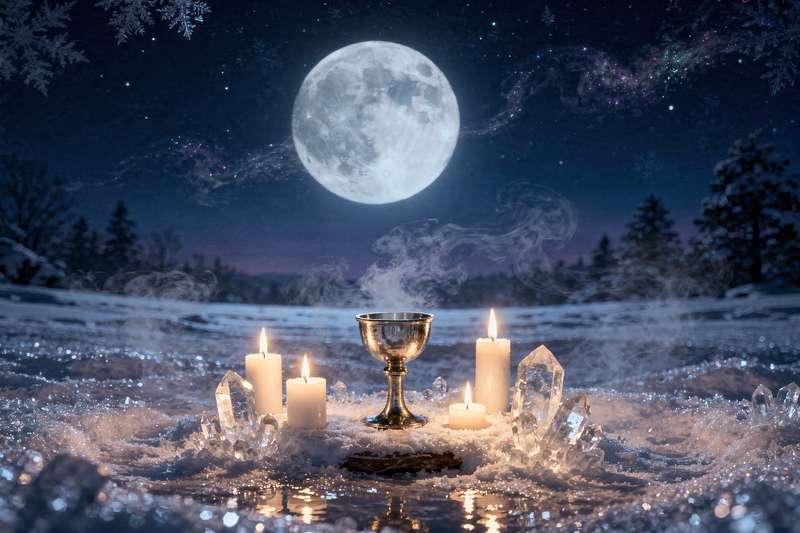
Altar Setup for the Cold Moon (December)
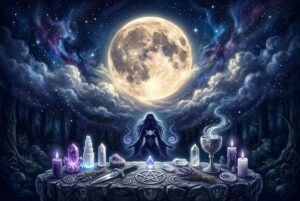
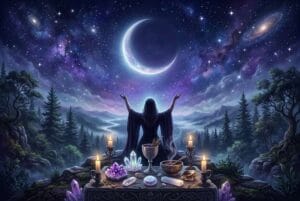
Your Cold Moon altar should reflect the season’s crystalline clarity and deep introspection. Here’s how to create a sacred space:
Foundation: Use a white, silver, or pale blue cloth as your base. If possible, position your altar where moonlight can touch it, or near a window.
Candles: Place white, silver, or pale blue candles at the altar’s center or corners. These represent the Cold Moon’s piercing light and the return of light after solstice.
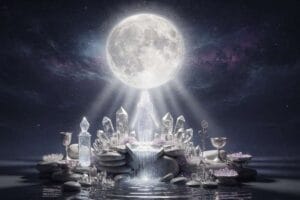
Elements of Winter: Add natural winter materials: white or clear quartz points, a bowl of water, branches dusted with fake snow or frost, pinecones, or dried berries. These ground your altar in the season’s actual energy.
Symbols of Release: Include a small bowl of salt (purification) or a feather (carrying away what no longer serves). You might also place a black cord or thread to symbolize cord-cutting work.
Personal Additions: Add items that represent your specific intentions for this moon phase—a journal, a crystal, a written intention, a photo of someone you’re honoring.
Arrangement: Create intentional symmetry. The symmetry itself becomes a meditation on balance and order in the darkness.
Crystals, Herbs & Colors for the Cold Moon (December)
Crystals for Cold Moon Work
- Clear Quartz: Amplifies clarity and intention-setting. Its icy appearance mirrors the Cold Moon’s crystalline light.
- Moonstone: Deepens connection with lunar energy and intuition. Particularly potent during full moons.
- Obsidian: Supports shadow work and protection. Its dark mirror reflects truth without judgment.
- Hematite: Grounding and centering. Helps you feel safe and rooted even as you journey inward.
- Blue Sapphire: Associated with wisdom, truth-seeing, and the completion of cycles.
Herbs for Cold Moon Rituals
- Frankincense: Sacred incense that opens spiritual awareness and honors the sacred nature of this time.
- Myrrh: Deepens introspection and supports grief processing and completion.
- Bay Leaf: Symbol of victory and completion. Burn to seal the old year and welcome the new.
- Rosemary: For remembrance, clarity, and protection. A traditional winter herb with deep magic.
- Mugwort: Enhances dreams, visions, and access to the subconscious—perfect for scrying and inner journeying.
Colors of the Cold Moon
- White: Purity, clarity, new beginnings
- Silver: The moon itself; intuition and feminine power
- Pale Blue: The winter sky; calm and deep inner knowing
- Black: The darkness that births light; shadow work and release
- Gray: The liminal space between seasons; reflection and rest
Journal Prompts for the Cold Moon (December)
Use these prompts to deepen your Cold Moon practice and honor your inner knowing:
- What are the three biggest lessons or challenges this year has offered me? What did I learn?
- What patterns, beliefs, or relationships am I ready to release? What’s keeping me from letting them go?
- If I could whisper one truth to myself at the year’s beginning, knowing all I know now, what would it be?
- In the darkness and stillness of winter, what wants to grow? What new seed is waiting to be planted?
- How have I changed since last winter? What am I most proud of in myself?
- What do I need to forgive myself for before the year ends? Can I offer myself that forgiveness now?
- If my inner landscape were a winter scene right now, what would it look like? Frozen? Peaceful? Barren? Beautiful in its starkness?
- What am I calling in for the new year? What kind of person do I want to become?
Affirmations for the Cold Moon (December)
Speak or write these affirmations during your Cold Moon rituals to anchor new beliefs and energy:
- “I release with grace and gratitude all that no longer serves my highest good.”
- “In stillness and darkness, I find clarity and profound strength.”
- “I trust in cycles of rest, reflection, and return.”
- “My shadow is sacred. I welcome all parts of myself with compassion.”
- “The darkness is not empty—it is full of potential and renewal.”
- “I am ready to close this chapter and begin anew.”
- “I honor my need for solitude, rest, and deep inner work.”
- “As the Light returns, I return to myself, whole and healed.”
- “I am exactly where I need to be on my sacred journey.”
- “This Cold Moon witnesses my transformation and celebrates my courage.”
How to Harness Cold Moon Energy Even If You Miss the Exact Night
The beauty of lunar magic is that it’s not confined to a single night. The Cold Moon’s energy extends for several days before and after the full moon. Here’s how to tap into it even if the exact moment passes:
Work within the Lunar Window: The full moon’s energy is strongest from approximately three days before to three days after the exact full moon moment. You have a six-day window to perform your rituals with full potency.
Extend Your Practice into December: Since the Cold Moon falls in December, you can honor its themes and energy throughout the entire month. December itself becomes a Cold Moon season, inviting year-end reflection and release work.
Use Proxy Rituals: If you miss the exact night, perform your Cold Moon ritual on the next available evening under the moon’s light. Intent and presence matter more than astronomical precision. The moon will still receive your prayer.
Create a Personal Cold Moon Tradition: Choose a specific day each December—perhaps the solstice, December 31st, or the actual full moon night—to honor this lunar cycle year after year. Repetition deepens the magic and creates a powerful annual anchor in your spiritual practice.
Journal Your Way In: If ritual feels uncertain, begin with simple journaling using the prompts above. Writing is itself a ritual, and your honest words carry power the moon recognizes and honors.
Sit Under the December Sky: Even if you don’t perform a formal ritual, simply spending time under the winter moon—wrapped in blankets, breathing cold air, witnessing its light—connects you to this cycle’s energy. Presence alone is enough.
FAQ
What is the Cold Moon and when does it occur?
The Cold Moon is December’s full moon, named for the deepening winter cold and representing stillness, completion, and the sacred long dark. It typically occurs in early to mid-December and often coincides with the winter solstice (around December 21), creating a powerful spiritual threshold.
What makes the Cold Moon different from other full moons?
The Cold Moon invites introspection and release rather than manifestation. Its crystalline light cuts through illusion, and its proximity to the winter solstice amplifies themes of completion, rest, and the return of light after darkness—making it uniquely powerful for year-end rituals and cord-cutting work.
Can I perform Cold Moon rituals if I miss the exact full moon night?
Yes. The full moon’s energy extends approximately three days before and three days after the exact moment, giving you a six-day window. You can also honor the Cold Moon’s themes throughout December, or create an annual December ritual on a consistent date that connects you to this lunar cycle’s energy.
What is the best Cold Moon ritual for beginners?
The Silent Reflection Ceremony is ideal for beginners—it requires no tools or advanced knowledge, just your willingness to sit with winter’s stillness. Alternatively, light a candle, write down what you’re releasing on paper, safely burn it, and speak gratitude to the moon. Simple, sincere rituals carry profound power.
How does the Cold Moon relate to the winter solstice?
The Cold Moon often falls near the winter solstice (December 21), the year’s darkest day. This timing creates a double threshold: the full moon’s illumination and the solstice’s promise of returning light merge into a singularly potent moment for releasing the old and welcoming the new. Together, they mark the year’s most introspective passage.