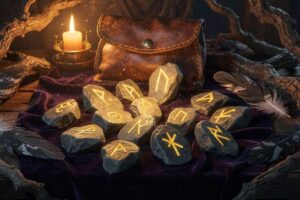
Geomancy — divination by earth marks — is one of the oldest and most widely traveled oracular arts in the world. Long before tarot cards or crystal balls, people were pressing their fingers into soil, tossing stones, and reading the patterns left behind as answers from the earth itself. If you’ve ever felt a pull toward grounded, elemental forms of spiritual guidance, geomancy might be the practice you’ve been waiting to discover. This ancient system of earth reading combines structured logic with genuine intuition, making it surprisingly accessible even if you’ve never tried divination before.
What Is Geomancy? The Art of Reading Earth Signs
The word geomancy comes from the Greek geomanteia — roughly translated as “divination by earth.” At its core, it’s a method of generating answers or insights by creating random marks and interpreting the geometric figures those marks produce. Think of it as a conversation between your focused intention and the raw, unfiltered energy of the physical world.
Unlike astrology, which reads celestial movements, or tarot, which works through symbolic imagery, geomancy is built on a binary logic system — each line in a figure is either odd or even, solid or dotted — which gives the practice an almost mathematical clarity beneath its mystical surface. Yet don’t let that fool you into thinking it’s cold or mechanical. The figures themselves carry rich symbolic meaning, and skilled readers bring warmth and nuance to every interpretation.
Geomancy has been classified alongside astrology and other respected divinatory arts throughout history, and the two traditions are closely linked. In medieval Europe, geomantic figures were often mapped directly onto astrological houses and planetary rulerships, creating a bridge between sky-reading and earth-reading that many practitioners still use today.
A Brief History of Earth Divination Across Cultures
Geomancy’s roots stretch across several continents. Its earliest traceable forms appear in sub-Saharan Africa, where diviners would cast handfuls of soil or sand and read the shapes that landed. This tradition — sometimes called Ifa or related earth-casting systems — was deeply embedded in spiritual and community life.
From Africa, the practice traveled north and east. Arabic scholars in the medieval Islamic world developed a highly formalized version known as ilm al-raml, meaning “the science of sand.” These scholars codified the 16 geomantic figures, assigned them astrological correspondences, and wrote extensive treatises on interpretation. It was largely through Arabic manuscripts that geomancy entered Europe during the 12th and 13th centuries.
In medieval and Renaissance Europe, geomancy became a serious academic discipline. Scholars like Cornelius Agrippa devoted significant attention to it alongside astrology, alchemy, and ceremonial magic. It was taught in universities, consulted by rulers, and considered a legitimate path to wisdom.
Meanwhile, in East Asia, related earth-reading traditions developed independently. Chinese feng shui — the art of reading terrestrial energies and orienting spaces accordingly — shares philosophical roots with geomancy, even if the specific methods diverge. Both traditions rest on the same foundational idea: the earth itself carries patterns of energy that human beings can learn to read.
The 16 Geomantic Figures and Their Meanings
The heart of geomantic earth divination is a set of 16 figures, each made of four rows of dots — either one dot (odd) or two dots (even). These combinations create a surprisingly rich vocabulary for describing life’s circumstances. Here’s a complete overview:
- Via — The Road: movement, change, journeys, and transitions
- Populus — The People: community, crowds, collective energy
- Albus — The White: clarity, peace, careful thought, and openness
- Rubeus — The Red: passion, volatility, conflict, and intense emotion
- Fortuna Major — Greater Fortune: lasting success, inner strength, significant achievement
- Fortuna Minor — Lesser Fortune: short-term gains, external help, fleeting luck
- Conjunctio — The Union: meetings, partnerships, agreements, and integration
- Carcer — The Prison: restriction, delay, boundaries, and limitation
- Tristitia — Sorrow: loss, grief, withdrawal, and introspection
- Laetitia — Joy: happiness, optimism, celebration, and upward movement
- Acquisitio — Gain: abundance, resources, holding on, and prosperity
- Amissio — Loss: release, letting go, scattering, and setbacks
- Puer — The Boy: boldness, impulsivity, raw energy, and action
- Puella — The Girl: receptivity, beauty, intuition, and emotional awareness
- Caput Draconis — Dragon’s Head: beginnings, entry points, new opportunities
- Cauda Draconis — Dragon’s Tail: endings, exits, completions, and release
Each figure carries its own personality. Some are considered favorable in most contexts (Fortuna Major, Laetitia, Acquisitio), while others signal caution or challenge (Rubeus, Tristitia, Carcer). But context matters enormously — a figure like Carcer placed in a question about protection can actually be reassuring, suggesting that something harmful is being held at bay.
How a Geomancy Reading Works Step by Step
One of the most appealing things about geomancy is that you can perform a reading with nothing more than a pen, paper, and a focused mind. Here’s how the process unfolds:
Step 1 — Set Your Question
Before you generate any figures, get clear on what you’re asking. Geomancy works best with specific, grounded questions — about decisions, relationships, career choices, or inner patterns you want to understand better. Take a moment to breathe, center yourself, and state your question internally or aloud.
Step 2 — Generate Your Marks
Traditionally, a geomancer would make a rapid series of marks in sand or soil — just letting the hand move without counting — then count the marks in groups to determine odd or even. You can replicate this easily on paper: quickly draw four rows of dots without counting, then go back and group them in pairs. An odd number of dots in a row gives you a single dot; an even number gives you two dots. Repeat this four times to create four complete figures, each with four rows.
Step 3 — Build Your Chart
These four initial figures are called the Mothers. From them, you derive four Daughters (by reading the rows horizontally across the Mothers), and then four Nephews (by adding pairs of figures together). Finally, two Witnesses emerge from the Nephews, and these combine to produce a single Judge — the figure that offers the core answer to your question.
It sounds complex written out, but once you’ve done it a few times, the process becomes almost meditative. Many practitioners find the act of constructing the chart as valuable as the interpretation itself.
Step 4 — Interpret the Reading
Start with the Judge for an overall answer, then look at the Witnesses for context — one represents the situation’s past or cause, the other the future direction or effect. From there, work back through the Nephews and Mothers to understand the finer layers of the situation. Trust what surfaces intuitively, especially as you become more familiar with the figures.
How to Work With Geomancy in Daily Spiritual Practice
Geomancy isn’t reserved for big, dramatic life questions. It can be woven into your everyday spiritual routine in gentle, practical ways.
- Morning check-ins: Pull a single geomantic figure each morning as a daily theme or prompt for reflection. You don’t need a full chart — just one figure to hold in mind as you move through your day.
- Decision support: When you’re weighing two options, assign one to the left hand and one to the right, generate a figure for each, and compare. The more favorable figure points toward the wiser choice — though always factor in your own knowledge and values.
- Journaling with figures: After any reading, write down your figures and initial impressions before looking up traditional meanings. This builds your intuitive relationship with the symbols over time.
- Pair it with astrology: Since many geomantic figures have planetary and sign correspondences, you can layer a geomancy reading with your natal chart. For instance, if Conjunctio (ruled by Mercury) appears prominently in a reading about communication, that echoes themes already present in Mercury-heavy charts.
- Seasonal earth rituals: On solstices, equinoxes, or new and full moons, perform a geomancy reading outdoors — literally in soil or sand — to reconnect with the earth element and the roots of the practice.
Common Misconceptions About Geomancy
- “It’s the same as feng shui.” Feng shui and geomancy share philosophical roots but are distinct practices. Feng shui focuses on spatial arrangement and environmental energy. Classical geomancy generates figures through random marks and interprets them through a symbolic system.
- “You need special tools or training.” A pen and paper are genuinely sufficient to start. The tradition has always been accessible — it was practiced by scholars and ordinary people alike throughout its history.
- “The figures give fixed, unchangeable predictions.” Geomancy, like all divination, reflects patterns in motion, not locked-in outcomes. What you see in a reading is a snapshot of current energies, not a sentence.
- “It’s less serious than astrology or tarot.” Geomancy was considered equally valid — sometimes more rigorous — than other divinatory systems in medieval scholarly traditions. Its logical structure actually makes it remarkably consistent.
- “You have to be psychic to interpret the figures.” Geomancy is one of the most learnable divination systems precisely because it uses a defined symbolic vocabulary. Intuition enriches the readings, but it isn’t a prerequisite.
Final Thoughts
Geomancy — divination through earth marks — offers something rare in spiritual practice: a system that is simultaneously ancient and logical, earthy and symbolic, structured and open to intuition. Whether you’re drawn to it because of its deep historical roots, its connection to astrology, or simply the satisfying ritual of making marks and reading patterns, geomancy has a way of grounding you — quite literally — in the present moment.
Start small. Learn a handful of figures. Ask one honest question. See what the earth has to say.
Frequently Asked Questions About Geomancy
What is geomancy and how does it work?
Geomancy is an ancient divination system that generates answers by creating random marks — traditionally in sand or soil — and interpreting the geometric figures those marks produce. A reader makes sets of dots, counts them as odd or even to build four-row figures, and arranges these into a chart whose final Judge figure reflects the core answer to a question.
How many geomantic figures are there?
There are 16 primary geomantic figures, each made of four rows of either one dot (odd) or two dots (even). Each figure has its own name, meaning, and traditional associations — including connections to planets, zodiac signs, and elements — giving the system a rich symbolic vocabulary.
Is geomancy related to astrology?
Yes, the two systems have been closely linked since at least medieval times. Each of the 16 geomantic figures carries planetary and zodiac correspondences, and traditional geomantic charts were often laid out in a 12-house structure mirroring an astrological chart. Many practitioners today use them together for deeper readings.
Can beginners practice geomancy without any prior knowledge of divination?
Absolutely. Geomancy is actually one of the more beginner-friendly divination methods because it has a clear, learnable structure. You only need paper and a pen to start, and the 16 figures can be studied gradually over time. Beginning with simple one-figure daily draws is an excellent way to build familiarity before attempting full chart readings.