Understanding the Conjunction Aspect
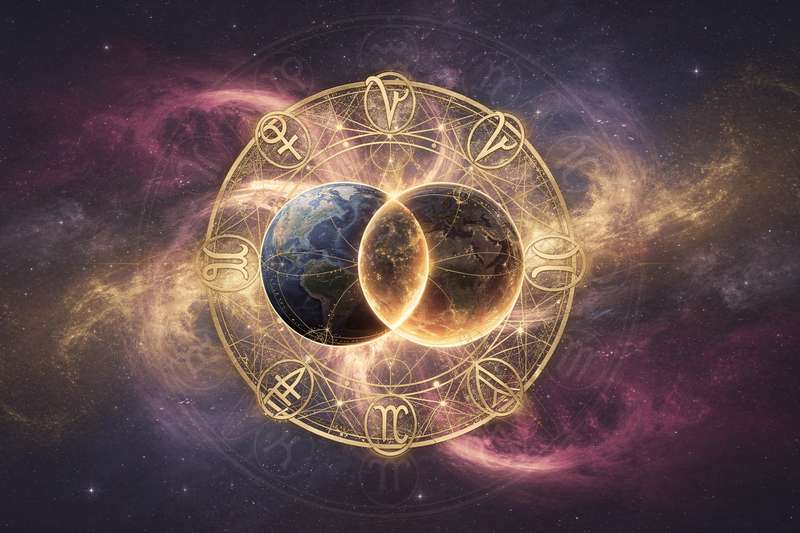
When two planets or celestial points occupy the same or nearly the same degree in your birth chart, they form what astrologers call a conjunction. This is one of the most potent aspects you can have in your natal chart, and it deserves your attention.
A conjunction isn’t inherently positive or negative—it’s simply powerful. Think of it as two planetary energies standing right next to each other, amplifying one another, creating an intensity that influences how you show up in the world. The exact meaning depends entirely on which planets are involved and what sign they’re in.
How Conjunctions Work in Your Chart
Astrologers typically consider two planets conjunct when they’re within about 8-10 degrees of each other (called an orb). The tighter the conjunction—meaning the closer the degrees—the stronger its influence on your personality and life experiences.
Unlike some aspects that create friction or easy flow, conjunctions create a blending effect. The planets’ energies don’t oppose each other or flow gently; instead, they merge into a single, concentrated force. This can feel like having two different instincts operating as one unified drive.
In synastry charts (relationship astrology), conjunctions between your planets and your partner’s planets show where you naturally amplify each other’s energy. This can be deeply bonding or intensely challenging, depending on the planets involved.
Common Planetary Conjunctions and Their Meanings
Each conjunction carries its own signature. Here are some of the most significant combinations you might encounter:
- Sun conjunct Moon: You have an integrated sense of self. Your conscious identity (Sun) aligns with your emotional nature (Moon), creating wholeness and clarity about who you are.
- Venus conjunct Mars: Passion and desire are strongly activated. You’re drawn to expressing love physically and romantically, with a direct, confident approach to attraction.
- Mercury conjunct Venus: Communication becomes an expression of love and beauty. You have a gift for speaking what you feel, making you persuasive and charming in conversations.
- Sun conjunct Saturn: You carry a serious, mature energy from early on. Authority, discipline, and responsibility feel native to you, though you may need to consciously cultivate lightness and joy.
- Moon conjunct Jupiter: Emotional expansion and generosity characterize your nature. You likely feel things deeply and have an optimistic, protective quality toward others.
- Mars conjunct Jupiter: Your will and confidence are amplified. You’re driven, ambitious, and naturally courageous, though you benefit from checking impulses before acting.
The Sign and House Matter
A Sun-Venus conjunction in creative Libra plays out very differently than the same aspect in practical Capricorn. The zodiac sign hosting your conjunction colors its expression entirely.
Similarly, the house your conjunction occupies shows which life area gets this concentrated planetary energy. A Mars-Venus conjunction in your 7th house of partnership expresses through relationships, while the same conjunction in your 10th house of career channels that passion into your professional pursuits.
Conjunction Energy in Different Life Areas
In Relationships
Conjunctions in your chart shape how you relate to others. If you have Venus conjunct Mars, you’re naturally magnetic and sexually confident. If you have Mercury conjunct Saturn, you might be reserved in communication initially but deeply thoughtful once you open up.
In synastry (comparing two charts), when your Venus conjuncts someone’s Mars, there’s immediate sexual chemistry. When your Moon conjuncts their Moon, you feel emotionally understood without needing to explain yourself.
In Career and Purpose
Sun conjunctions with career planets like Saturn, Midheaven, or the 10th house cusp create professional focus and ambition. Mercury conjunct your Midheaven gives you a gift for communication in your work. Mars conjunct your Midheaven drives you toward competitive, visible achievement.
In Personal Growth
Not all conjunctions feel easy. Sun conjunct Saturn can make you overly self-critical. Venus conjunct Saturn might make you hesitant in love. These harder conjunctions actually offer tremendous growth potential—they push you toward integration and mastery rather than passive ease.
Working With Your Conjunctions
If you have a conjunction that feels challenging, know that its intensity is actually an invitation to develop mastery. A difficult conjunction is like having a superpower that requires training.
For positive conjunctions, the invitation is different: don’t take the ease for granted. Venus-Jupiter conjunction brings luck in love, but only if you actively cultivate healthy relationships. Mars-Jupiter conjunction offers courage, but you still need to direct that energy wisely.
Understanding your conjunctions helps you stop fighting your own nature. Instead of wondering why you’re so intense about your goals (Sun-Mars) or why you feel deeply (Moon-Neptune), you can honor these tendencies and channel them constructively.
Transiting Conjunctions
Conjunctions don’t only matter in your natal chart. When planets in the current sky form conjunctions to your natal planets, they activate and amplify that energy in real time.
A transiting Venus conjunction to your natal Sun is known as a wonderful time for confidence and attraction. Transiting Saturn conjunct your natal Moon might bring emotional weight but also emotional maturity if you work with it consciously. These transiting conjunctions typically influence you for several weeks to months depending on the planets involved.
Conjunction Versus Other Aspects
Understanding where conjunctions fit among all aspects helps clarify their role. Trines and sextiles offer ease and flow. Squares and oppositions create tension that pushes you toward growth. Conjunctions do something different: they concentrate and intensify.
A trine between Mars and Jupiter makes you naturally lucky in action—things come easily. A conjunction between Mars and Jupiter makes you fearless and driven—you have raw power that requires conscious direction. A square between Mars and Jupiter creates friction that teaches you resilience through challenge.
Finding Your Conjunctions
To identify your conjunctions, you’ll need your birth chart, which requires your birth date, exact time, and location. Many free astrology websites generate charts instantly. Once you have your chart, look for planets marked with the conjunction symbol (☌) or listed as within a tight orb of the same degree.
Pay special attention to conjunctions involving personal planets (Sun, Moon, Mercury, Venus, Mars) as these affect your personality most directly. Conjunctions involving outer planets (Jupiter, Saturn, Uranus, Neptune, Pluto) influence broader life themes and generational patterns.
FAQ
Are all conjunctions difficult?
No. Some conjunctions like Venus-Jupiter or Sun-Jupiter feel naturally fortunate. Others like Saturn conjunctions feel restrictive initially but offer deep wisdom. Difficulty or ease depends on which planets are involved, though intensity is always present with conjunctions.
Can conjunctions change over time?
Your natal conjunctions never change—they’re fixed in your birth chart. However, transiting planets regularly form new conjunctions with your natal planets, creating temporary periods of activated energy. These transits typically last weeks to months.
What does a tight conjunction versus a wide conjunction mean?
A tight conjunction (1-3 degrees apart) feels very intense and is considered stronger. A wider conjunction (8-10 degrees) is still significant but feels less concentrated. The tighter the orb, the more merged the planetary energies become.
How do I use conjunction knowledge to improve my life?
First, accept your conjunctions as part of your wiring rather than fighting them. For challenging conjunctions, channel their intensity into skill-building. For supportive conjunctions, actively cultivate what they offer rather than taking them for granted. Awareness itself is transformative.