When you meet someone and feel an instant spark—or notice mysterious friction—astrology offers a framework to understand why. Your birth chart is a snapshot of the cosmos at your exact moment of birth, showing where every planet and luminary sat in the sky. When you compare your chart with another person’s, you’re not just looking at Sun sign compatibility (though that’s where many begin). You’re examining the intricate dance between your Venus, Mars, Moon, and dozens of other planetary positions. This practice is called synastry, and it’s far richer than surface-level horoscope matching.
What Is Synastry and Birth Chart Compatibility?
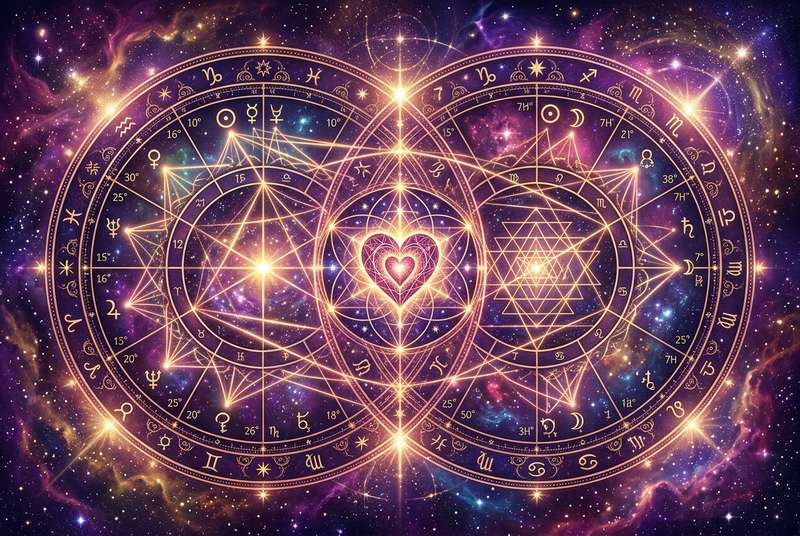
Synastry is the art of relationship astrology—the study of how two natal charts interact and influence one another. Each person carries a unique birth chart, a cosmic blueprint stamped with the positions of planets, signs, and houses at the moment they took their first breath. When two people’s charts are overlaid or compared side by side, something fascinating happens: the planetary energies from one chart form angles and connections with the other person’s planets.
Think of it this way: your birth chart is your personal operating system. Your partner’s chart is theirs. When these systems interact, the compatibility between you isn’t determined by a single factor—it’s a conversation between multiple layers of energy. You might have harmonious Sun signs but challenging Mars placements. You might feel emotionally safe (Moon compatibility) while struggling with communication (Mercury discord). Synastry shows you all of these threads.
Unlike simple Sun sign matching—the “Does a Leo get along with a Scorpio?” question—birth chart compatibility accounts for your Venus sign (how you love), your Mars sign (how you pursue), your Moon sign (your emotional nature), your rising sign (how you present), and how all of these interact with your partner’s placements. This is why two people with the same Sun sign can have completely different relationship experiences with different partners.
How Birth Chart Compatibility Works: The Core Mechanics
To read birth chart compatibility, astrologers examine the angles (called aspects) between planets in your chart and planets in your partner’s chart. These angles tell a story about ease, tension, attraction, and challenge.
The Seven Major Aspects
The distance between two planets is measured in zodiac degrees, and this distance creates a specific aspect. The seven major aspects are:
- Conjunction (0 degrees) – Same sign; the planets work together, amplifying each other’s energy. Intensity and alignment.
- Sextile (60 degrees / 2 signs apart) – Harmonious flow; compatible energy that supports easy collaboration and attraction.
- Square (90 degrees / 3 signs apart) – Tension and friction; challenges that push growth but require conscious effort.
- Trine (120 degrees / 4 signs apart) – The most harmonious; effortless compatibility and mutual support.
- Opposition (180 degrees / 6 signs apart) – Polar opposite energy; can feel like magnets (attraction) or like you’re pulling in different directions (conflict).
- Semisextile (30 degrees / 1 sign apart) – Slight harmony; pleasant but subtle.
- Quincunx (150 degrees / 5 signs apart) – Uncomfortable angle; requires adjustment and understanding to bridge.
These aspects matter most when they involve personal planets and points: the Sun, Moon, Venus, Mars, Mercury, the Ascendant (rising sign), and the Descendant. If your Venus makes a trine to their Mars, you likely experience effortless attraction and emotional warmth. If your Mars squares their Venus, you might feel frustrated or misunderstood about how you express desire.
The Most Important Synastry Connections
While all aspects matter, certain planetary connections carry extra weight in relationships:
- Sun-Venus aspects create a sense of harmony and contentment. The Venus person finds the Sun person charming; the Sun person feels beautiful around Venus. These aspects support genuine affection.
- Moon-Venus aspects smooth out rough edges and create deep emotional comfort. There’s an instinctive familiarity, and you feel the need to be physically near each other. These aspects are gold for long-term bonds.
- Sun-Moon aspects indicate emotional understanding. Your core selves (Sun) and emotional natures (Moon) either flow together or need negotiation.
- Venus-Mars aspects show sexual attraction and desire. These are crucial for romantic chemistry. Harmonious aspects (trine, sextile) create natural magnetism; challenging aspects (square, opposition) can feel like desire mixed with friction.
- Mercury-Mercury aspects determine how well you communicate. Harmonious aspects mean you speak the same language; difficult ones suggest you need to slow down and listen.
How Birth Chart Compatibility Affects Your Relationships
Understanding synastry doesn’t predict whether you’ll stay together forever—nothing does. What it does is illuminate the actual dynamics at play, so you can work with them consciously rather than being blindsided by patterns.
Easy Compatibility (Harmonious Aspects)
When your charts have many trines, sextiles, and conjunctions between key planets, you experience what feels like natural chemistry. Conversations flow. Physical attraction comes naturally. You enjoy each other’s company without exhausting effort. You might find you share values, humor, or interests without forcing them. Easy compatibility can actually be so comfortable that you stop paying attention to each other—don’t take it for granted.
Challenging Compatibility (Tense Aspects)
Squares, oppositions, and quincunxes between your charts show you areas where you naturally misunderstand each other or want different things. If your Venus squares their Mars, your expressions of love might not land the way you intend—they might interpret your care as controlling, or you might feel their passion as aggressive. If your Moon opposes their Saturn, they might feel cold when you need emotional softness, and you might feel smothered by their boundaries. These aspects aren’t dealbreakers; they’re growth points. They require you to explain yourself, compromise, and develop patience.
Mixed Compatibility (A Real-Life Mix)
Most couples have a blend: some harmonious aspects and some challenging ones. This is actually healthy. Purely harmonious charts can feel boring or create codependency. Purely difficult charts create constant conflict. The sweet spot is enough ease to like each other and enough challenge to stay engaged and grow.
Key Components of Birth Chart Compatibility
Beyond aspects, several other factors color your relationship dynamic:
Venus Sign Compatibility
Your Venus sign shows how you love, what you value in a partner, and how you express affection. Someone with Venus in Taurus seeks stability and sensual comfort. Someone with Venus in Gemini craves mental connection and variety. If your Venus signs are compatible (same element, harmonious aspect), you naturally appreciate each other’s love language. If they clash, you might feel the other doesn’t love you “right”—when really, you’re just wired differently. Understanding this removes shame from the difference.
Mars Sign Compatibility
Mars is desire, drive, and how you pursue what you want. It governs sexual attraction, ambition, and conflict style. If you have Mars in fiery Aries and your partner has Mars in cautious Virgo, you approach initiation very differently. Recognizing this helps you stop taking their slowness as rejection and helps them appreciate your courage instead of seeing it as recklessness.
Moon Sign Compatibility
Your Moon is your inner emotional world—your needs, fears, and comfort zones. Moon compatibility determines whether you instinctively understand each other’s feelings or whether you feel emotionally blind to each other. A harmonious Moon aspect means you soothe each other naturally. A difficult aspect means you have to actively learn what the other person needs emotionally.
Rising Sign (Ascendant) Compatibility
Your Ascendant is how you present to the world—your vibe, your first impression. If your Ascendants are in compatible signs, people often assume you’re already together when you first meet. If they clash, you might spend energy getting past the initial awkwardness, even if deeper compatibility exists.
How to Work With Your Birth Chart Compatibility
Once you’ve looked at your synastry, what do you actually do with this information?
1. Stop Blaming Yourself for Differences
If your chart shows you have a challenging aspect, that doesn’t mean you’re incompatible or that someone is broken. It means you have different operating systems. A square between your Venus and their Saturn doesn’t mean the relationship is doomed—it means you need to consciously communicate about emotional needs and boundaries instead of assuming they’ll just understand.
2. Play to Your Strengths
Identify your harmonious aspects and lean into them. If you have a beautiful Moon-Venus trine, prioritize emotional presence and physical affection as your love language. If your Mercury aspects are easy, make conversation and shared learning a cornerstone of your bond. These are your relationship superpowers.
3. Address Difficult Aspects Directly
If your Mars squares their Venus, don’t pretend the tension isn’t there. Instead, talk about it. Explain that your directness isn’t meant as aggression. Ask them to help you understand when they feel pushed. Turn the aspect into a teaching tool rather than a landmine.
4. Use Synastry for Self-Understanding
Sometimes a challenging synastry aspect reveals something about your own chart that needs healing. If you keep attracting people with Mars squaring your Venus, it might be worth exploring your own Mars energy and how you set boundaries. Synastry is a mirror, not just a predictor.
5. Look at Composite and Davison Charts (If You Go Deeper)
Beyond basic synastry, some astrologers create a composite chart (the midpoint between two charts) or a Davison chart (based on the midpoint in time and space between births). These show the relationship itself as a separate entity with its own birth chart and personality. These tools are optional but can offer deeper insight into your partnership’s purpose.
Common Misconceptions About Birth Chart Compatibility
- “If our synastry is hard, we should break up.” – Challenging aspects don’t doom relationships. Many lasting couples have tense synastry. Difficulty creates depth when you’re willing to work.
- “Sun sign compatibility is all that matters.” – Sun signs are a starting point, not the whole picture. You’re far more than your Sun.
- “Opposite signs can’t work.” – Oppositions (6 signs apart) create magnetic attraction. Many couples with opposite signs thrive because they balance each other.
- “Perfect synastry means a perfect relationship.” – Even charts with mostly trines require effort, communication, and respect. No chart guarantees forever.
- “Synastry can predict if we’ll stay together.” – Synastry shows patterns and dynamics, not destiny. Free will and conscious choice matter more than any chart.
- “You need exact aspect degrees for it to count.” – Astrologers use orbs (allowable degree range) that vary, but aspects within about 8 degrees are generally considered active.
Final Thoughts: Using Synastry as a Relationship Tool
Birth chart compatibility through synastry is one of astrology’s most practical gifts. It gives you language for differences you’ve felt but couldn’t name. It validates challenges you’ve struggled with. It shows you where ease naturally lives so you can protect those areas and keep them alive.
But here’s what synastry doesn’t do: it doesn’t choose for you. It doesn’t guarantee happily ever after. And it doesn’t let you off the hook for showing up with honesty, kindness, and effort. What it does do is illuminate the terrain you’re walking together—the natural pathways and the places where you’ll need to build bridges.
If you’re curious about your synastry, get your birth times accurate (this matters for the Ascendant and houses). Pull both charts, note the major aspects, and look especially at Venus, Mars, Moon, and Sun connections. If you’re in a relationship, use synastry to understand, not to excuse. If you’re dating, use it to see patterns—not to decide someone is “wrong” before you know them.
Your birth chart compatibility is a conversation between two souls who showed up in the same moment in time. What you do with that conversation is up to you.
FAQ
What is the difference between synastry and composite charts?
Synastry compares two birth charts side by side to show how the individuals interact. A composite chart is created by finding the midpoint between both people’s planetary positions and is read as the birth chart of the relationship itself. Synastry answers, “How do we relate?” Composite answers, “What is our relationship’s nature and purpose?”
Can you have good synastry but a bad relationship?
Yes. Good synastry shows potential and ease, but relationships are built on choice, communication, and emotional maturity. Two people with beautiful aspects can still hurt each other if they’re unwilling to be vulnerable or work through conflict. Synastry is a foundation, not a guarantee.
What synastry aspect is most important for attraction?
Venus-Mars aspects are the strongest for sexual and romantic attraction. Venus shows what you’re attracted to; Mars shows how you pursue. When these planets aspect each other between charts, physical chemistry is usually strong. However, emotional chemistry (Moon-Venus, Sun-Moon) often matters more for lasting relationships.
How do I find my birth chart for synastry?
You need your birth date, exact birth time, and birth location. Use a free site like Cafe Astrology, Astro.com, or Co-Star to generate your chart. Accuracy matters because your Ascendant and house positions change every few minutes. If you don’t have an exact birth time, use noon as a default and note that your Ascendant may be off.