Reading Tarot for Yourself: What You Need to Know First
Reading tarot for yourself is one of the most direct, empowering spiritual practices you can build into your life. Whether you are seeking clarity on a difficult decision, trying to understand your emotions, or simply wanting to tune into your inner guidance, a personal tarot reading can cut straight through the noise. Unlike seeking an outside reader, reading your own cards puts you at the center of the wisdom — and that changes everything.
The key to an effective self-reading lies not in memorizing every card meaning, but in learning to create the right conditions for genuine intuitive insight to flow. These seven steps will help you do exactly that.
Step 1: Create Sacred Space for Your Reading
A tarot reading does not begin when you touch the cards — it begins the moment you decide to sit down with them. How you prepare the space around you directly affects the quality of the insight you receive.
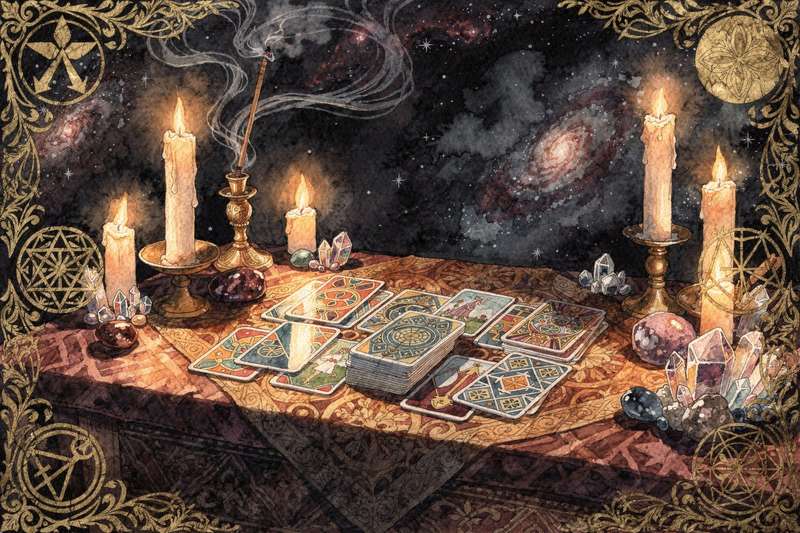
- Physical space: Lay out a tarot cloth, light a candle, burn incense, or place a crystal like clear quartz or amethyst nearby to amplify your focus.
- Mental space: Take three slow, deep breaths. Let your to-do list dissolve for a moment. You are stepping out of ordinary time.
- Emotional space: Release any emotional static from your day. You do not need to be in a perfectly calm state — but you do need to be willing to hear something unexpected.
- Spiritual space: Set a clear intention for the reading. Some readers call in their spirit guides, angels, or simply the energy of their higher self. Whatever feels true to you is the right approach.
This preparation shifts you from distracted and reactive to grounded and receptive — two very different states for reading cards.
Step 2: Get to the Heart of Your Question
The quality of your tarot question shapes everything that follows. Before you shuffle, ask yourself: What do I really need to know right now?
Avoid yes/no or fortune-telling style questions like “Will I get the promotion?” or “Will my relationship work out?” These questions hand your power over to fate and treat the future as fixed. Instead, frame your questions around understanding, growth, and conscious choice.
Instead of: “Will I get the job?”
Try: “What can I do to strengthen my chances of getting this role?”Instead of: “Should I stay in this relationship?”
Try: “What do I need to understand about this relationship right now?”
Empowered questions lead to empowered readings. You have free will — your tarot cards are here to illuminate your path, not walk it for you.
Step 3: Shuffle and Draw with Intention
There is no single correct way to shuffle tarot cards. What matters is that you shuffle with presence. Hold your question in your mind as you move the cards. Some readers shuffle until a card falls out naturally; others cut the deck into three piles and reassemble them. Trust your instincts here — the method that feels right to you is the right one.
When you feel ready, draw your cards. If you are just starting out, a simple three-card spread — Past / Present / Future or Situation / Action / Outcome — is one of the most effective layouts for self-readings.
Step 4: Observe Your First Impressions
Before you reach for your guidebook, look at the cards you drew. What is your gut reaction? What imagery jumps out at you? What emotions surface?
Your first impression — even if it seems irrational — often carries the most potent insight. Tarot speaks in symbols and feelings before it speaks in definitions. Make a mental note of your raw, unfiltered response before layering in any learned meanings.
Step 5: Read the Story the Cards Are Telling
Look at your spread as a whole, not just as individual cards. How do the cards relate to one another? Is there a theme emerging? Are multiple cards from the same suit appearing, suggesting a dominant energy — emotional (Cups), intellectual (Swords), material (Pentacles), or transformative (Wands)?
Consider the numerology within the cards too. A spread full of Aces signals new beginnings; a cluster of high-numbered cards may suggest a situation nearing completion. The tarot is a language, and you are learning to read its sentences, not just its individual words.
Step 6: Connect the Reading to Your Question
Now bring everything back to your original question. How does each card speak to your specific situation? This is where personal tarot readings become genuinely transformative — because only you know the full context of your life. A professional reader gives you interpretation; a self-reading gives you revelation.
Journaling your readings is one of the most powerful habits you can build. Write down the cards you drew, your question, your impressions, and any immediate insights. Over time, your journal becomes a record of your own unfolding — a deeply personal oracle in its own right.
Step 7: Close the Reading with Gratitude
When you feel the reading is complete, take a moment to acknowledge what came through. Thank your higher self, your guides, or simply the quiet wisdom that showed up for you. Ground yourself — drink some water, feel your feet on the floor, take a breath.
Then take one clear, practical action based on what you received. Even the most profound spiritual insight needs a foothold in the real world to become meaningful. What is one small step you can take today based on your reading?
Reading Tarot for Yourself in Love and Relationships
Personal tarot readings shine brightest when applied to matters of the heart — not because the cards will tell you who to love or whether love will last, but because they help you understand yourself within a relationship. The Ace of Cups appearing in a self-reading might point to an openness you have been closing off; The Lovers card may ask you to examine a core value rather than simply predict a romantic outcome.
Use self-readings in love to explore your emotional patterns, your needs, and the energy you are bringing into connection. This is where the heart chakra work of tarot becomes most tangible.
Reading Tarot for Yourself in Career and Finance
For career questions, tarot for yourself works best as a planning tool rather than a prediction machine. Ask what energy surrounds a situation, what you may be overlooking, or what strengths you can draw on. Suit your question to your actual moment — are you at a crossroads, a beginning, or a point of consolidation? The cards will meet you where you are.
Pentacle cards often dominate career spreads, speaking to practicality, resources, and long-term building. Pay attention when Major Arcana cards appear in career readings — they tend to signal turning points that go beyond the practical into the deeply purposeful.
The Spiritual Dimension of Reading Your Own Tarot
At its deepest level, reading tarot for yourself is a spiritual practice of self-inquiry. Each card is a prompt for honest reflection. Archetypes like The High Priestess invite you to trust what you already know; The Hermit asks you to turn inward rather than seek answers outside yourself.
Pairing your tarot practice with crystals such as labradorite for psychic clarity or black tourmaline for grounding can deepen the experience significantly. Aligning readings with moon phases — drawing cards on the new moon for intentions and the full moon for reflection — adds another layer of natural rhythm to your practice.
Your third-eye chakra is the energetic seat of intuition and inner sight — the very faculty that makes self-tarot readings possible. Any meditation or crystal work that supports this center will strengthen your readings over time.
FAQ: Reading Tarot for Yourself
Is it okay to read tarot cards for yourself?
Absolutely — reading tarot for yourself is not only acceptable, it is one of the most powerful ways to use the cards. The key is approaching your reading with openness and a genuine desire for insight rather than seeking confirmation of what you already want to believe.
How do I stop being biased when reading tarot for myself?
Bias in self-readings usually comes from emotional attachment to a specific outcome. To counter this, phrase your questions neutrally, take a moment to breathe and release expectations before drawing, and make a habit of noting your very first impression of each card before applying any personal interpretation.
How many tarot cards should I pull for a self-reading?
A single card pulled with clear intention can be extraordinarily insightful for daily guidance. For deeper questions, a three-card spread — Situation, Action, Outcome or Past, Present, Future — gives you enough context without overwhelming you. Simpler is almost always better when reading for yourself.
How often should I read tarot for myself?
Many experienced readers pull a daily card as a morning ritual, which builds your relationship with the deck and sharpens your intuition over time. For bigger questions, wait until you genuinely feel the need for insight rather than reading out of anxiety or compulsion — the cards speak more clearly when you come to them with real presence.