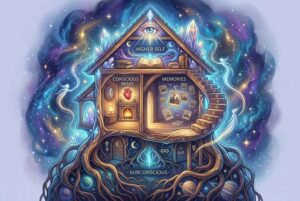
The potential of dream analysis stretches far beyond simple curiosity about symbols or premonitions. Dreams are one of the most direct windows into your subconscious mind — and, according to certain esoteric traditions like Human Design‘s DreamRave framework, they are something even more extraordinary: active programming instructions delivered to your body and psyche every single night.
Most people wake up, leave the dream behind, and get on with their day. But as Ra Uru Hu, the founder of Human Design, once observed with characteristic directness: “You think you wake up in the morning and you leave the dream behind. No, you don’t. It’s your dose for the day.” That shift in perspective — from dream as fleeting memory to dream as active program — is exactly what makes this field worth genuine, unhurried attention.
What Dream Analysis Reveals About Your Inner World
Before arriving at the metaphysical mechanics, it helps to understand what mainstream science and psychology have already confirmed. Dreams are not random noise. During REM (Rapid Eye Movement) sleep, your brain is deeply active — the amygdala fires, emotions are processed, and memories are consolidated. Research in neuropsychoanalysis has shown that dreaming involves complex neural networks responsible for attention, memory, language, and emotional regulation. You are not resting passively during this time. You are working at a level the waking mind rarely accesses.
Sigmund Freud, whose 1900 work The Interpretation of Dreams launched the formal study of dream analysis, proposed that dreams are the “royal road to the unconscious.” He distinguished between manifest content — the dream story you remember — and latent content — the hidden psychological meaning beneath it, shaped by repressed desires and unresolved conflicts. In his view, the dreaming mind transforms uncomfortable material through symbolization, condensation, and displacement, delivering it to you in disguise.
Carl Jung expanded this further, seeing dreams as expressions of the collective unconscious — archetypal stories reflecting your larger soul-level journey rather than purely personal repressions. Neither view is complete on its own, and that is precisely the point: the potential of dream interpretation is genuinely multidimensional, and any single framework will only take you part of the way.
The Spiritual Dimension of Dream Interpretation
Spiritually, dreams have been honored across virtually every tradition on Earth. The Babylonian Talmud states it plainly: “A dream which is not interpreted is like a letter which is not read.” Ancient Egyptians built specific temples for the practice of dream incubation. Indigenous traditions worldwide treated the dream state as a direct line to spirit guides, ancestors, and divine wisdom.
In modern spiritual practice, working with your dreams often involves the following:
- Identifying recurring symbols that carry personal or archetypal meaning unique to your history and psyche
- Tracking emotional tone — the feeling of a dream often carries more truth than the literal imagery
- Noticing synchronicities between dream content and events unfolding in your waking hours
- Working with the third eye chakra and crown chakra, which govern intuition, inner vision, and spiritual receptivity during the sleep state
- Using supportive crystals — amethyst and moonstone have long been placed near the bed to encourage vivid, meaningful dreams and strengthen the bridge between sleeping and waking consciousness
In the tarot, The Moon card speaks directly to this territory — the subconscious realm, hidden truths, and what surfaces in the night hours. The High Priestess governs the inner knowing that arrives outside of logical thought, precisely the kind of intelligence your dreams carry toward you.
Dream Analysis Through the Human Design DreamRave Lens
Here is where things get genuinely radical. In Human Design, the approach to dream analysis — explored through a specialized area of study called the DreamRave — proposes something that most psychological frameworks entirely miss: you are being actively conditioned while you sleep.
Ra Uru Hu described this with notable precision. When you sleep, planetary transits — the ongoing movement of celestial bodies through the 64 Gates of the Human Design system — continue to activate patterns in your BodyGraph. These activations form what he called your “dreaming design”: a set of programming instructions specific to that particular night. The information moves through your genetic chemistry, shaping how your system will respond throughout the following day.
This means the real potential of dream analysis, from a Human Design standpoint, is not primarily about decoding symbols. It is about recognizing the mechanism at work. The question shifts from “what did my dream mean?” to something more grounded and more consequential: how was I programmed last night, and how is that conditioning expressing itself through me right now?
“You think you wake up in the morning and you leave the dream behind. No, you don’t. It’s your dose for the day. It is your programming instructions, literally, for the day.” — Ra Uru Hu
Ra was emphatic about one key danger in this territory: treating dream analysis purely as psychology — as though it is all about personal meaning-making and symbol interpretation — misses the deeper mechanical truth. You are a deeply programmed creature, and the conditioning that occurs during sleep is real and consequential. Recognizing this does not diminish you. It gives you genuine clarity about what is actually moving through you each day, long after the dream imagery has faded.
Positive Meanings in Dream Analysis Practice
When you commit to working consciously with your dreams, remarkable shifts begin to happen. Here are the genuine gifts that dream analysis can open up for you:
- Emotional healing and integration: Research confirms that the dreaming mind processes unresolved emotions, helping to regulate affect and loosen the grip of past experiences on present behavior. Dreams can complete emotional cycles that the waking mind leaves perpetually unfinished.
- Problem-solving: The sleeping brain makes novel connections that analytical waking consciousness often misses entirely. Many people — scientists, artists, and writers among them — have reported creative breakthroughs that arrived fully formed through the dream state.
- Shadow work: Recurring dreams, especially those carrying strong emotional charge, often point toward aspects of the self that are ready for integration. What disturbs or confuses you in a dream is frequently a shadow aspect quietly requesting your full attention.
- Spiritual confirmation: Dreams can arrive as vivid encounters with ancestors, guides, or powerful symbols that align directly with what you have been meditating on or praying about. Many traditions treat these not as fantasy but as genuine contact experiences.
- Tracking your unique conditioning: For those working with the DreamRave, dream analysis becomes a way to map your conditioning patterns night by night, and begin distinguishing what is authentically yours from what was installed through transit activity while you slept.
Warning Signs and Cautions in Dream Analysis
Not everything that surfaces in dream analysis leads toward healing. There are real cautions worth holding in your practice.
The first, as Ra Uru Hu pointed out, is intellectualizing the dream rather than tracking its mechanical impact on your day. If you spend all your energy deciphering symbols, you can miss the way the dream has already moved through your body and shaped your waking state. The programmer and the programmed are what matter most — not only the poetic imagery that accompanies the process.
A second caution relates specifically to trauma. Neuropsychological research has shown that highly traumatic experiences can produce dreams that replay events almost literally rather than symbolically. If your dreams are regularly disturbing, replaying distressing events, or leaving you more anxious upon waking, working with a qualified therapist alongside your spiritual practice is both wise and appropriate.
Third, be cautious of rigid dream dictionaries claiming universal meanings for symbols. Freud himself was deeply skeptical of these. The meaning of any dream symbol is shaped by your unique history, your emotional associations, and the specific transit activations operating during your sleep on that particular night. No dictionary knows you the way your own dreaming mind does.
Common Dream Scenarios and Their Deeper Meanings
- Flying dreams: Often associated with a sense of freedom, expanded perspective, or spiritual transcendence. In esoteric practice, this dream frequently accompanies periods when you are beginning to move beyond old conditioning patterns and access a wider sense of what is possible. It is generally a positive, energizing sign from your inner landscape.
- Being chased: A classic threat-response dream linked to unprocessed anxiety or avoidance. The emotional quality — fear, panic, urgency — is more telling than the identity of the chaser. This dream invites you to look honestly at what you have been suppressing or running from in your waking life.
- Teeth falling out: One of the most widely reported dreams globally. Psychologically linked to anxiety, communication fears, or concerns about self-image and competence. Spiritually, it often signals a transition period — something must fall away before something new can take root.
- Meeting a deceased loved one: Many people describe these as among the most vivid and emotionally moving dreams of their lives, carrying a distinct quality of realness unlike ordinary dreaming. Across spiritual traditions, such encounters are widely regarded as genuine contact experiences. The veil between the living and those who have passed thins noticeably in the dream state.
- Lucid dreaming: When you become conscious within a dream while it is still happening, you enter a fundamentally different state — one where intentional self-observation and directed engagement become possible. In esoteric practice, lucid dreaming is considered one of the most powerful tools for direct communication with the subconscious and for consciously observing your own programming as it unfolds in real time.
What to Do After a Significant Dream
The first and most important step after any meaningful dream is to capture it before it dissolves. Keep a notebook or voice recorder at your bedside and record the dream immediately upon waking — before your phone, before coffee, before any conversation. Dreams fade with extraordinary speed, and the one that felt permanently etched at 3am is often gone entirely by 7am.
Then move through these steps:
- Note the emotional residue first. Before you analyze any content, ask yourself: how do you feel right now, in your body? That emotional tone is often the most honest and direct message the dream has left behind.
- Watch your day unfold. From a Human Design perspective, the dream’s programming will express itself through your waking hours. Notice what triggers you, what draws your attention, where you feel unusual energy or unexpected resistance. That is the dose working its way through your system.
- Look at your Human Design transits. If you work with your chart, check which gates were activated during your sleep period. This can reveal which aspects of your design were most heavily influenced overnight and why certain themes surfaced with such force.
- Draw a tarot card. After a vivid or unsettling dream, pulling a morning card — particularly from the Major Arcana — can help bridge the nocturnal intelligence to your waking understanding. The Moon or The High Priestess appearing here is rarely a coincidence.
- Hold the dream lightly. Not every dream is a prophecy or a directive. Some nights the dreaming mind is simply processing the day’s emotional residue — a completely natural and necessary function. Give yourself permission to note it, feel it, and release it without forcing a grand interpretation.
Dream Journal Prompt
Set aside five quiet minutes — either first thing this morning or before you fall asleep tonight — and write freely in response to this prompt:
“What is my dream life trying to show me that my waking mind keeps moving past? What emotion has appeared most often in recent dreams, and where do I recognize that same emotional quality expressing itself through my days?”
You do not need a complete answer. The act of asking the question sincerely is what opens the channel. Your dreaming mind has been communicating with you every night of your life. Dream analysis is simply the art of learning to listen.
Frequently Asked Questions About Dream Analysis
What is the spiritual purpose of dream analysis?
Dream analysis serves as a bridge between your conscious awareness and the deeper intelligence operating beneath it — whether you understand that as the subconscious mind, the soul, or the cosmic programming of planetary transits. Spiritually, it helps you recognize what has been conditioning your daily experience, provides a space to integrate emotions and receive guidance, and allows you to track your own evolution over time.
How does Human Design approach dream analysis differently from psychology?
Human Design’s DreamRave framework views dreams not as symbolic stories to decode but as evidence of an active programming mechanism operating during sleep. While you rest, planetary transits continue activating gates in your BodyGraph, conditioning your genetic chemistry for the coming day. Ra Uru Hu described this as your daily “dose” — programming instructions that shape how you respond to life long after the dream content itself is forgotten.
Can dreams really predict the future?
Certain traditions and many individuals report genuinely precognitive dreams, and Ra Uru Hu acknowledged this phenomenon as real. More commonly, what feels like a premonitory dream reflects the dreaming mind’s remarkable capacity to synthesize emotional patterns, environmental cues, and transit activations into a coherent forward-looking picture. Understanding which transits operated during your sleep can sometimes allow you to anticipate themes before they fully emerge in your waking day.
How do I begin analyzing my own dreams effectively?
Start with a bedside journal and the daily habit of recording your dreams immediately upon waking, before any other input enters your awareness. Focus first on emotional tone rather than symbols — how the dream felt is often more telling than what literally happened in it. Over weeks and months, patterns will emerge across your entries, pointing you clearly toward the themes your psyche and programming are most persistently working with.