Litha — the Summer Solstice — is the longest, brightest day of the year, and for witches and spiritual seekers of every path, it is one of the most electrically charged moments on the Wheel of the Year. Midsummer magic has been practiced for thousands of years across dozens of cultures: fire leapt over for purification, herbs gathered before dawn for their peak potency, and offerings left at the garden gate for the spirits of the wild. Whether you are a seasoned practitioner or lighting your very first candle, Litha invites you into something ancient and immediate all at once. The sun is at its absolute height. The earth is bursting. And the veil between the everyday world and the world of nature spirits is said to be almost paper-thin. This is the perfect moment to set intentions, release what holds you back, and step fully into your own light.
What Is Litha? The Summer Solstice in Witchcraft
Litha falls on or around June 21 in the Northern Hemisphere (December 21 in the Southern Hemisphere) and marks the peak of the solar year. The word “solstice” traces back to the Latin sol (sun) and sistere (to stand still) — because from our perspective on Earth, the sun appears to pause at its highest point before beginning its slow return southward. In modern Pagan and Wiccan practice, Litha is one of the eight sabbats on the Wheel of the Year, sitting opposite Yule on the wheel.
A common misconception is that Litha is purely a Wiccan holiday invented in the twentieth century. In reality, midsummer celebrations are among the oldest human observances on record — from the Inca festival of Inti Raymi to Norse fire rites to ancient Egyptian star-watching. Modern witches are not inventing something new; they are stepping into a current that has run through human civilization for millennia. You do not need to follow any one tradition to observe Litha. You simply need an open heart and a willingness to honor the sun.
Types of Litha Practice: Many Paths, One Sun
One of the most beautiful things about midsummer magic is that it fits naturally into almost any spiritual framework. Here are a few of the most common approaches:
- Wiccan and Traditional Pagan Litha: Often focuses on the mythic cycle of the Oak King and the Holly King — two divine forces representing the waxing and waning halves of the year. At midsummer, the Holly King defeats the Oak King, and the days begin to shorten. Rituals may honor the God at his peak and the Goddess in her full-mother aspect.
- Eclectic Witchcraft: Pulls from multiple traditions to create a personal solstice ritual. You might blend Norse solar lore, Celtic fairy offerings, and a simple candle spell all in one ceremony. There are no gatekeepers here.
- Kitchen Witch Litha: Centers on the kitchen and hearth — baking sun-shaped breads, brewing mead or herbal teas, and cooking seasonal foods as acts of sacred magic. The meal itself becomes the ritual.
- Hedge Witch or Green Witch Practice: Focuses heavily on herb gathering, plant communion, and working with the spirits of the land. Midsummer is considered the single most potent moment of the year for harvesting magical herbs.
- Secular or Spiritual-But-Not-Religious Celebration: You don’t need to identify as a witch to mark the solstice. Simply sitting with the sunrise, writing in a journal, and lighting a candle with intention is a meaningful way to honor this turning point.
How to Celebrate Litha: Step-by-Step Midsummer Rituals
Step 1 — Set Your Intention Before the Solstice
The days leading up to Litha are ideal for reflection. Ask yourself: What has grown strong in your life since Yule? What do you want to carry forward into the second half of the year? What needs to be released into the fire? Write your answers in a journal. Clear, conscious intention is the foundation of any effective magical practice, and the more honestly you sit with these questions, the more powerful your solstice work will be.
Step 2 — Gather Your Midsummer Herbs
If you have access to a garden, park, or countryside, the morning of the solstice — ideally just before or around sunrise — is considered the peak moment to harvest herbs. Their magical and medicinal properties are said to be at their strongest at this liminal time. Key herbs associated with Litha include St. John’s Wort (solar protection and healing), mugwort (prophetic dreaming and psychic work), yarrow (love and healing), and vervain (purification and spiritual protection). Even if you buy dried herbs from a shop, hold them in your hands, breathe on them, and consciously connect with their energy before using them.
Step 3 — Build or Visualize Your Midsummer Fire
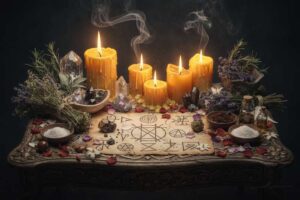
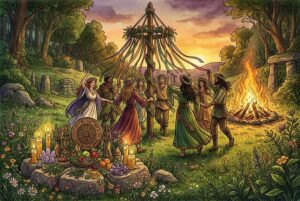
Fire is the heart of Litha. Across Europe and beyond, enormous bonfires were lit on midsummer’s eve to honor the sun, purify communities, and strengthen the coming harvest. If you have outdoor space, even a small fire pit or a terracotta pot with a safe fire will do. If you live in an apartment or cannot have an open flame, a cluster of orange, yellow, and gold candles on your altar works beautifully. The fire is a symbol of the sun brought to earth — treat it with reverence.
Light your fire at sunset on Midsummer’s Eve or at sunrise on the solstice itself. As you do, speak aloud or silently what you are welcoming into your life with the sun’s blessing.
Step 4 — Write and Burn Your Release
On a small piece of paper (biodegradable paper is ideal), write down what you are ready to let go of — a fear, an old story you tell yourself, a relationship dynamic that no longer serves you, a habit. Fold the paper away from you, and when your fire or candle is burning steadily, drop it into the flame. Watch it burn. This is not superstition — it is a physical, embodied act of decision-making. Your nervous system responds to ritual. Something shifts when you see your burden turned to ash.
Step 5 — Leave Offerings for the Spirits of the Land
Midsummer is one of the times when the boundary between our world and the world of nature spirits — sometimes called the Fair Folk, the Hidden People, or simply land spirits — is at its thinnest. This is very different from the thinning of the veil at Samhain, which connects us to ancestors. At Litha, the contact is with wild, elemental intelligence: the spirit of the oak, the river, the hedgerow. Whether you take this literally or as a poetic way of honoring nature, the act of leaving offerings is a beautiful practice. Traditional offerings include a small dish of milk or cream, a spoonful of honey, a piece of bread, or fresh flowers. Leave them at the base of a tree, near running water, or at the edge of your garden. Do not expect anything in return — this is an act of gratitude, not a transaction.
Step 6 — Try a Simple Litha Candle Spell
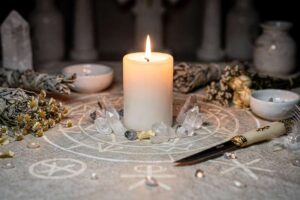
Choose a candle in gold, orange, yellow, or white. Anoint it with a solar oil — sunflower oil, frankincense, or orange essential oil all work well. As you rub the oil from the base to the tip of the candle (drawing energy toward you), speak your intention clearly. Light the candle and sit with it for at least ten minutes, visualizing your intention as already real — feel the warmth of having it, the ease, the joy. Let the candle burn down safely or snuff it (never blow it out, which is said to disperse the energy) and relight it over the following nights until it is finished.
Step 7 — Perform Love or Clarity Divination
Midsummer has long been associated with love divination and glimpsing the future. You don’t need to believe in fate to find this valuable — divination is really a tool for accessing your own intuition. On Midsummer’s Eve, try placing a sprig of dried yarrow under your pillow with the intention of receiving a meaningful dream. Alternatively, sit quietly with a tarot deck, a scrying mirror, or a bowl of water by candlelight. Ask a single question that genuinely matters to you, and trust the images, feelings, or cards that arise. Journal whatever comes immediately afterward.
Step 8 — Spend Time in the Sun
This is the simplest and perhaps most profound Litha practice of all: go outside. Sit in the actual sunlight. Feel it on your skin. Close your eyes and turn your face toward it. In a world where so much spiritual practice has moved online and indoors, this act of direct, physical communion with the solar energy of the solstice is genuinely magical. You are part of the same system as the sun. Let that land.
Step 9 — Close Your Ritual with Gratitude
However elaborate or simple your Litha practice has been, close it consciously. Thank any deities, spirits, or energies you worked with. Thank the sun. Thank yourself for showing up. If you cast a circle, close it. Extinguish candles safely. Ground your energy by eating something — seasonal fruits, honey cake, or whatever feels nourishing — and drink a glass of water. Grounding after magical work is not optional; it brings your energy fully back into your body and the present moment.
Essential Tools and Supplies for Midsummer Magic
You do not need to spend a fortune to celebrate Litha meaningfully. Here are the basics:
- Candles: Gold, orange, yellow, or white. Tealights work perfectly.
- Herbs: St. John’s Wort, mugwort, yarrow, vervain, chamomile, lavender. Dried is fine.
- Crystals: Citrine, sunstone, and carnelian all carry solar energy beautifully. Clear quartz amplifies any intention.
- Essential oils or incense: Frankincense, orange, cinnamon, or rose for your altar or anointing work.
- A journal: For pre-ritual reflection, intention-setting, and recording dreams or divination results.
- Offerings: Honey, milk, flowers, or bread for nature spirits and deities.
- A fireproof dish or cauldron: For safely burning your release paper.
- Seasonal flowers: Sunflowers, marigolds, elderflower, and roses are all traditionally associated with midsummer.
Ethics and Best Practices for Litha Spellwork
Magic is a practice of intention, and intention carries responsibility. A few guiding principles worth holding as you work:
Do not cast spells that remove someone else’s free will. Love spells that target a specific person without their knowledge, binding spells cast in anger, or workings designed to manipulate another’s choices cross an ethical line that most experienced practitioners would counsel against — not because of abstract rules, but because such magic tends to create tangled, unwanted consequences.
Work from clarity, not desperation. The most effective magic is rooted in a calm, clear state. If you are in acute emotional distress, the better practice is grounding, self-care, and journaling first.
Respect cultural practices. Some midsummer traditions — particularly those tied to specific Indigenous or closed religious traditions — are not yours to adopt wholesale. Appreciate, learn, and draw inspiration, but be thoughtful about what you take into your own practice.
Harm to none, including yourself. This means not burning yourself out, not neglecting practical action in favor of magic alone, and not using spiritual practice to bypass genuine healing work.
Common Beginner Mistakes in Litha Practice
- Treating the solstice as just a single day: Litha energy peaks on the solstice but runs for several days before and after. You have a window, not a deadline.
- Overcomplicating your first ritual: A single candle lit with genuine intention is more powerful than an elaborate ceremony performed with a distracted mind. Start simple.
- Skipping the grounding step: Energizing rituals like fire magic can leave you feeling scattered or ungrounded. Always eat, drink water, and take a few slow breaths after working.
- Not writing anything down: Magic worked without a journal is magic half-forgotten. Recording your intentions, experiences, and results is how you learn what works for you.
- Expecting immediate, dramatic results: Spellwork plants seeds. Some intentions manifest quickly; others unfold over months. Patience is not passivity — it is trust.
- Feeling you are doing it wrong: There is no single correct way to celebrate Litha. If something you read doesn’t resonate, leave it. Your practice belongs to you.
How to Build Your Midsummer Practice Over Time
Your relationship with Litha will deepen every year you observe it. In your first year, simply show up — light a candle, go outside at sunrise, write in your journal. In your second year, you might add herb work or a more structured ritual. By your third year, you will likely have developed personal traditions that feel entirely your own.
The Wheel of the Year is a teacher that meets you exactly where you are. Each time the solstice comes around, you are a different person standing in the same light. Notice how your intentions shift. Notice what you are releasing versus what you were releasing two years ago. This is how a practice becomes a genuine spiritual path — not through accumulating more tools or more knowledge, but through showing up, again and again, with honesty and presence.
Final Thoughts on Litha Midsummer Magic
Litha is an invitation. The sun does not ask for credentials before it shines on you. Whether you identify as a witch, a Pagan, a curious seeker, or simply someone who finds meaning in marking the natural cycles of the year, the Summer Solstice belongs to you too. Step into the light. Set your intentions. Leave something at the edge of the garden for the wild things. And trust that the longest day of the year is also, in its own quiet way, the beginning of a beautiful turning.
Frequently Asked Questions About Litha
What is the difference between Litha and the Summer Solstice?
They refer to the same astronomical event — the longest day of the year. “Summer Solstice” is the scientific term, while “Litha” is the name used within modern Pagan, Wiccan, and witchcraft traditions. Not all practitioners use the name Litha; some simply call it Midsummer. The celebration, regardless of name, centers on honoring the sun at its annual peak.
Can beginners practice Litha magic safely?
Absolutely. Litha is considered one of the most accessible sabbats precisely because it is tied to natural, visible phenomena — sunlight, warmth, fire, and growing plants. A beginner can start with something as simple as sitting in sunlight, lighting a candle, and writing their intentions. No advanced training or initiation is required to honor the solstice.
What herbs are used in Litha midsummer magic?
The most traditionally associated herbs include St. John’s Wort for solar protection, mugwort for dreamwork and psychic awareness, yarrow for love and healing, and vervain for purification. Chamomile, lavender, and elderflower are also popular for midsummer workings. Many practitioners gather herbs at sunrise on the solstice, believing this is when their energy is at its strongest.
Do I need to believe in fairies to celebrate Litha?
Not at all. The fairy lore associated with Midsummer can be approached literally, symbolically, or poetically — all are valid. If the idea of nature spirits resonates with you, working with that framework can deepen your practice. If it doesn’t, focus on the solar and fire aspects of Litha instead. The tradition is broad enough to hold many different worldviews.