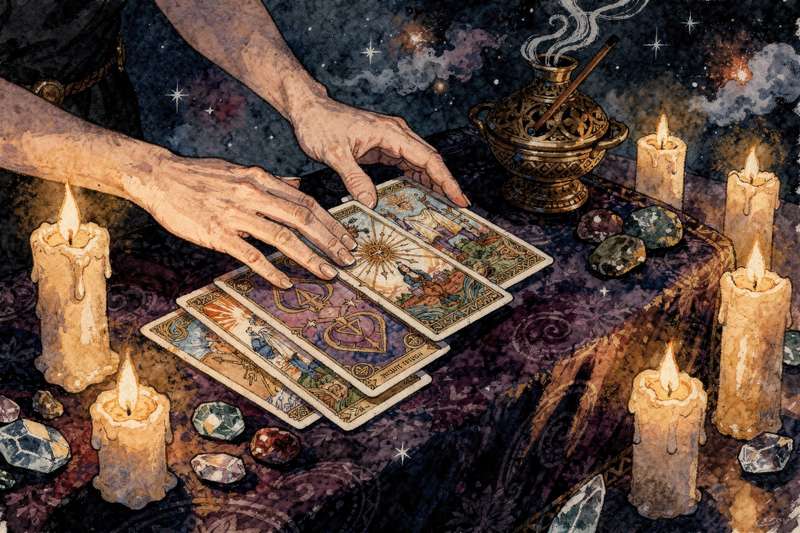
The Practice of Self-Tarot Reading at a Glance
Reading tarot for yourself is a powerful form of self-inquiry that many experienced practitioners consider essential to spiritual growth. Self-tarot reading allows you to access your intuition directly, without the filter of another person’s perspective or bias.
Contrary to outdated myths, you absolutely can and should read tarot for yourself. The practice develops three core skills: recognizing your intuitive voice, trusting your first impressions, and tracking how guidance unfolds over time. When you pull cards for yourself, you’re not predicting a fixed future—you’re entering a conversation with your unconscious mind.
The key difference between effective and ineffective self-readings lies in your approach. Clarity of question, emotional groundedness, and willingness to hear uncomfortable truths determine whether your reading offers genuine insight or merely reflects what you want to hear.
Creating the Right Environment for Your Reading
Before touching your deck, establish a physical and mental space conducive to insight. This doesn’t require elaborate rituals or expensive tools—simple intentionality shifts your awareness from daily concerns to reflective inquiry.
Find a quiet location where interruptions are unlikely. A clean surface, whether a table or floor space, helps you focus. Some readers place a cloth beneath their cards to define the reading space, while others work directly on any surface. What matters is that the environment feels distinct from where you handle mundane tasks.
Take three deep breaths to center yourself. Notice tension in your body and consciously release it. If you’re feeling intensely emotional—anxious, desperate, or euphoric—acknowledge this state. High emotional charge doesn’t prevent reading, but awareness of it helps you interpret cards more objectively.
Optional Elements That Support Focus
- A candle to mark the beginning and end of your session
- Incense or essential oil if scent helps you transition mentally
- A clear quartz or amethyst crystal to hold while formulating your question
- Soft instrumental music if silence feels distracting
Formulating Questions That Yield Useful Answers
The quality of your question determines the usefulness of your reading. Vague or yes-no questions produce equally vague or limited responses. Your question should be specific enough to provide context but open enough to receive unexpected wisdom.
Instead of asking “Will I get the promotion?” which seeks a prediction, try “What do I need to understand about my career advancement right now?” This version invites insight about factors within your control, blind spots, and timing considerations.
Replace “Is this person my soulmate?” with “What does this relationship reveal about my needs and growth?” The second question acknowledges your agency and focuses on self-understanding rather than external validation.
Questions beginning with “What,” “How,” or “Why” typically produce richer readings than those starting with “Will,” “Should,” or “When.” You’re consulting your inner wisdom, not outsourcing your decisions.
Selecting and Working With Tarot Spreads
A spread is simply a pattern that assigns specific meanings to card positions. For self-readings, simpler is usually better. The three-card spread offers remarkable depth despite its brevity.
Try these three-card frameworks depending on your question type:
- Past-Present-Future: Shows trajectory and momentum
- Situation-Challenge-Advice: Illuminates obstacles and paths forward
- Mind-Body-Spirit: Reveals different aspects of your current state
- You-Other Person-Relationship: Clarifies interpersonal dynamics
As your confidence grows, experiment with five-card spreads like the Cross formation (situation, challenge, past influence, near future, outcome) or seven-card layouts. The Celtic Cross, while comprehensive, can overwhelm beginners with too many variables to track simultaneously.
The spread you choose should match your question’s complexity. Don’t use ten cards when three will answer your inquiry completely.
Shuffling and Drawing Your Cards
Hold your question clearly in mind as you shuffle. There’s no mystically correct shuffling method—use whatever technique feels natural and allows cards to mix thoroughly. Overhand shuffling, wash shuffling on the table, or riffle shuffling all work equally well.
Shuffle until you feel an internal sense of completion, which might manifest as a subtle shift in energy or simply knowing you’re ready. Some readers shuffle for a specific count, while others continue until a card falls from the deck.
“Jumper” cards—those that leap out during shuffling—deserve attention. Many practitioners interpret these as particularly significant to your question. Place jumpers aside to examine separately, or include them in your spread if they appear before you’ve drawn all positions.
When drawing, take cards from the top of your shuffled deck, or fan the cards and select those your hand naturally moves toward. Both approaches access intuition. Draw all cards for your spread, placing them face-down in their positions before turning any over. This prevents the first card from influencing your subsequent draws.
Interpreting Cards With Intuition and Knowledge
Flip your cards one at a time. Before consulting any reference material, notice your immediate emotional and physical response. Does the card’s imagery make you feel relieved, anxious, curious, or resistant? This gut-level reaction contains valuable information about the card’s message for your specific situation.
Next, consider the card’s traditional symbolism. If you’re still learning meanings, reference a guidebook or reliable online resource, but don’t let prescribed interpretations override your intuitive hit. The card meanings are frameworks, not rules.
Now integrate the card with its position in the spread. A card suggesting new beginnings means something different in a “past influence” position versus a “near future” spot. Position context shapes interpretation significantly.
Reading Cards in Relationship
After interpreting each card individually, step back and observe the full spread. Look for patterns:
- Dominant suits (many Cups suggest emotional themes, Pentacles indicate material concerns)
- Court card concentration (multiple court cards often point to different aspects of yourself or various people influencing the situation)
- Major Arcana presence (these cards signal significant life themes and soul-level lessons)
- Numerical sequences (consecutive numbers sometimes show progression)
- Visual flow (where are figures looking? Do images seem to interact?)
Cards don’t exist in isolation. The Seven of Cups next to The Tower suggests very different circumstances than the same Seven appearing beside The Star.
Recording Your Reading for Future Insight
Immediately after your reading, while impressions are fresh, document everything in a dedicated journal. Include the date, your emotional state, the exact question asked, the spread used, each card and its position, and your interpretation of both individual cards and the overall message.
This written record serves three purposes. First, it prevents you from unconsciously revising your interpretation later to match outcomes. Second, it reveals patterns in how certain cards speak to you personally over time. Third, it shows how accurately you’re reading guidance, which builds trust in your intuitive abilities.
Return to recorded readings after a week or month. How did the situation unfold? Did unexpected meanings become clear? Were you accurate about timing, or did your hopes color your interpretation? This feedback loop is how self-reading skill develops.
Don’t expect every reading to be profound. Some sessions offer straightforward confirmation of what you already knew, which itself provides value by validating your conscious awareness.
Common Pitfalls in Self-Reading Practice
The primary mistake is asking the same question repeatedly, hoping for a different answer. If you pull cards, dislike the message, shuffle, and draw again, you’re not reading tarot—you’re avoiding truth. Respect your first draw. If the cards seem confusing, sit with that confusion rather than seeking clearer cards.
Another trap is reading only during crisis. Tarot becomes a crutch rather than a tool for growth when you consult cards exclusively in desperation. Regular readings during calm periods build skill and perspective, making crisis readings more accurate because you’ve developed interpretive muscle memory.
Beware of reading when you’re deeply attached to a specific outcome. The stronger your emotional investment in a particular answer, the harder it becomes to interpret objectively. In these cases, consider waiting a day, asking a different question that focuses on your internal state rather than external circumstances, or requesting a reading from a trusted friend.
Finally, don’t mistake the cards for external authority. They reflect your inner knowing back to you—they don’t control your fate. You remain the ultimate decision-maker in your life, regardless of what any spread suggests.
Deepening Your Self-Reading Skills Over Time
Proficiency in self-tarot reading develops gradually through consistent practice. Start with weekly readings using simple spreads, even when no pressing questions exist. Ask “What do I need to know this week?” or “Where should I focus my energy today?”
Study one card deeply each week. Meditate on its imagery, research its symbolism across different tarot traditions, and notice when its themes appear in your daily life. This slow, thorough approach builds fluency faster than trying to memorize all 78 cards simultaneously.
Exchange readings with other learners if possible. Reading for someone else and receiving their reading in return shows you how different perspectives interpret the same cards, which paradoxically strengthens your unique interpretive voice.
Trust builds slowly. Early readings may feel like guesswork, but if you maintain your journal practice, you’ll notice your accuracy improving within three to six months. The cards will begin speaking in your personal symbolic language, and your intuition will grow stronger and clearer.
When to Seek an Outside Reader
Even experienced practitioners occasionally need objectivity they cannot provide themselves. Seek another reader when you’ve asked a question multiple times and can’t accept any of the responses, when you’re emotionally overwhelmed and can’t think clearly, or when you need someone to point out blind spots you’re not seeing.
There’s no weakness in this. Sometimes we’re too close to our situations to read them accurately. An external perspective isn’t superior to self-reading—it’s complementary. Skilled readers use both approaches as situations warrant.
After receiving an outside reading, return to your deck and ask “What do I need to understand about this reading I received?” This integrates external insight with your inner wisdom.
Conclusion
Reading tarot for yourself transforms a card deck into a mirror for self-awareness and a map for personal growth. The practice requires no special gifts—only honesty, consistency, and willingness to hear truths that may challenge your preferences.
Your relationship with your cards will deepen with time. What begins as consulting external symbols evolves into recognizing that the wisdom was always inside you. The cards simply provide structure and language for accessing what you already know.
Begin today with a single three-card spread and an open question. Your intuition is ready to speak—you need only create space to listen.
Frequently Asked Questions
Can reading tarot cards for yourself be accurate?
Yes, self-readings can be highly accurate when you approach them with clear questions, emotional awareness, and honesty about your biases. Keeping a reading journal that you review later proves accuracy over time. The key is respecting your first draw and avoiding re-shuffling to get preferred answers.
How often should I do tarot readings for myself?
Weekly readings during calm periods build skill and intuition more effectively than only consulting cards during crises. Daily single-card draws offer gentle guidance, while deeper spreads work well monthly or when facing specific decisions. Avoid reading the same question repeatedly within short timeframes.
What’s the easiest tarot spread for beginners doing self-readings?
The three-card spread is ideal for learning, offering depth without overwhelming complexity. Try Past-Present-Future for general insight or Situation-Challenge-Advice for specific questions. These simple layouts teach you to read cards in relationship to each other while remaining manageable.
Should I read reversed tarot cards when reading for myself?
Reversed cards are optional, not required. Many experienced readers use only upright positions and find complete meaning in the full 78-card spectrum and card combinations. If reversals feel confusing as a beginner, focus on upright meanings first. You can always add reversals later once your foundation is solid.