
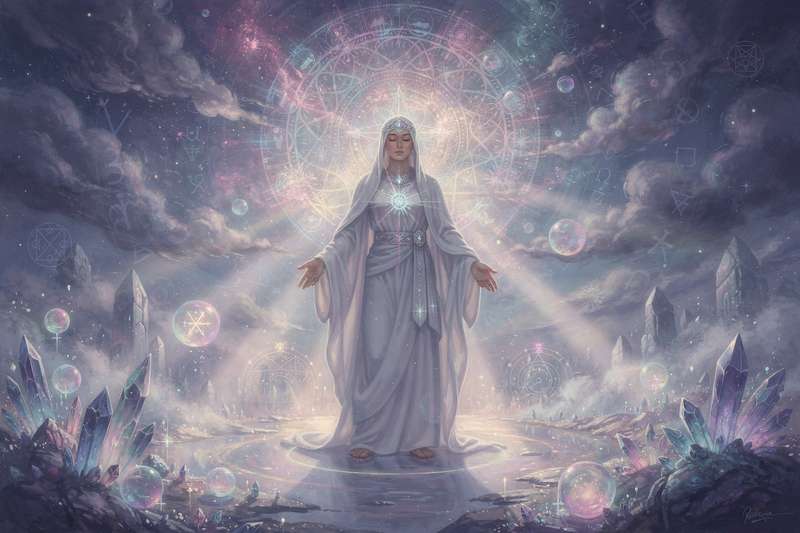
Esoteric symbols in art carry meanings that whisper to the part of you beyond everyday awareness—the intuitive mind that recognizes patterns and truths hidden beneath the surface. When you stand before a painting filled with alchemical emblems, sacred geometry, or mythological figures, you’re not just looking at decoration. You’re encountering a visual language developed over millennia to transmit wisdom that words alone cannot capture. These mystical symbols in paintings serve as bridges between the material and spiritual realms, inviting you to see with more than your physical eyes.
Throughout history, artists have embedded occult symbolism in art to preserve knowledge, communicate with initiates, and encode spiritual teachings. From ancient Egyptian hieroglyphs to Renaissance alchemical imagery, from Kabbalistic diagrams to modern abstract visions, each symbol functions as a key. When you learn to read this language, every gallery becomes a temple, and every canvas becomes a doorway.
What Are Esoteric Symbols in Art?
Esoteric symbols are visual elements that carry layered meanings beyond their surface appearance. Unlike conventional imagery that simply depicts what exists, these symbols point toward what cannot be easily shown—states of consciousness, spiritual principles, cosmic laws, and transformative processes. Sacred geometry art uses mathematical proportions like the golden ratio, spirals, and mandalas to reflect universal patterns found in nature and consciousness itself.
When artists incorporate these elements, they create works that function on multiple levels. A casual viewer might appreciate the aesthetic beauty, while someone familiar with the symbolic vocabulary recognizes deeper teachings. The serpent eating its tail (ouroboros) represents cycles of death and rebirth. The eye within a triangle speaks to divine perception and higher consciousness. A rose with specific petal arrangements encodes spiritual unfolding and the heart‘s journey.
This visual language draws from diverse traditions—Egyptian mystery schools, Greek philosophy, Jewish Kabbalah, Christian mysticism, Islamic sacred geometry, Hindu mandalas, Buddhist thangkas, and indigenous shamanic art. Despite cultural differences, certain patterns recur: the tree as axis between worlds, the circle as wholeness, the cross as intersection of spirit and matter, the spiral as evolution and return.
Historical Streams of Symbolic Art
Ancient civilizations understood that images could transmit knowledge directly to the subconscious. Egyptian temple walls contained hieroglyphs with multiple readings—literal, symbolic, and spiritual. Only initiates trained in mystery schools could decode all layers. Greek philosophers like Pythagoras taught that number and form held divine essence; geometric patterns weren’t mere decoration but revelations of cosmic order.
During the Renaissance, European artists revived interest in Hermetic philosophy, alchemy, and Kabbalah. Painters like Botticelli embedded Neoplatonic concepts in works like “Primavera,” where every flower, gesture, and spatial relationship carries philosophical meaning. Alchemical manuscripts flourished with imagery depicting chemical processes that simultaneously described spiritual transformation—lead into gold mirroring ego into enlightenment.
The 19th century brought Theosophy, Rosicrucianism, and revived interest in Western mystery traditions. Artists began creating work directly inspired by spiritual visions. Swedish painter Hilma af Klint developed abstract compositions years before the movement gained recognition, creating large-scale works based on spiritual communications and cosmological understanding. Her paintings use color, form, and geometry to map invisible realities and evolutionary processes.
The Role of Secret Societies
Freemasonry, Rosicrucianism, and other initiatory orders developed rich symbolic vocabularies visible in their ceremonial spaces and artwork. The square and compass, the blazing star, the checkerboard floor—each element teaches moral and spiritual lessons to members. These symbols occasionally appeared in public art, recognizable to fellow initiates while remaining opaque to outsiders.
This wasn’t about exclusion but about protection. Certain knowledge was considered dangerous or sacred, requiring preparation before understanding. The symbols served as memory devices for initiates and as invitations for seekers ready to pursue deeper studies.
Common Symbols and Their Meanings
Certain images appear repeatedly across cultures and centuries because they tap into archetypal patterns within human consciousness. When you recognize these symbols, you begin reading the hidden text beneath the visible image:
- The Eye: Perception beyond physical sight, divine awareness, the witness consciousness that observes without judgment
- The Serpent: Transformation through shedding old forms, kundalini energy, wisdom, healing, and regeneration
- The Tree: Connection between earth and heaven, the nervous system, family lineage, spiritual growth from root to crown
- The Circle: Wholeness, cycles, eternity, the self, protection, and the infinite nature of consciousness
- The Triangle: Trinity principles (body-mind-spirit, maiden-mother-crone, creation-preservation-destruction), stability, ascension
- The Square: Earth, matter, the four elements, foundation, structure, manifestation
- The Rose: The heart center, spiritual unfolding, beauty emerging from difficulty, divine love
- The Sun: Consciousness, life force, masculine principle, illumination, the true self
- The Moon: The unconscious, receptivity, feminine principle, cycles, intuition, reflection
- The Star: Hope, guidance, divine spark within, aspiration toward higher realms
Understanding these building blocks allows you to decode complex compositions. A painting showing a figure with one hand pointing up and one down (as in the Magician card) teaches “as above, so below”—the hermetic principle that microcosm reflects macrocosm, that spiritual laws manifest in material reality.
Sacred Geometry: Mathematics as Mystical Language
Geometry provides perhaps the most universal symbolic language because mathematical relationships exist independently of culture. When you see the golden ratio (phi) in a composition, you’re witnessing the same proportion that spirals seashells, structures flower petals, and organizes galaxies. Artists use this ratio deliberately to create harmony that resonates with patterns already encoded in your body and perception.
The Flower of Life—a pattern of overlapping circles—appears in temples from Egypt to China. This configuration generates other sacred forms: the Seed of Life, the Tree of Life, the Fruit of Life, and Metatron’s Cube. Each pattern holds geometric keys to understanding creation, dimensionality, and the relationship between unity and multiplicity.
Mandalas use radial symmetry to represent the cosmos and the journey toward center. Whether in Buddhist thangkas, Hindu yantras, or Gothic rose windows, circular compositions with central focus points guide the eye and mind inward. Creating or contemplating mandalas becomes meditation—a practice of recognizing that your center point contains everything, that the periphery always returns to origin.
The Platonic Solids
Five three-dimensional forms can be created using regular polygons: tetrahedron, cube, octahedron, dodecahedron, and icosahedron. Greek philosophers associated these with the elements and with cosmic structure itself. Renaissance artists studying these forms recognized them as fundamental templates underlying visible reality.
When these shapes appear in esoteric art, they reference the building blocks of existence, the mathematical elegance underlying apparent chaos, and the idea that consciousness itself has geometric structure.
How Artists Transmit Spiritual Knowledge
Artists working with esoteric content often describe themselves as channels rather than creators. They receive visions, instructions, or inspirations from sources beyond ordinary consciousness—whether understood as higher self, spiritual guides, or direct perception of non-physical dimensions. The artwork becomes a recording of these experiences, a way to make visible what was witnessed in altered states.
Hilma af Klint worked with a group practicing automatic drawing and spiritual communication. Her abstract compositions predated the official recognition of abstract art as a movement, yet she developed this visual language through meditative practices and spiritual study. Her work maps evolutionary processes, stages of spiritual development, and the relationship between matter and spirit using color theory, geometry, and symbolic forms she developed through years of disciplined practice.
Other artists use psychoactive plants, meditation, breathwork, or intense devotional practices to access non-ordinary states where these symbols and visions arise. The resulting artwork serves multiple functions: personal integration of the experience, transmission of teachings to others, and creation of visual tools that can induce similar states in receptive viewers.
The Viewer’s Role
Esoteric art requires active participation. Unlike entertainment that washes over you passively, symbolic artwork invites contemplation. When you spend time with these images, asking questions, noticing details, feeling into the composition’s energy, you engage in a form of visual meditation. The symbols work on your consciousness whether or not you intellectually understand every reference.
This explains why certain paintings feel powerful or unsettling even when you don’t know the tradition behind them. The forms and colors create specific effects in your energy field, activate particular chakras, or resonate with archetypal patterns in your unconscious. Spending time with sacred geometry can bring clarity and balance. Contemplating alchemical imagery might catalyze transformation in areas of life where you feel stuck.
Color as Symbolic Language
In esoteric traditions, colors carry specific frequencies and meanings beyond aesthetic preference. Artists choose pigments deliberately to invoke particular energies or teachings:
- Red: Life force, passion, root energy, physical vitality, will, blood, sacrifice
- Orange: Creativity, sexuality, pleasure, emotional flow, warmth, sociability
- Yellow: Mental clarity, power, transformation, solar consciousness, joy
- Green: Heart, healing, growth, nature, balance between heaven and earth
- Blue: Truth, communication, peace, higher mind, throat center, devotion
- Indigo: Intuition, third eye, inner vision, mystery, depth
- Violet: Spirituality, crown connection, transmutation, mysticism
- White: Purity, wholeness, all possibilities, divine light, emptiness
- Black: Mystery, void, potential, dissolution, the unknown, fertile darkness
- Gold: Divine consciousness, illumination, incorruptibility, sacred value
Combinations create additional meanings. Blue and gold together evoke heaven and transcendence (seen in countless religious artworks). Red and white speak to the alchemical marriage of opposites. Green and gold suggest natural wisdom recognized as divine.
Alchemical Imagery in Art
Alchemy provides rich symbolic material because it describes transformation at every level—chemical, psychological, and spiritual. Medieval and Renaissance alchemical manuscripts contained elaborate illustrations depicting processes like calcination, dissolution, separation, conjunction, fermentation, distillation, and coagulation. While these could be read as laboratory procedures, initiates understood them as maps of spiritual development.
The Green Lion devouring the sun represents the initial stages where raw nature must consume ego-consciousness. The Chemical Wedding shows masculine and feminine principles uniting. The Phoenix rising from ashes depicts death of the false self and resurrection of the true. The Philosopher’s Stone, goal of the Great Work, symbolizes consciousness perfected, the union of all opposites, enlightenment achieved through integration rather than transcendence.
Contemporary artists working with alchemical themes often explore personal transformation, shadow work, and the integration of rejected aspects of self. The imagery provides a visual vocabulary for processes everyone experiences but struggles to articulate—the death of old identities, the breakdown that precedes breakthrough, the slow refinement that turns suffering into wisdom.
Working With Esoteric Art in Your Spiritual Practice
You don’t need to be an art historian to benefit from symbolic imagery. Consider these approaches for incorporating esoteric art into your path:
Create a visual altar: Select images containing symbols relevant to your current growth edge—a mandala if you’re seeking wholeness, a tree if you’re working on grounding and reaching simultaneously, a serpent if you’re in transformation. Place these where you’ll see them daily. Notice how they affect your awareness over time.
Practice image meditation: Spend 10-20 minutes gazing at a symbolic artwork. Don’t analyze—simply observe. Notice colors, shapes, relationships, feelings that arise. Let the image work on your consciousness without forcing understanding. Insights often come hours or days later.
Create your own symbolic art: You don’t need technical skill. Draw or paint intuitively, allowing symbols to emerge. What shapes want to appear? What colors feel necessary? This practice develops your personal symbolic vocabulary and helps integrate unconscious material.
Journal with images: After viewing esoteric art, write freely about what you noticed, felt, or understood. Sometimes articulating the experience clarifies teachings the artwork carries for you specifically.
Study progressively: Choose one symbol system—Kabbalah, alchemy, sacred geometry, or another—and study it systematically. Learn the traditional meanings, then notice how the symbols appear in your dreams, synchronicities, and daily life once you’ve planted them in consciousness.
Modern Esoteric Artists to Explore
While historical masters provide foundation, contemporary artists continue developing this language for current consciousness:
- Alex Grey: Detailed anatomical paintings showing energy systems, chakras, and the intersection of body and spirit
- Amanda Sage: Visionary artwork depicting consciousness, transformation, and the unity of all life
- Android Jones: Digital sacred geometry and fractal imagery for the modern mystical mind
- Martina Hoffmann: Alchemical symbolism and shamanic journeys rendered in meticulous detail
- Robert Venosa: Biomechanical mysticism blending Giger-influenced forms with spiritual themes
These artists often participate in visionary art festivals, create album covers for consciousness-expanding music, and teach workshops on using art as spiritual practice. Their work bridges traditional symbolism and contemporary experiences, making ancient wisdom accessible through modern visual languages.
Recognizing Esoteric Elements in Museums
Once you develop eyes for symbolic content, even conventional museum visits become treasure hunts. Renaissance religious paintings contain hidden geometry, astrological references, and alchemical codes. Portraits of wealthy patrons sometimes include Masonic or Rosicrucian symbols identifying their affiliations. Landscape paintings may encode spiritual geographies where natural features represent psychological or metaphysical territories.
Look for repeated motifs: pillars (representing the pillars of the Tree of Life or temple entrances), mirrors (self-reflection, the soul), books (hidden knowledge), skulls (memento mori and impermanence), hourglasses (time’s passage), candles (consciousness, life’s flame). Artists included these elements deliberately, creating paintings that functioned as teaching devices for those who could read them.
The Psychological Dimension
Carl Jung recognized that esoteric symbols represented archetypal patterns within the collective unconscious. His studies of alchemy, Gnosticism, and Eastern philosophy informed his understanding that these images arise spontaneously in human consciousness because they map universal psychological processes. The alchemical vessel represents the psyche containing transformation. The union of sun and moon depicts conscious and unconscious integration. The dragon guarding treasure symbolizes the fear that protects but also imprisons authentic self-expression.
When you work with esoteric art, you’re engaging these archetypal layers of your own consciousness. The symbols activate corresponding patterns within, facilitating growth, integration, and wholeness. This explains why contemplating certain images can trigger dreams, insights, or life changes—the visual form touches psychological structures that then reorganize according to healthier patterns.
Distinguishing Authentic Symbols from Appropriation
As esoteric aesthetics gain popularity, not all symbolic imagery carries authentic depth. Some contemporary work borrows visual elements without understanding traditional meanings or personal experience of the states these symbols represent. Discernment helps:
Authentic esoteric art often demonstrates systematic knowledge of a tradition, shows internal consistency in symbol use, and creates a palpable energetic effect beyond mere visual appeal. The artist can articulate what the work means and why specific elements appear. The piece invites contemplation rather than just consumption.
Appropriative work might jumble symbols from unrelated traditions, use sacred images decoratively without respect for their origins, or create superficial “mystical” aesthetics without substance. When symbols become mere style divorced from meaning, they lose transformative power.
Trust your direct experience. Does this artwork open something in you? Does it invite deeper seeing? Or does it feel empty despite surface appeal?
Why This Language Matters Now
In an age of literal thinking and materialist worldview, symbolic literacy offers crucial balance. Not everything that matters can be measured, proven, or explained in linear language. Beauty, meaning, love, consciousness itself—these fundamental experiences require poetic, symbolic, and artistic expression. Esoteric art preserves ways of knowing that complement scientific understanding without contradicting it.
When you develop fluency with symbolic languages, metaphor becomes a tool for navigating complexity. You recognize patterns across different domains—the spiral in galaxies and in personal growth cycles, the tree structure in both biological systems and spiritual maps. This perception sees unity without erasing diversity, finds meaning without imposing rigid dogma.
The symbols also connect you with lineages of seekers across time. When you contemplate the same geometric forms that mesmerized Pythagoras, paint mandalas similar to those created by Buddhist monks, or work with alchemical imagery that absorbed medieval mystics, you join a conversation spanning millennia. The wisdom these forms encode remains relevant because human consciousness, despite surface changes, confronts the same essential questions each generation.
Final Thoughts
Esoteric symbols in art offer a visual language for dimensions of experience that resist ordinary description. Whether geometry revealing cosmic order, alchemical processes mapping transformation, or archetypal images from the collective depths of human consciousness, these forms speak to the part of you that knows without knowing how it knows. As you develop literacy with this language, art becomes medicine, contemplation becomes practice, and beauty reveals itself as a frequency that attunes awareness to finer realities. The symbols wait in museums, books, and galleries—patient teachers offering their lessons to anyone willing to look beyond surface and see.
Frequently Asked Questions
What makes a symbol “esoteric” versus just decorative?
Esoteric symbols carry intentional layers of meaning beyond their visual appearance, often encoding spiritual teachings, philosophical principles, or mystical experiences. Decorative elements please the eye but don’t necessarily point toward hidden knowledge or require initiatory understanding to decode.
Can I understand esoteric art without formal training in occult traditions?
Yes, though depth of understanding grows with study. These symbols often work on intuitive and energetic levels before intellectual comprehension. Your direct experience with an artwork—feelings, insights, or questions it provokes—provides valid entry into its meaning, even without academic knowledge of the tradition behind it.
Why did artists hide spiritual teachings in their work instead of stating them openly?
Historical contexts often made open expression of non-orthodox spiritual ideas dangerous due to religious persecution. Additionally, many traditions believed certain knowledge required preparation—that encountering advanced teachings prematurely could confuse or harm unprepared students. Symbols allowed layered communication: accessible surface meanings for general audiences, deeper teachings for initiates.
How do I start learning to recognize and interpret esoteric symbols?
Begin by choosing one symbol system that interests you—perhaps sacred geometry, alchemical imagery, or a specific tradition’s iconography. Study its core symbols and meanings, then practice spotting them in art, architecture, and nature. Keep a journal noting where symbols appear and what associations arise. Over time, you’ll develop intuitive recognition alongside intellectual understanding.