
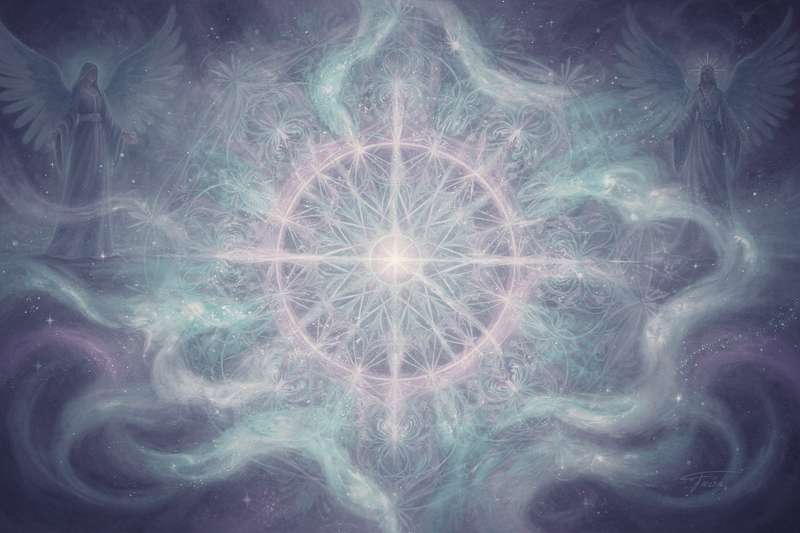
Esoteric symbols for meditation offer a direct pathway to your subconscious mind, where transformation begins. These sacred geometry patterns and spiritual symbols act as focal points that quiet mental chatter and harmonize opposing energies within you. When you meditate on these ancient forms, you’re not just observing shapes—you’re activating archetypal patterns that have guided seekers for millennia.
Unlike breath-focused meditation alone, working with visual symbols engages both hemispheres of your brain simultaneously. This creates a bridge between logic and intuition, masculine and feminine energies, conscious thought and deeper knowing. The result? A meditation practice that feels more anchored, more potent, and more aligned with universal rhythms.
Below, you’ll find a collection of powerful esoteric meditation symbols, each with its own energetic signature. Choose one that calls to you, study its form with open eyes, then close your eyes and recreate it in your mind’s eye. This simple practice can shift your consciousness in profound ways.
Understanding Sacred Geometry as Meditation Focus
Sacred geometry forms the foundation of most esoteric meditation symbols. These aren’t random designs—they’re mathematical blueprints that appear throughout nature, from spiraling galaxies to the cells in your body. When you focus on these patterns, you’re attuning yourself to the underlying order of existence.
The key to working with these symbols lies in sustained attention. Start by gazing at the symbol for several minutes, allowing your eyes to trace its lines and curves. Notice how it makes you feel. Does your breathing slow? Does your mind settle? Then, when you close your eyes, hold that image steady in your inner vision. Don’t worry if it fades or shifts—simply bring it back gently, again and again.
This practice strengthens your concentration while simultaneously dissolving the boundary between observer and observed. You become the symbol, and the symbol becomes a doorway.
Foundational Symbols: Building Blocks of Creation
The Vesica Piscis: Portal of Divine Union
Two circles overlap so that each passes through the center of the other, creating an almond-shaped lens between them. This is the Vesica Piscis, one of the most ancient meditation symbols known to humanity. The two circles represent complementary forces—masculine and feminine, sun and moon, thought and feeling—while the central vesica (Latin for “vessel” or “bladder”) symbolizes the creative void from which all form emerges.
When you meditate on the Vesica Piscis, focus your attention on the very center of that almond shape. This point corresponds to your third eye chakra and represents the marriage of dualities. Many practitioners report experiencing sudden insights or a sense of unity consciousness when working with this symbol regularly.
Hidden within this simple form are other powerful shapes, including multiple hexagrams (six-pointed stars). Each of the two circles contains a hexagram, and their overlap creates a third, smaller hexagram in the central lens. These stars represent the balanced integration of above and below, spirit and matter.
The Triquetra: Triple Intelligence Awakening
Add one more circle to the Vesica Piscis, positioned so all three circles intersect at their centers, and you create the Triquetra. This Celtic-influenced symbol represents the harmony of three essential intelligences: mind, body, and spirit. The central point where all three circles meet becomes a powerful meditation focus for those seeking to integrate these often-fragmented aspects of self.
When you rest your awareness on the Triquetra’s center, you’re inviting all three intelligences to communicate freely. Your logical mind stops dominating. Your body’s wisdom rises. The quiet voice of spirit becomes audible. This balanced state is where intuition sharpens and authentic guidance emerges.
The Seed of Life: Source Energy Connection
Seven circles arranged in a perfect hexagonal pattern—six outer circles surrounding one central circle—form the Seed of Life. This symbol appears in spiritual traditions worldwide, from ancient Egyptian temples to modern ceremonial spaces. The six outer circles can be understood as three pairs representing masculine and feminine principles in equilibrium, while the seventh central circle embodies Source Energy itself.
Meditating on the exact center of the Seed of Life helps you access what mystics call the “origin point of creation.” This isn’t abstract philosophy—many people experience a palpable sense of groundedness and expansiveness simultaneously when focusing here. You feel both deeply rooted and infinitely connected.
Advanced Geometric Meditation Symbols
The Flower of Life: Blueprint of Existence
When you expand the Seed of Life outward, adding more circles in the same overlapping pattern, you eventually create the Flower of Life—a mesmerizing array of nineteen interlocking circles that seems to pulse with life itself. This symbol has been found carved into ancient temples in Egypt, China, and beyond, suggesting its universal recognition as a map of consciousness.
The Flower of Life contains within it the mathematical relationships that govern our physical reality: the Platonic solids, the golden ratio, the structure of DNA. But you don’t need to understand the geometry intellectually to benefit from meditating on it. Simply gazing at this symbol helps dissolve the illusion of separation. The circles flow into one another seamlessly, reminding you that all boundaries are ultimately permeable.
Focus on the very center of the pattern, or allow your eyes to drift across the entire form, noting how each circle contains and is contained by others. This practice cultivates both concentration and expansive awareness—the paradox at the heart of meditation itself.
Metatron’s Cube: Cosmic Order Harmonizer
Derived from the Flower of Life, Metatron’s Cube consists of thirteen circles connected by straight lines, forming a complex three-dimensional lattice. This symbol contains all five Platonic solids—the tetrahedron, cube, octahedron, dodecahedron, and icosahedron—which represent the fundamental building blocks that shape physical reality.
Meditating on Metatron’s Cube brings a quality of sacred order to your inner landscape. If your thoughts feel chaotic or your emotions scattered, this symbol acts as a crystallizing force. Focus on its central point and imagine divine geometry reorganizing the energies within your body, clearing blockages and restoring flow. Many energy workers use this symbol specifically for clearing and protecting their energetic field.
The Sri Yantra: Cosmic Womb Activation
Nine interlocking triangles radiate from a central point called the bindu in this ancient Tantric symbol. Five triangles point downward, representing Shakti (divine feminine energy), while four point upward, representing Shiva (divine masculine consciousness). Their geometric interaction creates forty-three smaller triangles, all emanating from and returning to that single bindu at the center.
The Sri Yantra is considered one of the most powerful meditation tools in the yogic tradition. When you focus on the bindu—that tiny dot at the heart of the pattern—you’re connecting with what tantrics call the “cosmic womb,” the creative source from which all manifestation springs. This practice can awaken dormant energies within your subtle body and accelerate spiritual development. Approach it with reverence and consistent practice.
Symbols of Balance and Protection
The Yin Yang: Dancing Opposites
Perhaps the most recognizable symbol of balance, the Yin Yang depicts two teardrops swirling together, one black with a white dot, one white with a black dot. This Taoist emblem reminds us that light contains darkness and darkness contains light—that opposites are not enemies but dance partners in an eternal cosmic rhythm.
The center point between the two swirls is called Wu Ji, the “point of stillness” or “supreme ultimate emptiness.” Meditating on this point helps you stop resisting the dual nature of existence. You learn to honor both your active and receptive sides, your strength and vulnerability, your knowing and not-knowing. Peace arises not from eliminating one side of the equation but from embracing both.
The Hexagram: Divine Equilibrium
Two equilateral triangles overlapping to form a six-pointed star—this hexagram appears in numerous spiritual traditions, from Jewish mysticism (as the Star of David) to Hindu yantra practice. The upward-pointing triangle represents ascending spiritual aspiration, while the downward-pointing triangle symbolizes descending divine grace. Their intersection marks the human heart, where heaven and earth meet.
When you meditate on the hexagram’s center, you’re affirming your role as a bridge between realms. You’re neither purely spiritual nor purely physical, but a conscious integration of both. This symbol helps balance your root chakra with your crown chakra, grounding celestial insights into embodied wisdom.
The Solar Cross: Cosmic Rhythm Alignment
One of humanity’s oldest spiritual symbols, the Solar Cross consists of a circle divided into four equal quadrants by a vertical and horizontal line. It represents the four cardinal directions, the four seasons, the four elements (earth, water, fire, air), and the four phases of any cycle (birth, growth, decline, death/rebirth).
Meditating on the Solar Cross attunes you to natural rhythms. Modern life often disconnects us from these cycles, leaving us feeling unmoored and exhausted. Focusing on this simple, elegant symbol reminds your nervous system that everything has its season. Rest follows action. Darkness follows light. Holding this awareness in meditation brings a quality of patience and trust to your life.
Working with Mandalas and Circular Patterns
Mandalas are circular geometric designs that radiate from a central point, often featuring symmetrical patterns, repeated motifs, and layers of increasing complexity. The word “mandala” comes from Sanskrit, meaning “circle” or “sacred space.” In Tibetan Buddhism, creating and meditating on mandalas is a core spiritual practice.
What makes mandalas particularly powerful for meditation is their structure: they have a clear center and expand outward in organized layers. This mirrors the process of consciousness itself—moving from a still point outward into the complexity of experience, then returning to center again. When you meditate on a mandala, let your eyes travel from the outer edge inward, spiraling toward the center. Then reverse the process, moving from center outward. This back-and-forth trains your mind to expand and contract with grace.
You can meditate on traditional Buddhist or Hindu mandalas, or work with simpler circular patterns like the Torus—a donut-shaped field that represents the self-sustaining flow of energy found in everything from atoms to galaxies to the human aura. Visualizing your own energetic field as a torus helps you align with universal flow and feel the continuous circulation of life force through your being.
Protective and Intuitive Symbols
The Shaman’s Eye: Inner Vision Strengthener
This Native American symbol consists of interwoven lines forming a diamond shape with an eye at the center. It represents the ability to see beyond surface appearances into the deeper truth of any situation. Meditating on the Shaman’s Eye strengthens your intuition and helps you trust your inner knowing even when external voices contradict it.
If you’re working on developing psychic abilities or simply want to hear your own guidance more clearly, make this symbol your meditation focus for at least a week. Place an image of it at eye level, light a candle, and spend ten minutes daily gazing at it, then closing your eyes and recreating it internally. Notice what insights arise in the days following this practice.
The Witch’s Knot: Boundary Protection
Four interlocking loops forming a square shape characterize the Witch’s Knot, a symbol used for centuries in European folk magic for protection. The continuous line that creates these loops represents the unbroken flow of personal power and the importance of clear energetic boundaries.
When you meditate on the Witch’s Knot, you’re affirming your right to discern what energies you allow into your field and what you deflect. This isn’t about building walls—it’s about strengthening your capacity to stay centered in your own truth regardless of external pressure. If you tend toward codependency or energy depletion around others, this symbol can be particularly helpful.
How to Begin Your Symbol Meditation Practice
Starting a meditation practice with esoteric symbols doesn’t require special training or initiation. The symbols themselves will teach you. However, these practical steps can help you establish a consistent and effective practice:
- Choose one symbol to work with for at least a week. Jumping between symbols daily prevents the deep attunement that develops through repetition. Select a symbol that genuinely calls to you, not necessarily the most complex or “powerful” one.
- Print or draw the symbol clearly. You need a physical reference point, at least initially. Place it at eye level where you’ll meditate, ensuring good lighting so you can see details clearly.
- Begin with open-eye gazing. Spend 3-5 minutes simply looking at the symbol with soft focus. Don’t strain or analyze—just observe. Notice the shapes, lines, negative space. Let the form imprint on your consciousness.
- Close your eyes and recreate the symbol internally. This is the core practice. See the symbol in your mind’s eye with as much clarity as possible. When it fades (and it will), simply open your eyes, look again, close them, and continue. This trains both concentration and visualization.
- End with a gratitude moment. Before opening your eyes and moving on with your day, take a breath and silently thank the symbol for its teaching. This simple act closes the practice with intention and honors the exchange.
As your practice deepens, you may begin to see your chosen symbol throughout your day—in patterns on walls, in natural formations, in dreams. This is a sign that the symbol’s frequency is integrating into your consciousness. Stay with it. The most profound shifts often happen just when you think “nothing is happening.”
Common Questions About Symbol Meditation
Do I need to understand the symbol’s meaning to benefit from meditating on it?
No. While intellectual understanding can enhance your practice, the symbols work on a subconscious level regardless of your conceptual knowledge. Your deeper mind recognizes these archetypal patterns instinctively. Trust the process and let meaning reveal itself through experience rather than study alone.
Can I meditate on multiple symbols in one session?
It’s better to focus on one symbol per session, especially when beginning. Each symbol carries a distinct vibration and teaches specific lessons. Mixing them creates energetic confusion rather than clarity. Once you’re experienced, you might explore how symbols relate to each other, but start simple.
How long should I meditate on a symbol before switching to a different one?
At minimum, work with a single symbol for seven consecutive days. Many teachers recommend 40 days with one symbol to allow full integration. You’ll know it’s time to move on when the symbol feels complete—when you can visualize it easily and the insights have plateaued.
What if I can’t visualize the symbol clearly with my eyes closed?
This is completely normal and doesn’t indicate failure. Visualization is a skill that strengthens with practice. Keep alternating between open-eye gazing and closed-eye attempting. Even if you only “sense” the symbol rather than “see” it clearly, the practice is working. Some people are more kinesthetic than visual, and that’s perfectly fine.
Final Thoughts
The esoteric symbols you’ve encountered here represent thousands of years of accumulated wisdom. They’ve guided mystics, shamans, yogis, and seekers through the inner territories of consciousness. Now they’re available to you, not as museum pieces but as living tools for transformation.
Your relationship with these symbols will be unique. The Flower of Life might speak to your friend differently than it speaks to you. The Vesica Piscis might unlock something in you today that it didn’t touch last year. This is the beauty of symbol work—it meets you where you are and grows with you.
Start small. Choose one symbol. Set aside ten minutes daily. Approach the practice with curiosity rather than expectation. Over time, you’ll notice shifts—more mental clarity, stronger intuition, a sense of being aligned with something larger than your individual concerns. These symbols don’t create change through force. They create change through resonance, by reminding your consciousness of patterns it has always known.
The practice is yours now. The symbols await your attention.
Frequently Asked Questions
What are esoteric symbols for meditation and how do they work?
Esoteric symbols for meditation are sacred geometric patterns and spiritual designs that serve as focal points during contemplative practice. They work by engaging your subconscious mind directly, bypassing mental chatter and activating archetypal patterns that harmonize opposing energies within you.
Which meditation symbol is best for beginners?
The Yin Yang or a simple mandala are excellent starting points for beginners. These symbols are visually clear, culturally familiar, and their meanings are intuitive, making them easier to hold in your mind’s eye during early visualization practice.
How long should I meditate on a sacred geometry symbol?
Begin with 5-10 minutes per session, spending at least seven consecutive days with the same symbol before switching. Many experienced practitioners work with a single symbol for 40 days to allow deep integration and full energetic attunement.
Can symbol meditation help balance my chakras?
Yes, many esoteric meditation symbols correspond to specific chakras and energy centers. The Vesica Piscis connects with the third eye chakra, while the hexagram helps balance root and crown chakras by integrating earthly and spiritual energies simultaneously.