Sun-Moon aspects in astrology represent one of the most revealing conversations happening within your birth chart. These powerful connections between your conscious will (Sun) and emotional nature (Moon) shape how you experience the fundamental tension between what you want and what you need. When you understand your Sun-Moon aspect, you gain clarity about why certain decisions feel effortless while others create internal conflict, and why your energy fluctuates in patterns that seem connected to something deeper than circumstance.
The Sun represents your core identity, ego, and life force—the part of you that takes action and pursues goals. The Moon governs your emotional responses, instincts, and subconscious patterns—the part of you that seeks comfort and security. The aspect these two luminaries form in your natal chart reveals whether these fundamental drives work in harmony or create friction in your daily experience.
What Sun-Moon Aspects Reveal About Your Inner World
Every aspect between the Sun and Moon tells a story about integration. When these two luminaries connect in your chart, they describe how well your rational mind and emotional body communicate with each other. This isn’t just theoretical astrology—you live this dynamic every day when you make choices about relationships, career moves, or even simple decisions like whether to stay home or go out.
The aspect formed between your Sun and Moon also reflects the messages you absorbed from parental figures during your formative years. Even siblings raised in the same household often develop different Sun-Moon aspects because each child internalizes parental dynamics in unique ways. One child might perceive their parents as a united team (conjunction), while another experiences them as representing opposing values (opposition). What matters isn’t the objective reality of your childhood, but rather how you perceived the expectations placed upon you.
This subjective imprint creates lasting patterns in how you approach life’s challenges. If your Sun and Moon received harmonious messages early on, you likely find it easier to satisfy both your ego needs and emotional requirements without feeling torn. If they received conflicting messages, you may experience a persistent sense that fulfilling one part of yourself comes at the expense of another.
The Five Major Sun-Moon Aspects and How They Shape You
Sun Conjunct Moon (New Moon Birth)
If you were born with the Sun and Moon in conjunction—often called a New Moon birth—you possess remarkable focus and clarity about your direction in life. Your wants and needs align naturally, which gives you a decisiveness that others may find enviable or, occasionally, a bit overwhelming. You don’t typically agonize over options because you have an intuitive sense of what serves you.
This aspect creates a “double dose” of whatever sign your luminaries occupy, amplifying its qualities throughout your personality. You’re subjective rather than conflicted, able to trust your gut and move forward without second-guessing. People often describe you as straightforward—what they see is what they get. You have strong instincts about people and situations, reading the emotional temperature of a room with ease.
The challenge with this aspect is that you may not naturally understand why others struggle so much with decisions. Your internal dialogue is relatively uncomplicated, which can make it difficult to empathize with those who experience more inner conflict. You’re also a creature of habit, deeply attached to your heritage and the familiar. Change doesn’t come easily when your emotional nature and conscious will are so tightly bound together.
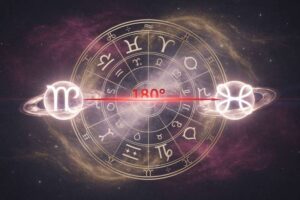
Sun Opposite Moon (Full Moon Birth)
Born under a Full Moon, you carry an awareness of duality that permeates your entire experience. You constantly see both sides of every situation, which makes you fair-minded and objective but also prone to indecision. When you commit to one path, something within you immediately pulls your attention to the alternative. “But what if…” and “on the other hand…” become recurring themes in your internal dialogue.
Your vitality fluctuates more dramatically than most people’s. You might power through a week of intense productivity, then find yourself unable to muster motivation the following week. This isn’t laziness—it’s the natural rhythm of someone whose conscious will and emotional needs are pulling in opposite directions. Learning to honor both phases without judgment becomes essential for your wellbeing.
Early in life, you likely received contradictory messages from parental figures about what was expected of you. Perhaps they represented fundamentally different values, or you perceived their desires for you as incompatible. This created an internal split between ego satisfaction and emotional fulfillment—when you feed one, the other feels neglected. Your growth involves learning to integrate these opposing forces rather than constantly choosing between them.
Sun Square Moon (Quarter Moon Birth)
The square aspect creates friction between your Sun and Moon, manifesting as internal tension that drives you toward action. You feel a persistent restlessness, a sense that something needs to change or be resolved. Unlike the opposition, where you see both sides clearly, the square creates blind spots—you may struggle to understand why satisfaction feels so elusive.
This challenging aspect often indicates that parental figures sent mixed signals that weren’t quite opposite but definitely didn’t align. You may have felt that meeting one parent’s expectations meant disappointing the other, or that your own needs were somehow at odds with what was required of you. This creates a pattern where fulfilling your ego’s desires feels emotionally uncomfortable, or vice versa.
The gift hidden within this tension is motivation. People with harmonious Sun-Moon aspects sometimes lack the drive to push through obstacles because inner peace comes more easily. You, however, have an engine of creative tension that propels you toward growth. Once you learn to work with this friction rather than against it, you discover tremendous capacity for achievement.
Sun Trine Moon
With the Sun and Moon in a flowing trine aspect, you experience a natural harmony between what you want and what you need. Your ego and emotions collaborate rather than compete, allowing you to pursue goals without the internal resistance that plagues harder aspects. You have an easier time finding satisfaction because these two fundamental drives complement each other.
This doesn’t mean you’re lazy or unmotivated—quite the opposite. When your inner world isn’t constantly at war with itself, you have more energy available for external pursuits. You tend to be emotionally stable, with fewer dramatic mood swings than those born under challenging lunar aspects. Others may perceive you as lucky or naturally gifted, not realizing that your real advantage is internal coherence.
The main challenge with this easy aspect is that you might not develop the same depth of self-awareness that comes from struggling with inner conflict. Because things flow relatively smoothly, you may not feel compelled to examine your motivations or emotional patterns as closely. Conscious development requires deliberately creating the introspection that others are forced into by their charts.
Sun Sextile Moon
The sextile creates opportunity for harmony between your Sun and Moon, but unlike the trine, it requires conscious activation. You have the potential for easy integration between ego and emotion, but you need to recognize and use these opportunities when they arise. This aspect gives you options rather than guarantees.
You likely received generally positive but not identical messages from parental figures. They may have complemented each other’s approaches rather than perfectly aligning, giving you a sense that different parts of yourself could coexist peacefully. You’re adaptable, able to shift between your Sun’s goals and your Moon’s needs without too much internal drama.
The key with the sextile is active engagement. You have natural talents for emotional intelligence and self-awareness, but they blossom when you deliberately cultivate them. Taking time to check in with both your rational mind and emotional body, then finding ways to honor both, allows this aspect to function at its highest potential.
How Sun-Moon Aspects Influence Your Relationships
Your Sun-Moon aspect profoundly affects how you show up in partnerships. If you have a harmonious aspect, you likely seek partners who enhance your existing sense of wholeness. You’re looking for complement rather than completion because you already experience reasonable integration within yourself.
Those with challenging aspects often unconsciously seek partners who represent the missing piece—someone who embodies either the solar or lunar qualities they struggle to integrate. A person with Sun square Moon might attract partners who are emotionally expressive (if their own Moon is suppressed) or action-oriented (if their Sun is compromised). These relationships can feel intensely magnetic because the other person carries something you need to develop within yourself.
Understanding your Sun-Moon aspect helps you recognize when you’re projecting your internal dialogue onto your relationships. If you find yourself constantly torn between what your partner wants and what you want, your chart might be mirroring an internal split between Sun and Moon. The relationship becomes the stage where your inner drama plays out—which means real resolution requires internal work, not just relationship negotiation.
Working Consciously with Your Sun-Moon Aspect
Regardless of which aspect you were born under, awareness transforms it from an unconscious pattern into a conscious tool. Here are practices tailored to each aspect:
For Conjunctions:
- Practice considering perspectives outside your immediate instinct—your clarity is a strength, but actively seeking other viewpoints prevents tunnel vision
- Journal about moments when your usual decisiveness fails you, as these instances reveal hidden complexities worth exploring
- Create space for emotions that don’t immediately lead to action, allowing your Moon to speak without your Sun rushing to respond
For Oppositions:
- Set designated times for decision-making rather than allowing the back-and-forth to continue indefinitely—your gift is seeing both sides, but you also need to practice choosing
- Track your energy cycles to identify patterns, then honor both your high-energy and rest phases as equally valuable
- Find physical practices that help integrate opposites, such as yoga or tai chi, which teach you to hold tension mindfully
For Squares:
- Channel your internal friction into creative outlets—this aspect generates tremendous energy that needs expression
- When you feel stuck, ask yourself which part is speaking: your ego’s agenda or your emotional needs? Then find ways to acknowledge both
- Reframe your restlessness as a catalyst rather than a problem; you’re built for dynamic growth rather than static peace
For Trines and Sextiles:
- Deliberately create challenges for yourself to prevent complacency—your ease can become a trap if you never stretch beyond your comfort zone
- Use your natural harmony to help others integrate their own contradictions, becoming a mediator or counselor
- Practice gratitude for your inner peace while staying curious about the depth that difficulty can bring
Common Misconceptions About Sun-Moon Aspects
- Misconception: Challenging aspects are “bad” and harmonious aspects are “good” — Reality: Every aspect offers both gifts and challenges. Difficult aspects create motivation and depth, while easy aspects provide stability that can lead to complacency.
- Misconception: Your Sun-Moon aspect determines your relationship success — Reality: It influences your internal dynamics, which affects relationships, but conscious awareness allows you to work with any aspect successfully.
- Misconception: Sun conjunct Moon people are simple or one-dimensional — Reality: They have focused clarity, not lack of depth. Their singleness of purpose is sophisticated, not simplistic.
- Misconception: Sun opposite Moon people are unstable or unreliable — Reality: They’re aware of complexity in ways others miss. Their fluctuations reflect genuine engagement with multifaceted reality.
- Misconception: You need to “fix” your Sun-Moon aspect — Reality: Your aspect is a permanent feature of your cosmic blueprint. The goal is integration and conscious expression, not elimination.
- Misconception: Siblings should have similar Sun-Moon aspects since they share parents — Reality: Each child perceives and internalizes parental dynamics differently, creating unique Sun-Moon relationships even within the same family.
Your Sun-Moon Aspect as a Lifelong Teacher
Your Sun-Moon aspect is one of the first patterns you’ll recognize once you begin studying your birth chart with real attention. Unlike slower planetary movements that shift throughout your life, this aspect represents a constant—a fundamental tone that colors your entire experience from birth until your last breath.
Think of it as your internal weather pattern. Some people are born with mostly sunny skies (trine), others with regular storms that clear the air (square or opposition), and still others with conditions that shift based on which way the wind blows (sextile). None of these patterns is superior. Each creates its own landscape of possibility.
The most powerful shift happens when you stop judging your aspect as good or bad and start working with it as information. When you understand that your indecision (opposition) or your intensity (square) or your need for partnership (conjunction) isn’t a flaw but a feature, you can design a life that works with your wiring rather than against it.
Your chart isn’t a life sentence—it’s a user manual. The Sun-Moon aspect is one of its most important chapters, revealing how to navigate the daily negotiation between who you’re becoming (Sun) and who you’ve always been (Moon). Read it carefully, and you’ll find that much of what seemed like personal failure was simply you trying to override your cosmic design.
Final Thoughts
The conversation between your Sun and Moon is the most intimate dialogue in your chart—a constant negotiation between the self you present to the world and the self you know in solitude. Understanding this aspect doesn’t eliminate its challenges or diminish its gifts. Instead, it gives you the awareness to work consciously with your fundamental nature rather than fighting against it.
Whether your luminaries dance in harmony or generate creative tension, they’re working together to make you precisely who you are. Your task isn’t to change this cosmic conversation but to listen to it with compassion and curiosity, allowing both voices their full expression. When you honor both your Sun’s drive and your Moon’s needs, you step into the wholeness your birth chart has always held as possible.
Frequently Asked Questions About Sun-Moon Aspects
What does it mean if I don’t have a Sun-Moon aspect in my chart?
If your Sun and Moon don’t form a major aspect (conjunction, opposition, square, trine, or sextile), it means these two parts of your psyche operate more independently. You may find it easier to compartmentalize your emotional needs and ego drives, accessing each without much interference from the other. This can feel liberating but may also require conscious effort to integrate these separate parts of yourself.
Can my Sun-Moon aspect change throughout my life?
No, your natal Sun-Moon aspect remains constant throughout your life—it’s determined by the exact positions of the Sun and Moon at your birth moment. However, transiting planets can temporarily activate or challenge your natal aspect, bringing its themes into sharper focus during specific periods. Your experience and understanding of the aspect will definitely evolve as you mature.
Which Sun-Moon aspect is most common?
Because the Moon moves quickly through the zodiac (completing a full cycle in about 29.5 days), all aspects occur with roughly equal frequency over time. However, conjunction and opposition are each only possible during narrow windows (around the New Moon and Full Moon respectively), while trines, squares, and sextiles have slightly broader orbs of possibility.
Do Sun-Moon aspects affect compatibility with a partner?
Yes, but indirectly. Your Sun-Moon aspect shapes how you integrate masculine and feminine energies within yourself, which influences what you seek in partnership. Someone with a harmonious aspect may need less from a partner in terms of balancing their internal dynamics, while someone with a challenging aspect might unconsciously seek a partner who represents their disowned solar or lunar qualities.