What Is Tasseography and Why You Should Try It
Tasseography, also called tasseomancy, is the ancient art of reading tea leaves—and sometimes coffee grounds—to gain insight into your life and future. This practice stretches back centuries across Asia, the Middle East, Ancient Rome, and Greece. When tea arrived in Europe during the 17th century, it became wildly popular among fortune tellers and seekers alike. Today, you can use it as a personal practice that combines intuition, creativity, and self-reflection.
Beyond fortune-telling, tea leaf reading is genuinely powerful for connecting with your inner wisdom. It quiets your mind, honors your intuition, and gives you space to listen to what you already know deep down. Whether you read your leaves every morning or once a month, this practice helps you start from a centered, grounded place.
Setting Up Your Tea Leaf Reading Practice
You don’t need special equipment, but a few thoughtful choices will enhance your experience. Gunpowder green tea or other loose-leaf green teas work best because they unfurl beautifully and create detailed images in your cup. Black tea also works well; some people even use coffee grounds, though they can be trickier to interpret.
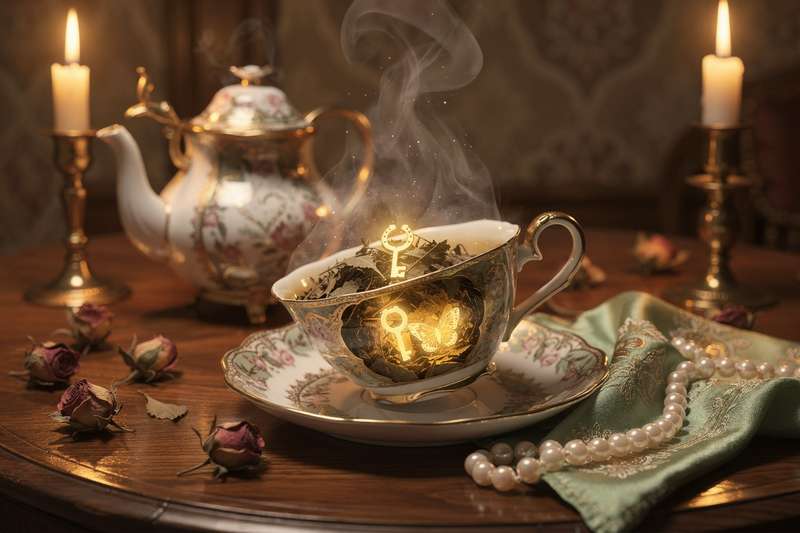
Your cup matters too. Choose one that’s light-colored or plain so the leaves show clearly against it. A traditional teacup with sloped sides works better than a flat mug because the leaves stick to the sides and create readable patterns. Many readers dedicate a special cup just for this purpose, which adds intention and meaning to each reading.
The ritual itself is simple: brew your tea, let it steep a few minutes, then drink it slowly while holding a question or intention in your mind. Drink until about a teaspoon of liquid remains at the bottom. Ground yourself with deep breaths, clear your mind, and invite any guides or your own intuition to help you.
The Tea Leaf Reading Process
Once you’ve finished drinking, it’s time to reveal the symbols. Swirl your cup three times counterclockwise with your non-dominant hand, flip it onto the saucer, and turn it clockwise three times—or tap the bottom three times. This action releases the leaves and settles them into their final positions. Do whatever feels right to you; the ritual is personal.
Now flip the cup back over and examine it clockwise, starting with the handle pointing toward you. This is when the symbols begin to reveal themselves.
Understanding Cup Sections and Timing
The cup is divided into three areas, each representing different timeframes:
- Top outer rim: Immediate future (within the next few days)
- Middle section: Near future (roughly one to two weeks)
- Bottom: Distant future (one month or more ahead)
Some readers use the opposite interpretation—bottom as immediate, top as distant. What matters is that you decide which system resonates with you and stick with it. Announce your chosen layout before you begin, and the symbols will align with your intention.
Common Tea Leaf Symbols and Their Meanings
When you first look at your cup, pause and notice what jumps out immediately. Often your first instinct is the most accurate. As you rotate the cup slowly and let your eyes adjust, shapes will become clearer. Trust what you see—there’s no overthinking in tasseography. With practice, you’ll read faster and with more confidence.
Animal Symbols
Animals carry universal meanings that resonate across cultures:
- Birds: Freedom, travel, news arriving soon, or messages coming your way
- Fish: Luck, abundance, and good fortune
- Elephant: Good health, strength, longevity, and solid foundations
- Bee: Busy season ahead, productivity, and teamwork
- Butterfly: Transformation, fate, change, and personal evolution
- Cat: Secrets about to surface, intuition, or hidden truths coming to light
- Dog: Loyal friendship, protection, and trustworthy people entering your life
- Angel: Divine protection, spiritual guidance, and being watched over by higher forces
Pay attention to the animal’s position in the cup. An animal near the rim suggests something happening soon; one deeper in the cup points to developments further away.
Heart Shapes
A heart is unmistakable—a soft, rounded curve sometimes bisected by a line or dot. Hearts signal love, affection, deep connection, or something that matters greatly to you. If the heart hides deep in the foam or sediment, the feeling may be secret, private, or something you haven’t yet acknowledged. A heart near the rim suggests love or important relationships are about to shift or become more visible. Hearts always carry positive, tender energy.
Lines and Bars
Straight lines represent journeys, change, or clear direction. A thin line can symbolize a boundary or separation—something you’ve set apart or distinguished from other areas of your life. A thick, bold line suggests strength, decisiveness, and firm resolution. Pay attention to the line’s direction: vertical lines often point upward, suggesting growth or elevation; horizontal lines can indicate stability or a plateau. Lines crossing or intersecting may show decisions, crossroads, or multiple influences coming together.
Circles and Dots
Circles represent wholeness, completion, cycles, and unity. A perfect circle suggests something coming full circle or reaching resolution. Dots scattered throughout your cup often indicate blessings, opportunities, or small but meaningful moments accumulating. Clusters of dots may show abundance or a period of activity and movement.
Triangles
Triangles point toward change, growth, or a shift in perspective. The direction matters: a triangle pointing upward suggests expansion, success, or rising energy; pointing downward, it can indicate releasing something or moving through a challenging period. Triangles often appear when you’re at a turning point or threshold.
Letters and Numbers
Letters usually represent initials of people important to your question or situation. If you see a clear “J” near a heart, it might point to someone whose name begins with J. Numbers carry numerological significance and can indicate timing (how many weeks, months, or days until something manifests) or amplification of a message.
Clouds and Fog
Murky areas or cloudy patches suggest confusion, uncertainty, or unclear situations. This doesn’t mean something bad—it simply means you need more time or information before clarity arrives. Fog can also indicate spiritual growth happening beneath the surface, invisible but real.
Crosses and Stars
A cross traditionally symbolizes a challenge, decision point, or spiritual significance. Stars are universally positive—they represent hope, guidance, wishes coming true, and alignment with your true path. Multiple stars scattered through your cup suggest blessings and bright possibilities ahead.
How to Deepen Your Tea Leaf Reading Practice
Start by reading your own leaves regularly. Morning readings set the tone for your day; weekly or monthly readings show you broader patterns. Keep a simple journal of what you see and what unfolds afterward. Over time, you’ll notice which symbols appear repeatedly for you and develop a personal language with the tea leaves.
Remember that symbols are clues, not certainties. Tea leaf reading is less about predicting the future and more about tuning into the energy and themes moving through your life right now. Use the symbols to ask yourself meaningful questions: What does this bird mean about my freedom? What is this heart telling me about what matters most? What does this line show me about where I’m headed?
Trust your intuition first. If a symbol carries different meaning for you than the traditional interpretation, your inner knowing is always right. The tea leaves work with your personal energy and understanding.
Common Mistakes to Avoid
Don’t overthink what you see. Your first impression is usually accurate. Avoid trying to force shapes into meanings—if you don’t see something clear, that’s okay; not every tea leaf will form a distinct symbol. Don’t read for others without their permission or while doubting the process; skepticism creates static that interferes with intuitive clarity. And don’t use tea leaf reading to avoid making decisions—use it to gain perspective, then trust yourself to choose.
Why This Practice Matters for You
In a world that constantly pushes you toward logic and external validation, tea leaf reading invites you back to your own wisdom. It’s a practice of self-trust, creativity, and presence. Even if the tea leaves never predict a single thing, the real gift is the quiet moment you create, the attention you pay to symbols and patterns, and the way you deepen your relationship with your own intuition. That’s magic worth brewing a cup of tea for.
FAQ
Can you read tea leaves with a regular tea bag instead of loose leaf tea?
While loose leaf tea works best because the leaves unfurl and create clearer patterns, you can open a tea bag and use those leaves in a cup. The symbols may be smaller and slightly harder to interpret, but the practice still works. What matters most is your intention and intuition, not the method.
What does it mean if I don’t see any clear symbols in my tea cup?
Sometimes scattered or unclear leaves mean the message is about confusion, uncertainty, or that you need to sit with your question longer before clarity arrives. It can also indicate that the answer will come through other means, or that you’re not ready to receive the full message yet. Trust that the silence itself is meaningful.
How do you know if a tea leaf symbol is positive or negative?
Most symbols carry both light and shadow meanings depending on your intuition and life context. For example, a snake might mean transformation or hidden danger. Pay attention to how the symbol makes you feel and where it sits in your cup—its position and your gut reaction guide whether it’s a warning or an invitation.
Can you do a tea leaf reading for someone else, or does it only work for yourself?
You can absolutely read for others, and many readers do this for friends and family. The key is that the person asking the question should hold their intention while you brew and drink the tea together. Their energy and focus create the reading, so you’re serving as an interpreter of symbols meant for them.