What Is Litha Sabbat?
Welcome to the most luminous and powerful time of the pagan year. Litha Sabbat, also known as Midsummer, is one of the eight sacred festivals celebrated on the Wheel of the Year. This is the moment when the Sun God reaches the absolute peak of his power, and the veil between the mundane and magical worlds grows delightfully thin. If you’ve ever felt the electric energy of a midsummer’s night, you’ve touched the essence of Litha.
During the Litha Sabbat, the longest day of the year arrives, bringing with it an explosion of light, heat, and vibrant life force. The earth is at her most fertile, gardens overflow with abundance, and your own magical potential feels boundless. This is the festival of fullness—when everything you’ve planted (literally and metaphorically) reaches its glorious peak.
When Is Litha Sabbat Celebrated?
The Litha Sabbat falls on the summer solstice, which occurs around June 20-22 each year in the Northern Hemisphere. The exact date shifts slightly depending on astronomical calculations, but the energy remains consistent: this is the turning point when daylight begins—ever so gradually—to fade, even as the sun’s warmth intensifies.
For those in the Southern Hemisphere, Litha is celebrated around December 20-23, aligned with their summer solstice. The key is honoring the astronomical moment when your local sun reaches its highest point in the sky.
History & Origins of Litha Sabbat
The roots of Litha Sabbat run deep into ancient pagan cultures across Europe and beyond. Archaeological evidence suggests that prehistoric peoples marked the summer solstice with profound reverence—from Stonehenge’s alignment with the solstice sunrise to Celtic beltane fires that celebrated the sun’s power.
The name “Litha” itself comes from Anglo-Saxon tradition, meaning “gentle” or “navigable,” referring to calm summer seas. In ancient times, the summer solstice was a moment of communal gathering, fertility rites, and offerings to the gods. Celtic peoples lit bonfires to honor the sun and ensure its return. Germanic tribes celebrated the god Lugh’s festival (Lughnasadh’s precursor) with games and gatherings.
When modern witches and pagans reconstructed the Wheel of the Year, they wove together these ancient traditions into the vibrant Litha celebration we know today.
Spiritual Meaning & Symbolism of Litha Sabbat
The Litha Sabbat represents the ultimate expression of solar masculine energy—not aggressive or dominating, but radiantly generous, vital, and life-giving. You are invited to embody this energy and step into your own power.
Key spiritual themes include:
- Peak Power & Fullness: Everything is at its height. This is the moment to recognize and celebrate your own personal power and achievements.
- Abundance & Prosperity: The earth’s generosity is visible everywhere. The Litha Sabbat reminds you to acknowledge abundance in your life and plant intentions for continued growth.
- Vitality & Life Force: The sun’s energy pulses through all living things. This is a time to revitalize yourself, charge your magical workings, and feel truly alive.
- Magical Potency: On Midsummer’s night, magic reaches extraordinary potency. Spells cast during Litha are said to be especially powerful, particularly those involving protection, prosperity, and purification.
- The Shadow Begins: Though celebratory, Litha also marks a subtle turning point. After this day, the light begins to diminish. This teaches us that all cycles contain both light and shadow, growth and release.
Deities & Archetypes of Litha Sabbat
The divine energies honored during Litha Sabbat embody solar radiance and generative power:
The Sun God stands at the center of Litha celebrations. Known by many names—Apollo in Greek tradition, Ra in Egyptian mystery, Helios in ancient cosmology, and Lugh in Celtic lore—the Sun God represents conscious will, clarity, creativity, and divine masculine vitality.
The Great Goddess in her Mother or Lover aspect is also present, pregnant with the fruits of spring’s union. She celebrates the fullness of her creative power and the abundance she has brought forth.
Lugh, the Celtic god of craftsmanship, commerce, and the arts, is particularly honored during midsummer, with many traditions celebrating his festival (Lughnasadh) in late summer as the first fruits are harvested.
Helios and Apollo represent the conscious, illuminating aspects of solar energy—truth-telling, healing, prophecy, and the light that reveals what was hidden.
Rituals for Litha Sabbat
As you prepare to celebrate the Litha Sabbat, consider which of these rituals calls to your spirit:
- Solstice Bonfire Ritual: If you have access to a safe space, kindle a bonfire at sunset on Midsummer’s Eve. Gather with community or loved ones, speak gratitude for the sun’s gifts, and leap over the flames (safely!) to absorb solar energy and mark your commitment to continued growth.
- Sunrise Celebration: Wake before dawn on the solstice and travel to a high place to greet the sunrise. Bring water, tea, or mead as an offering, and speak aloud your intentions for the remainder of the year. Feel the sun’s first rays charge your body and spirit.
- Herbal Magic & Blessing: Gather magical herbs at their peak potency—St. John’s Wort, mugwort, vervain, and lavender. Dry them, bundle them with solar-colored ribbons, and use them in smoke cleansings throughout the year, or infuse them into ritual oils for protection and prosperity magic.
- Water Blessing & Charging: Collect water under the solstice sun (morning dew, spring water, or rainwater gathered just before the solstice). Leave it in direct sunlight throughout the day, infusing it with solar energy. Use this “sun water” in your magical workings all year.
- Tarot or Oracle Reading: On Midsummer’s night, when magical sight is heightened, pull cards asking: “What is reaching its peak in my life?” “What am I ready to release as the light begins to wane?” “How can I honor my own power?”
- Sacred Fire Meditation: If outdoor fire isn’t possible, light a candle or fireplace. Gaze into the flames and visualize the sun at its zenith within your own being. Feel the warmth, the clarity, the unstoppable life force radiating from your center.
- Midsummer Feast & Gratitude Circle: Prepare foods blessed by the sun, share them with loved ones, and speak aloud what you’re grateful for. Let this be a celebration of abundance, community, and the generosity of both earth and sky.
Altar Setup for Litha Sabbat
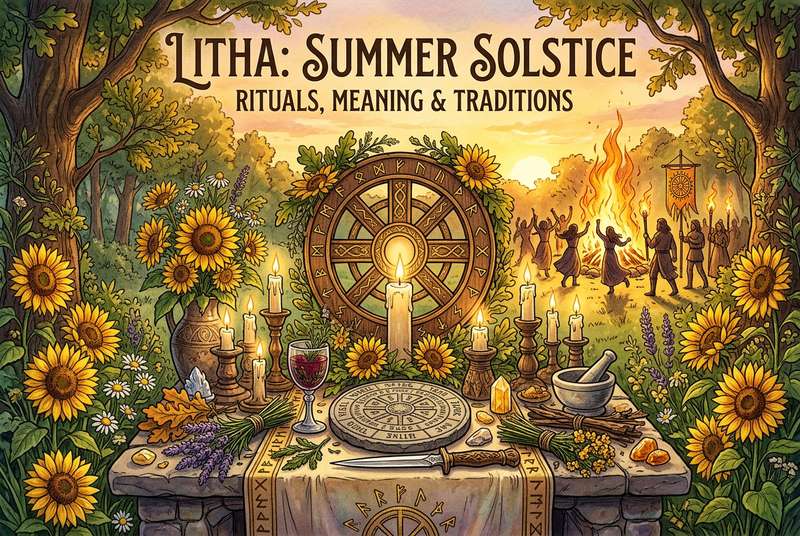
Your Litha Sabbat altar should radiate light and solar warmth. Consider this sacred arrangement:
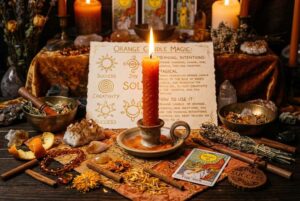
Center: A golden or yellow candle representing the Sun God at peak power, or a small cauldron filled with sand and a solar symbol drawn in the center.
North/East: Fresh flowers in summer colors—sunflowers, marigolds, and red poppies—representing the earth’s full bloom.
Symbols: A sun wheel, a golden coin, a crystal sun catcher, or an image of the sun in its glory.
Herbs: Bundle fresh St. John’s Wort, lavender, and mugwort. Place them on the altar as both decoration and powerful magical tools.
Water Element: A bowl of spring water or “sun water” (charged under the solstice sun) for blessings and purification.
Incense: Frankincense, copal, or solar-scented blends to honor the sun’s essence.
Herbs, Crystals & Colors for Litha Sabbat
Herbs of Power: St. John’s Wort (protection and sun energy), mugwort (prophetic dreams), vervain (magical amplification), lavender (peace and purification), chamomile (solar blessings), and sunflower petals (solar connection).
Crystals to Carry: Citrine and pyrite (prosperity and solar energy), carnelian (vitality and creativity), amber (ancient solar wisdom), and clear quartz (amplifies all magical intention).
Sacred Colors: Gold, yellow, orange, red, and white—all representing the sun’s radiant spectrum and the blazing light of Midsummer.
Foods Traditional for Litha Sabbat
Celebrate Litha with foods blessed by the summer sun:
- Fresh berries and stone fruits (strawberries, peaches, apricots)
- Honey cakes and sun-shaped pastries
- Mead or honeyed wine
- Fresh salads with edible flowers
- Bread baked with solar herbs
- Fire-roasted vegetables
- Cream and dairy products (representing the Goddess’s nurturing abundance)
Modern Ways to Celebrate Litha Sabbat
You don’t need to live in ancient times or have access to a forest to honor the Litha Sabbat authentically. Modern witches celebrate in ways that feel true to their lives:
- Urban Bonfire: Gather friends for a rooftop ceremony, backyard fire pit gathering, or even a candlelit circle in your apartment.
- Summer Solstice Pilgrimage: Visit a sacred site, ancient monument, or power place at sunrise on the solstice.
- Digital Ritual: Host a virtual circle with witches across the globe, all honoring the sun together despite physical distance.
- Garden Blessing: Spend the day tending your garden (or potted plants), speaking gratitude and intentions into the soil as you water and nurture growth.
- Solar Crafting: Create sun-charged water, make herbal bundles, craft sun wheel decorations, or paint sacred art by natural light.
- Self-Care Ritual: Honor your own solar energy through sunbathing (with protection), light therapy, creative expression, or simply basking in the longest day.
The beauty of Litha Sabbat is that it invites you to step into your own radiance and recognize the light that lives within you. Whether you gather in ancient groves or in your own backyard, the sun shines equally on all seekers. This is your moment to celebrate, to charge your magic, and to embody the fullness of your own divine power.
FAQ
What is the difference between Litha and Beltane?
Litha (summer solstice, June 20-22) celebrates the sun at its peak power and the longest day of the year, while Beltane (May 1st) marks the beginning of summer and fertility transitions. Both are fire festivals in pagan traditions, but Litha focuses on the sun’s maximum strength whereas Beltane emphasizes the liminal boundary between seasons.
When is Litha Sabbat celebrated in 2024?
Litha Sabbat is celebrated on June 20-22, 2024, depending on the exact moment of the summer solstice in your location. In the Northern Hemisphere, the solstice typically occurs around June 20-21, while Southern Hemisphere celebrations align with their summer solstice around December 20-23.
What rituals should I perform during Litha?
Common Litha rituals include lighting bonfires or candles to honor the sun’s power, creating flower crowns, performing abundance magic, and meditating on manifestation of your goals. Many pagans also make offerings to the sun god, gather herbs at peak potency, or celebrate with community gatherings and feasts.
Why is Litha called the summer solstice?
Litha coincides with the astronomical summer solstice, the moment when the sun reaches its highest point in the sky, creating the longest day of the year. The term ‘solstice’ comes from Latin meaning ‘sun stands still,’ marking the turning point after which daylight gradually decreases.
What flowers and herbs are associated with Litha?
Litha is associated with sunflowers, roses, lavender, St. John’s Wort, and chamomile—all plants at peak potency during summer solstice. These herbs and flowers are traditionally gathered, used in rituals, or placed on altars to harness the season’s maximum solar energy.