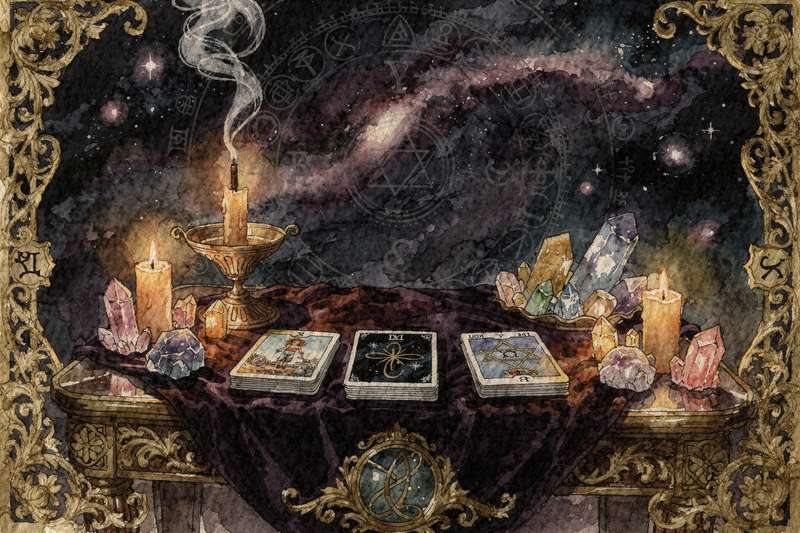
The Yin Yang Tarot Reading at a Glance
The Yin Yang Tarot reading is one of the most philosophically rich spreads in the tarot tradition. Rooted in the ancient Taoist concept of complementary opposites — yin representing the receptive, dark, and intuitive, while yang represents the active, light, and outward — this reading places your current situation within the eternal interplay of balance and imbalance. It is not a spread that delivers simple yes-or-no answers. Instead, it holds up a mirror and asks: where in your life are you out of rhythm with yourself?
Unlike single-card pulls or linear spreads, the Yin Yang reading divides your cards into two distinct energetic poles. Cards falling on the yin side reveal what is happening beneath the surface — your emotions, subconscious patterns, what is being received or absorbed. Cards on the yang side reveal what is visible, active, or being projected outward into the world. Together, they create a full portrait of where you are standing right now.
Upright Meaning: When the Forces Are in Flow
When a Yin Yang Tarot reading lands in its most aligned expression, you are being shown a moment of integration. The two sides of your life — or of a situation — are not at war. Perhaps you have recently moved through a period of conflict, confusion, or extreme effort, and the cards are confirming that you are arriving at a natural resting point where both energies can breathe.
This is not stagnation. The yin yang symbol always contains movement — the curved line between the two halves is never straight. Harmony here means dynamic equilibrium, like a skilled surfer who is always subtly adjusting without ever losing their footing on the board. The upright Yin Yang reading says: you are adjusting well. Keep going.
- Core themes: wholeness, integration, self-awareness, duality accepted
- Emotional tone: calm, centered, peaceful readiness
- Action guidance: trust both your instincts and your logic — neither alone is enough right now
Reversed Meaning: When the Scales Have Tipped
A Yin Yang Tarot spread carrying reversed or blocked energy does not mean something is catastrophically wrong. It means the scales have tipped, and one side is bearing too much weight. This can show up in countless ways: you are all action with no reflection, or all introspection with no movement. You are pouring love outward without refilling your own cup. You are being so cautious that opportunity passes by unrecognized.
The reversed Yin Yang reading is a recalibration notice from your higher self. The specific cards that appear alongside this imbalance will tell you exactly which polarity needs attention. A heavily watery, emotional spread signals you may need to ground yourself in practical action. A spread full of fire and swords energy might be asking you to slow down, go quiet, and listen inward.
“Within you there is a stillness and sanctuary to which you can retreat at any time and be yourself.” — Hermann Hesse
Love & Relationships: The Balance Between Two Souls
In a love reading, the Yin Yang spread is uniquely powerful because romantic relationships are perhaps the most vivid arena where opposing forces meet. Every partnership contains two people with different internal rhythms, needs, and ways of expressing themselves. This spread asks you to look honestly at the give-and-take between you and the person you are focused on.
If the yin cards in the reading are heavy or overwhelming, one partner may be over-absorbing — taking on the other’s emotions, anxieties, or expectations to the point of losing their own identity. If the yang cards dominate, someone in the relationship may be pushing too hard, speaking too loudly, or controlling the direction of things without leaving space for the other person to contribute.
For those who are single, the Yin Yang love reading often points to an internal relationship — the balance between your masculine and feminine energies, your independence and your desire for connection. Before the right person can show up in balanced form, you are being invited to find that balance within yourself first.
- Are you giving more than you receive — or resisting receiving at all?
- Is there space in this relationship for both silence and honest conversation?
- Do you feel like yourself when you are with this person?
Career & Finance: Finding the Middle Path
The Yin Yang Tarot reading applied to career and money matters is a sophisticated tool for anyone who feels like they are either burning out or spinning their wheels. The yang side of a career reading reveals where your visible efforts are going — your output, ambitions, and external actions. The yin side reveals the quieter reality: your motivation levels, your underlying fears about success or failure, and the creative reserves you are drawing from.
If your yang career cards are strong but your yin cards show depletion, the reading is practically shouting that rest is not laziness right now — it is strategy. Your best ideas will not come from grinding harder. They will come from stepping away from the screen, taking a walk, and letting your subconscious do its work.
Financially, the Yin Yang spread often reveals whether you are in a receiving or a giving cycle. Neither is permanent. A period of financial outflow (investing, spending on growth, supporting others) will naturally move into a period of return — provided the underlying intention is clear and the action is balanced with patience.
Spirituality: The Sacred Union of Opposites
At its deepest level, the Yin Yang Tarot reading is a spiritual practice in itself. The act of sitting with two opposing forces — light and shadow, knowing and mystery, the self you show the world and the self only you know — is the heart of genuine spiritual growth. Many traditions speak of this: Jungian psychology calls it integrating the shadow, Taoism calls it the Way, and countless mystical paths describe the union of opposites as the doorway to wholeness.
In a spiritual context, this reading often surfaces around pivotal moments of identity — when you are releasing an old version of yourself or preparing to step into something new. The cards are not asking you to choose between who you were and who you are becoming. They are showing you that both are real, both are valid, and both are part of the same continuous being.
Crystals that align beautifully with the Yin Yang reading include obsidian (for shadow integration and protection), clear quartz (for amplifying clarity and light), and moonstone (for tuning into the receptive, intuitive yin energy). Working with the third-eye chakra and the heart chakra during or after this reading can help you process what the cards reveal on both a mental and an emotional level.
The Yin Yang Tarot Reading in a Reading: How to Apply It
To conduct a Yin Yang Tarot reading, you do not need a complicated ritual. Shuffle your deck with your question or current situation held in mind, then divide your draw into two positions: one card (or multiple cards) representing the yin force at work, and one representing the yang force. Some readers use three cards per side for a more layered reading.
Once your cards are laid out, resist the urge to immediately judge one side as good and the other as problematic. Both yin and both yang cards carry value. Even a so-called difficult card like The Tower on the yang side might simply mean that a necessary disruption is breaking through stagnation. The High Priestess on the yin side might be confirming that the answers you seek are already inside you — you simply have not gone quiet enough to hear them.
- Set your intention before shuffling — clarity of question produces clarity of reading.
- Lay one card in the yin position (left or lower) and one in the yang position (right or upper).
- Read each card on its own terms first, then consider how the two interact.
- Ask yourself: which energy feels more present in my life right now? Which one am I resisting?
- Journal your response — the act of writing often unlocks insights the mind alone cannot reach.
The Yin Yang Tarot reading is not a one-time tool. It is particularly useful to return to during transitions, at the new moon or full moon, or any time life feels lopsided. The cards will always show you something different, because you are always in a different place in your cycle. That is, after all, the point — balance is not a destination. It is a practice.
Frequently Asked Questions
What is a Yin Yang Tarot reading used for?
A Yin Yang Tarot reading is used to reveal the balance — or imbalance — between opposing forces in your life, such as action and rest, giving and receiving, or conscious and unconscious patterns. It is especially useful during periods of transition, inner conflict, or when you feel pulled in two directions at once. The reading helps you identify which energy needs more attention so you can recalibrate.
How many cards do you use in a Yin Yang Tarot spread?
The simplest version uses two cards — one representing yin energy and one representing yang energy. Many readers expand this to three cards per side for a more detailed picture, covering past influences, present energy, and future direction within each polarity. There is no rigid rule; what matters most is the clear intention you bring to the spread.
Can the Yin Yang Tarot reading predict relationships?
It can offer powerful insight into the dynamics of a relationship rather than straightforward predictions. The reading reveals where complementary energies exist between two people and where imbalances may be creating tension. It is better understood as a tool for self-awareness and conscious relating than as a fortune-telling device.
What tarot cards are most significant in a Yin Yang reading?
Cards with strong duality symbolism tend to carry extra weight in this spread — The High Priestess, The Moon, and the Two of Cups often speak powerfully to yin energy, while The Emperor, The Chariot, and the Ace of Wands carry strong yang resonance. That said, every card’s meaning shifts depending on which position it occupies and what card appears beside it.