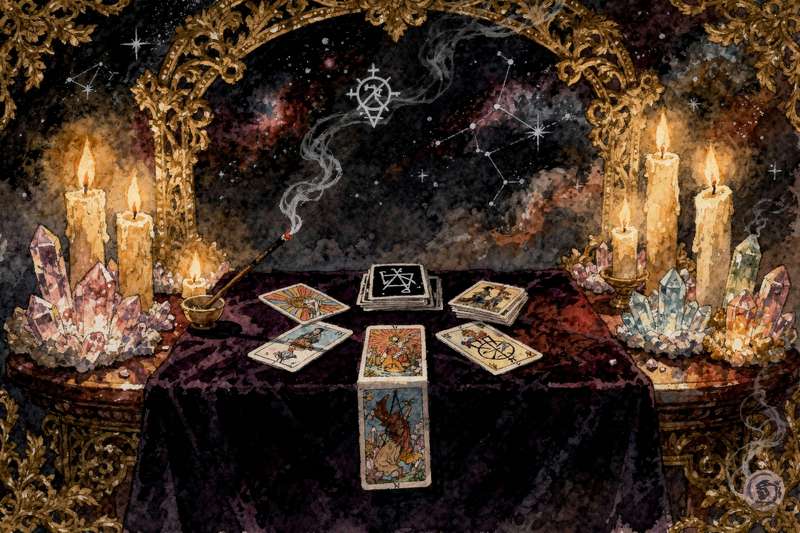
Tarot meditation and mindful card reading go hand in hand — the moment you bring conscious awareness to a draw, the entire experience shifts. Rather than scanning a card for a quick fortune-telling answer, you begin using tarot for self-reflection, emotional insight, and a genuine anchor in the present moment. This practice has the power to deepen your intuition while quieting the restless mind that so often gets in the way of real clarity.
You don’t need years of tarot experience to begin. All you need is a single card, a quiet space, and the willingness to actually sit with what you see.
Tarot Meditation & Mindfulness at a Glance
- Primary purpose: Present-moment awareness and intuitive self-inquiry
- Session length: 5 minutes (quick check-in) to 20+ minutes (deep visual meditation)
- Best time to practice: Morning intention-setting, evening reflection, or any transitional moment in your day
- Key cards for meditation: The High Priestess, The Hermit, The Moon, The Star, The Hanged Man
- Supportive crystals: Amethyst for intuition, clear quartz for mental clarity, labradorite for inner sight
- Chakras activated: Third eye (intuition), crown (spiritual receptivity), heart (emotional awareness)
Upright Meaning: When Your Mindful Tarot Practice Flows
When the energy of this practice is open and upright, you enter each reading with genuine receptivity. You’re not gripping for answers — you’re listening. The card in front of you becomes more than ink on cardstock; it becomes a conversation between your conscious mind and the deeper intelligence that lives beneath it.
In this open state, tarot meditation cultivates several things at once:
- Concentration: Focusing on rich symbolic imagery trains the mind to sustain attention without strain or effort
- Self-compassion: Sitting with a card that reflects difficult emotions teaches you to witness yourself without judgment
- Intuitive trust: The more you honor what arises during quiet card meditation, the more you learn to trust your inner knowing in daily life
- Emotional regulation: Cards serve as emotional mirrors, helping you name and breathe through what you’re feeling rather than suppressing it
A simple practice to try: choose one card from a shuffled deck. Place it at eye level. For ten minutes, do nothing but breathe and look. Notice what draws your eye, what makes you uncomfortable, what makes you feel seen. Then write one sentence about what the card revealed about this moment. That’s the whole practice — and it’s more powerful than it sounds.
Reversed Meaning: When Your Tarot Mindfulness Practice Needs Attention
Even the most committed practitioners hit walls. The reversed state of a tarot mindfulness practice looks different for everyone, but common signs include:
- Pulling cards rapidly without sitting with any of them
- Immediately reaching for a guidebook instead of trusting your own first response
- Feeling anxious during the draw rather than curious or calm
- Using multiple daily pulls as a form of reassurance-seeking rather than genuine inquiry
- Zoning out during visual meditation instead of staying present with the imagery
None of this means the practice is broken — it means it needs tending. The reversed invitation is always the same: go slower, do less, strip it back to the simplest possible version. One card. Five breaths. One honest look. That’s enough to reconnect.
The third eye chakra, when congested, can make intuitive reading feel like static on a radio. Holding amethyst during your session, or spending a few minutes in gentle breathwork before drawing, can help clear that channel and bring you back into genuine contact with the cards.
Love & Relationships: Mindful Tarot Reading for the Heart
Tarot meditation is particularly transformative when applied to questions of love — not because the cards predict who you’ll be with, but because they show you who you are in relationship.
Try this three-card emotional check-in for your love life:
- Card 1: My current emotional state in this relationship (or around love in general)
- Card 2: The feeling beneath the feeling — what needs attention that I may be avoiding
- Card 3: How to care for my heart with compassion right now
For each card, spend three to five minutes in quiet observation before attempting any interpretation. Notice what emotions arise. Notice where you feel tension or ease in your body. The heart chakra opens remarkably when you approach these questions with softness rather than urgency.
Cards like The Lovers and the Ace of Cups naturally lend themselves to heart-centered meditation. But don’t overlook more challenging cards — The Moon, held with mindful attention, can reveal exactly what’s ready to be released from your love life.
Career & Finance: Grounded Tarot Mindfulness for Practical Decisions
The rational mind often dismisses tarot in professional contexts — which is precisely why bringing a mindfulness practice to career readings can be so unexpectedly useful. You’re not asking the cards to run your business strategy. You’re using them to surface your own knowing about a situation you’re already living inside.
Before a major career decision, try this structured practice:
- Write your question or decision on paper and set it face-down beside you
- Sit for five slow breaths, hands resting on your shuffled deck
- Draw one card with a clear intention: “Show me what I need to see about this situation clearly”
- Spend ten minutes in silent observation of the card before reading any external interpretation
- Write down your first three responses — emotional, physical (body sensations), and intuitive
What you’ll often find is that your body already knew the answer before the card was drawn. The card’s imagery simply gives your intuition something to crystallize around, making the knowing easier to act on.
Spirituality: The Deeper Dimension of Mindful Tarot Practice
For many practitioners, tarot meditation becomes a cornerstone of their entire spiritual path. It sits naturally alongside shadow work, manifestation practices, and moon phase rituals — offering a daily touchstone that keeps you grounded in your inner landscape no matter what’s happening around you.
The Hermit speaks directly to this dimension. In the Rider-Waite-Smith deck — designed by Pamela Colman Smith and A.E. Waite, published in 1909 — The Hermit stands alone on a mountaintop, lantern raised. Not to light the path for others, but to trust the light he carries within himself. Meditating with The Hermit is an act of sacred solitude. You withdraw from noise, lower your gaze, and listen for the voice that only speaks in stillness.
The High Priestess is equally a powerful meditation companion. She sits at the threshold between the known and the unknown, inviting you to stop seeking answers outside yourself and trust what already lives in your depths. Placing The High Priestess before you during a crown chakra meditation can open channels of intuition that logical analysis simply cannot reach.
A walking meditation variation worth trying: draw a single card before a mindful walk outdoors. Let the card’s theme guide your attention throughout. Drew The Star? Notice where beauty and hope show up in the ordinary world around you — in cracked pavement, in a stranger’s smile, in the quality of afternoon light. The card becomes a lens, and the world becomes full of meaning.
Tarot Meditation & Mindfulness in a Reading
When tarot meditation themes appear in a spread — or when you feel called to use these techniques within a reading for yourself or someone else — treat it as an invitation to slow down and go inward rather than seeking external validation.
Cards that most naturally call for a meditative approach include:
- The High Priestess: Trust inner knowing; sit with uncertainty for now rather than forcing clarity
- The Hermit: Solitary reflection is needed before any outward action
- The Moon: The truth is below the surface — meditate, don’t analyze
- The Star: Hope and healing are available; receive them quietly rather than chasing them
- The Hanged Man: The pause itself is the teaching; resist the urge to rush forward
- Four of Swords: Rest, recuperation, and inner stillness are the medicine this moment requires
If any of these cards appear in a reading, consider ending the session with a brief visual meditation on the card in question. Even two minutes of shared silence with the imagery can offer more than ten minutes of explanation.
“The cards don’t predict your life — they reflect it. The more honestly you look, the more clearly they show you what’s already true.”
A daily tarot mindfulness habit doesn’t require elaborate ritual. One card drawn with presence, held with curiosity, and released without grasping — repeated consistently — builds both mindfulness capacity and genuine intuitive depth over time. This is a long practice, not a quick fix, and that’s exactly what makes it worth returning to.
Frequently Asked Questions About Tarot Meditation & Mindfulness
How do you use tarot cards for meditation?
Choose one card and place it at eye level. Spend 10–15 minutes breathing gently while examining every visual detail — colors, expressions, symbols, and spatial relationships. When your mind wanders, use the card’s imagery as an anchor back to present-moment awareness, just as you would use the breath in traditional mindfulness meditation.
Can tarot really be used as a mindfulness practice?
Yes — tarot cards are highly effective mindfulness tools because their rich imagery gives the mind a meaningful focal point, which makes sustained attention easier than focusing on something abstract. The cards also carry personal resonance, which keeps engagement genuine rather than mechanical or forced.
What tarot cards are best for meditation?
The High Priestess, The Hermit, The Moon, The Star, and The Hanged Man are particularly suited to meditative practice because their imagery naturally invites inward reflection. That said, any card can become a meditation object — even a challenging card, held with patience and openness, offers profound insight.
How long should a tarot meditation session last?
Even five minutes of genuine, focused attention on a single card is valuable and counts as real practice. For deeper work, 10–20 minutes is ideal. What matters far more than duration is the quality of your presence — a distracted 30-minute session offers less than a fully present 5-minute one.