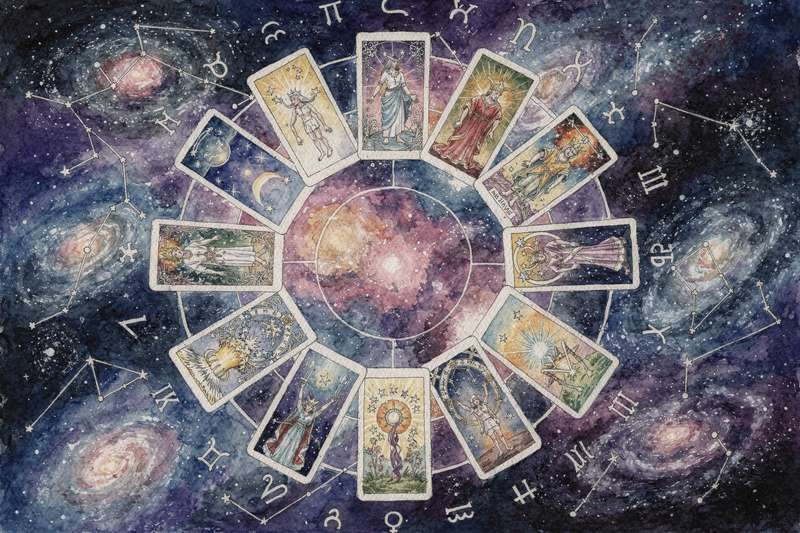
Tarot astrology in the Golden Dawn tradition is one of the most structured and profound systems ever developed for reading the cards. When you pick up a Rider-Waite-Smith deck, a Thoth deck, or any tarot born from the Hermetic Order of the Golden Dawn, you are working with a living astrological map — one where every Major Arcana card carries a planetary or zodiacal signature, and every suit breathes with elemental force. This is not the astrology of sun-sign horoscopes. It is something older, more deliberate, and more deeply woven into the symbolic language of the cards themselves.
The Golden Dawn Tarot Astrology System at a Glance
The Hermetic Order of the Golden Dawn was founded in Britain in 1888, and for several extraordinary decades it became the center of gravity for Western esoteric thought. From its initiatory teachings, four tarot decks entered the world — each shaped by a different master of the tradition:
- The Rider-Waite-Smith Tarot — brought to life by Dr. Arthur Edward Waite, with imagery painted by Pamela Colman Smith (1909)
- The Thoth Tarot — conceived by Aleister Crowley, illustrated by Lady Frieda Harris (published 1944)
- The Golden Dawn Tarot — rooted in the foundational inner teachings of Samuel Liddell MacGregor Mathers, the Order’s chief architect of its initiatory curriculum
- The BOTA Tarot — developed by Paul Foster Case, founder of the Builders of the Adytum
These four figures drew from the same esoteric well. They differed in emphasis and expression, but the astrological skeleton underneath all four decks is largely shared. Once you understand the Golden Dawn framework, you can read any of these decks at a deeper level — because you understand why the symbols are the way they are.
Upright Meaning: Clarity Through Cosmic Correspondence
When Golden Dawn tarot astrology is working clearly in your readings, everything sharpens into focus. Each card stops being a floating image and becomes a precise statement about energy in time and space. The Magician is not just a figure with a wand — he carries the full signature of Mercury: communication, skill, and the bridging of worlds. The High Priestess is not just a mysterious woman behind a veil — she is the Moon’s deepest face: intuition, hidden knowledge, and the pull of what lies beneath the surface of conscious awareness.
Using the Golden Dawn system in its clearest form means allowing the astrological layer to sharpen your intuition rather than replace it. A reading that might otherwise feel vague gains direction the moment you recognize that the card drawn carries a Venus vibration in the middle of a career question — and you understand what that says about the energy at play.
Reversed Meaning: When the Structure Becomes a Cage
The challenge of any structured esoteric system — and the Golden Dawn’s approach is among the most structured — is that rigid application can dull your instincts. When this system’s energy is reversed or blocked in a reading context, it often shows up as over-intellectualization: citing the planetary ruler correctly while missing the living message entirely.
A reversed application might also signal a moment when the traditional framework simply does not fit the situation in front of you. Not every reading calls for the full weight of Hermetic analysis. Sometimes a card speaks plainly, and layering astrological doctrine on top of it creates noise instead of signal. The system is a lens — if it is not helping you see, set it down and look with fresh eyes.
The Seven Sacred Planets and Their Tarot Signatures
The Golden Dawn worked exclusively with the seven sacred planets of the ancient world. The outer planets — Uranus, Neptune, and Pluto — were either unknown or newly discovered during the Order’s active period and were not part of the original framework. Modern interpreters have since added them, but the classical system remains remarkably complete without them:
- Sun — The Sun card: consciousness, vitality, radiant clarity, the light of the self
- Moon — The High Priestess: intuition, mystery, the subconscious, hidden tides
- Mercury — The Magician: communication, intellect, dexterity, the bridge between worlds
- Venus — The Empress: love, beauty, fertility, abundance, creative overflow
- Mars — The Tower: force, disruption, the revelation that comes through conflict
- Jupiter — The Wheel of Fortune: expansion, opportunity, the turning of cosmic cycles
- Saturn — The World: completion, karmic structure, earned mastery, the fullness of time
Knowing these seven assignments by heart transforms your relationship with the Major Arcana. You begin to feel a planet’s quality the moment a card appears — and that felt recognition is where intuitive reading and structured knowledge finally meet.
The Four Elements in Golden Dawn Tarot Astrology
Alongside the planets, the four classical elements give every suit its essential character. These are the first building blocks beneath the more complex astrological assignments:
- Fire — Wands: intuition, spirit, creative will, initiative, and goal-directed action
- Water — Cups: emotion, feeling, relationship, the flow of the unconscious and the heart
- Air — Swords: intellect, thought, the precision of the mind, conflict born of ideas
- Earth — Pentacles/Disks: material life, the body, growth, endurance, and practical accumulation
When you draw a Wands card in a love reading, the Fire element speaks first: this is a passionate, instinct-driven energy — not yet settled or long-term. When a Pentacle appears in a spiritual question, the Earth element grounds what might otherwise float into abstraction. The element is always the first layer of meaning; the planet or zodiac sign is the second.
Love & Relationships: Venus, the Moon, and the Water Cards
In Golden Dawn tarot astrology, love readings are richest when you pay attention to the Venusian cards and the Water element. The Empress, ruled by Venus, speaks of nurturing love, sensual connection, and creative partnership. When she appears in a relationship reading, the energy is fertile and generous — but it requires active tending to flourish. The High Priestess, ruled by the Moon, brings a different kind of love: one that values emotional depth and unspoken understanding over explicit declaration.
The Cups suit — governed by the Water element — is the primary language of relationship in this system. Its connection to the Cancer, Scorpio, and Pisces energy of the zodiac adds meaningful nuance: watery love can be transformative and soul-deep (Scorpio), idealistic and spiritually bonded (Pisces), or protective and home-centred (Cancer). Reading the element and the planetary ruler together gives you far more than reading the card image in isolation ever could.
Career & Finance: Mars, Jupiter, Saturn, and the Earth Element
For career and financial questions, the Golden Dawn’s planetary framework brings remarkable precision. The Tower, carrying Mars energy, points to a sudden shake-up — a disruption that feels destabilizing in the moment but ultimately clears space for something stronger to emerge. The Wheel of Fortune’s Jupiter vibration signals expansion, opportunity, and the turning point when fortune moves in your favor. The World, with Saturn at its core, represents earned completion: the reward that arrives after sustained, disciplined work.
Earth-element cards (Pentacles or Disks) speak most directly to material life. In a career reading, a strong showing of Earth energy alongside Jupiter’s influence suggests steady growth that is ready to scale. A Saturn-heavy reading calls for patience and structural thinking before the breakthrough arrives — but Saturn always delivers when the work has been done with integrity.
Spirituality: The Major Arcana as an Astrological Map of the Soul
The deepest gift of the Golden Dawn tarot astrology system is what it reveals about the soul’s journey. The 22 Major Arcana cards form a complete cosmological map once you understand their planetary and zodiacal assignments. From the Fool — pure spirit before it enters form — to the World — the soul that has moved through a full cycle of experience — each card is a station on a path that mirrors the structure of the heavens.
This is the Hermetic principle made visible in card form: as above, so below. The planets are not abstract astronomical bodies in this context — they are living spiritual intelligences whose qualities you can encounter, embody, and ultimately integrate within yourself. Many practitioners find that the third-eye chakra opens naturally to this kind of layered, symbolic contemplation, while the crown chakra gradually receives the fuller wisdom of the completed map.
Studying Golden Dawn astrology tends to shift the experience of reading tarot from consulting a reference book to developing genuine symbolic literacy — a felt, instinctive understanding of why each card holds the energy it holds. That shift is the tradition’s most lasting gift.
The Golden Dawn Tarot Astrology System in a Reading
If you want to bring Golden Dawn astrological correspondences into your practice, start with the Major Arcana. Before a reading session, spend a moment with the planetary ruler of each card — not intellectually, but imaginatively. What does Mercury feel like in the body? What does Saturn ask of you? Then, when a card appears in a spread, let both the image and its planetary signature inform your interpretation simultaneously.
For Minor Arcana cards, begin with the elements. Ask what the suit’s elemental quality is saying about the situation. If you want finer detail, the specific astrological decan assigned to each pip card adds another layer of precision — but this is best approached once the foundational planetary and elemental correspondences feel natural and instinctive.
The Golden Dawn’s astrological framework was never meant to be a constraint. It was designed to expand what a reader can perceive — to give structure to intuition, and depth to what might otherwise remain surface-level impressions.
Bring it into your readings as an ally, not a rulebook, and it will do exactly that.
Frequently Asked Questions
What is the Golden Dawn tarot system?
The Golden Dawn tarot system is a structured symbolic framework developed by the Hermetic Order of the Golden Dawn, a British esoteric society founded in 1888. It assigns specific planets, zodiac signs, and classical elements to every tarot card, linking astrology and tarot into a unified interpretive language that underpins four major decks still in wide use today.
How does astrology connect to tarot in the Golden Dawn tradition?
In the Golden Dawn tradition, astrology is built into the cards at a foundational level — not added on as an afterthought. Each Major Arcana card carries a planetary or zodiacal ruler, and each suit corresponds to one of the four classical elements. Together, these layers mean every card you draw makes a precise astrological statement about the energy present in your situation.
Which tarot decks came from the Golden Dawn tradition?
Four major decks trace their roots to the Golden Dawn: the Rider-Waite-Smith Tarot (A.E. Waite and Pamela Colman Smith, 1909), the Thoth Tarot (Aleister Crowley and Lady Frieda Harris, published 1944), the Golden Dawn Tarot (rooted in MacGregor Mathers’ inner teachings), and the BOTA Tarot (Paul Foster Case). All four share the same astrological correspondence structure at their foundation.
Why didn’t the Golden Dawn use Uranus, Neptune, and Pluto in tarot?
The Golden Dawn built its system on the seven sacred planets of the ancient world: Sun, Moon, Mercury, Venus, Mars, Jupiter, and Saturn. Uranus, Neptune, and Pluto were either unknown or very recently discovered during the Order’s active period, so they were not incorporated into the original framework. Modern interpreters have since added them, but the seven-planet system remains internally consistent and complete on its own.