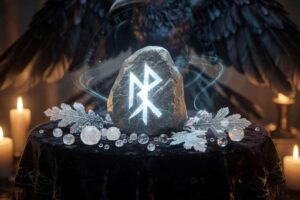
Isa rune meaning centers on one of nature’s most powerful forces: ice. Pronounced EE-sah, this ancient Elder Futhark symbol carries the energy of stillness, patience, and the quiet strength that builds beneath a frozen surface. As the ice rune, Isa doesn’t promise dramatic breakthroughs — it invites you to stop, breathe, and trust the slow, invisible work happening underneath.
At first glance, a rune that signals pause might seem unwelcome. But the Norse people who lived with harsh winters understood something essential: ice is not the absence of life. It is life held in perfect suspension, gathering force for the thaw ahead. When Isa appears for you, it asks the same awareness.
What Is the Isa Rune? Definition, Shape, and Origin
Isa is the eleventh rune of the Elder Futhark — the oldest known runic alphabet, used across Germanic and Norse cultures from roughly the 2nd to 8th centuries CE. It belongs to the second ætt (the group of eight runes spanning positions nine through sixteen), which is associated with transformation and the forces of nature. Within that group, Isa occupies the third position.
Its shape is almost disarmingly simple: a single vertical line. No curves, no branches, no crossbars. That stark, unbroken stave is itself a message — pure stillness, nothing extraneous. The rune’s name descends from the Proto-Germanic īsaz, which became Old Norse ís, Old English īs, and eventually the modern English word “ice.” Across every Germanic language, the root meaning never changed.
One particularly notable quality: Isa has no reversed or merkstave form. Because the vertical line looks identical from every angle, the rune carries the same meaning however it falls. This isn’t a limitation — it reflects Isa’s message perfectly. Stillness is stillness. There is no “upside-down” version of patience.
Isa in the Ancient Rune Poems
Three surviving rune poems — Anglo-Saxon, Norwegian, and Icelandic — each approach Isa with a mixture of reverence and warning that reveals how intimately northern peoples knew ice.
- The Anglo-Saxon Rune Poem marvels at ice’s gemlike brilliance and its treacherous slickness, comparing a frost-hardened floor to something almost too beautiful to walk on safely.
- The Old Norwegian Rune Poem calls ice “the broad bridge” — a frozen river that connects communities in winter — while noting that a blind person must be guided across it, lest they fall.
- The Old Icelandic Rune Poem takes the darkest tone, describing ice as the bark of rivers and the roof of the sea, deadly to those who trust it carelessly.
Together, these poems frame Isa as something genuinely dual: beautiful and useful, yet capable of killing the unwary. That duality is not a contradiction — it is wisdom. Ice preserves. Ice connects. Ice also demands respect and honest assessment of where you actually stand.
Isa Rune Symbolism: Ice, Fire, and the Creation Myth
To understand why Isa carries such deep weight in Norse cosmology, you need to know where it fits in the creation story. In Norse myth, the universe began in the space between two primordial forces: Niflheim, the realm of ice and mist in the north, and Muspelheim, the realm of fire in the south. Where these forces met — ice and fire colliding — the first life emerged.
Isa, as the ice principle, is not passive in this myth. It is one half of creation itself. Without the stillness and cold of Niflheim, there is nothing for fire to animate. This is why Isa’s energy is sometimes described as feminine in its orientation — not in any rigid gender sense, but in the archetype of receiving, holding, and preparing conditions for new life rather than forcing growth before its time.
Isa stands in natural polarity with Kenaz, the torch rune of fire, inspiration, and creative heat. Where Kenaz burns forward, Isa holds still. Both are necessary. The tension between them is generative, not oppositional.
Element, Aett, and Correspondences
- Element: Water (in its frozen form)
- Phonetic value: Long “ee” sound
- Aett: Second (Heimdall’s ætt), position 3 within the ætt
- Key themes: Stillness, patience, preservation, consolidation, inner focus
- Associated chakra: Third Eye — the inward gaze, perception, and clarity of mind
- Moon phase resonance: New Moon — the quiet before emergence
The third-eye connection makes intuitive sense: Isa is a rune that rewards looking inward rather than acting outward. When external movement is frozen, inner perception sharpens. The new moon association follows the same logic — both represent the charged stillness right before a cycle begins to build again.
Isa Rune Meaning in Divination: What It Tells You
When Isa appears in a rune reading, it is almost always pointing to a period of enforced or necessary pause. Plans may be stalled. A relationship may feel like it has gone quiet. A project sits waiting for the right conditions. Isa doesn’t tell you this to discourage you — it tells you so you stop wasting energy pushing against something that isn’t ready to move yet.
Think of it this way: if you stand on ice and push hard against nothing, you slip. Isa counsels you to plant your feet, observe your surroundings with full attention, and wait for the thaw that is already on its way.
“Ice is the broad bridge — but the blind man must be led.” — Old Norwegian Rune Poem
This verse is a quiet instruction for any Isa moment: you need a guide, and that guide is your own honest perception. Don’t rush across the frozen surface. Move carefully, with full awareness of where you are.
Isa in Love and Relationships
In matters of the heart, Isa often signals a cooling-off period. This doesn’t necessarily mean a relationship is ending — more often, it means one or both people need time for individual reflection and recharging. There may be a sense of emotional distance or a relationship that has gone quiet, and that can feel unsettling.
But consider what ice actually does in nature: it preserves. Things held in cold storage don’t decay. A relationship that has entered an Isa phase may be protecting itself, holding its energy intact until both people are ready to move forward with greater honesty. Use this time to understand what you genuinely want — not what you think you should want, but what you actually feel when you’re still enough to listen.
Isa as Advice
If you draw Isa as a guidance rune, its message is direct: this is a season for waiting, not acting. Complete your research. Reassess your direction. Let the dust settle before making decisions. The frustration you might feel during this period — the sense that nothing is happening — is itself part of the process. Seeds germinate in the dark. Strength builds in stillness.
Isa as advice is not telling you that you’ve failed or that you’re stuck permanently. It’s telling you that the next move will be far more effective if you make it from a place of genuine readiness rather than impatience.
How to Work With Isa’s Energy
Working with Isa isn’t about performing elaborate rituals — this rune’s energy actually resists forced action. Instead, practices that deepen stillness and sharpen inner awareness are most aligned with what Isa offers.
Practical Ways to Honor Isa
- Meditate with the rune shape. Draw a single vertical line on paper or carve it into a candle. Sit with it in silence and notice what arises when you stop trying to move things forward.
- Journal through the pause. Ask yourself: What am I trying to force right now? What would become visible if I stopped pushing? What do I genuinely want beneath the urgency?
- Work with cool, calming crystals. Clear quartz amplifies inner perception and mirrors ice’s reflective quality. Aquamarine carries water’s calm depth and supports honest self-reflection during waiting periods.
- Use the new moon intentionally. Since Isa resonates with the new moon’s inward energy, use that phase each month to check in with yourself — not to set bold intentions, but to listen.
- Practice deliberate stillness. Even five minutes of sitting without a phone, task, or goal is a small act of Isa magic. You’re training yourself to find value in the pause.
Crystals and the Third Eye Connection
Because Isa connects to the third-eye chakra, working with stones that support inner vision and calm mental chatter can deepen your relationship with this rune’s energy. Amethyst quiets an overactive mind and supports the kind of patient, receptive state Isa calls for. Labradorite enhances intuitive perception — useful when you’re trying to understand what’s happening beneath the frozen surface of a situation.
Common Misconceptions About the Isa Rune
- “Isa means nothing is happening.” The opposite is often true. Like winter preparing soil for spring, enormous invisible work can be underway during an Isa period. Stillness on the surface doesn’t mean stagnation at the root.
- “It’s always a negative sign.” Isa is challenging if you need urgency, but it’s genuinely supportive if you need rest, perspective, or preservation. Context matters enormously.
- “Since there’s no reversed form, Isa is weaker than other runes.” The symmetry doesn’t reduce its power — it makes its message consistent and reliable. Isa always means what it means.
- “Isa in love means the relationship is over.” A cooling period is not an ending. Many relationships emerge from an Isa phase stronger and more honest than before.
- “You should draw Isa again to override it.” Trying to draw your way out of an Isa message misses the point entirely. The rune is asking you to be still — drawing more runes is the opposite of that.
Final Thoughts on Isa Rune Meaning
Isa is one of the most misunderstood runes in the Elder Futhark precisely because it asks something modern life rarely rewards: the willingness to stop. In a culture that prizes constant movement and visible progress, a rune that tells you to wait can feel like a setback. But Isa knows what ice has always known — that the world beneath the frozen surface is alive, working, preparing.
When this rune shows up for you, it’s not a verdict on your efforts. It’s an invitation to trust a different kind of strength — the strength of stillness, of honest self-examination, of preserving your energy for the moment when the ice finally breaks and forward movement becomes effortless.
The thaw always comes. Isa simply asks you to be ready when it does.
Frequently Asked Questions About the Isa Rune
What does the Isa rune mean in a love reading?
Isa in a love reading typically signals a period of cooling or emotional distance between people. This doesn’t mean a relationship is over — it often points to a necessary pause for individual reflection and honest reassessment. Relationships can emerge from an Isa phase with renewed understanding and depth.
Can the Isa rune be reversed or read as merkstave?
No. Because Isa is a single vertical line, it looks identical from every angle, so there is no traditional reversed or merkstave interpretation. Its meaning remains consistent however it falls in a reading, which makes it one of the most straightforward runes to read.
Which Elder Futhark position does Isa hold?
Isa is the eleventh rune of the Elder Futhark. It belongs to the second ætt — the group of eight runes occupying positions nine through sixteen — and holds the third position within that group.
What is Isa’s element and how does it affect the rune’s meaning?
Isa is associated with the water element in its frozen state. This distinguishes it from flowing water runes — Isa’s water is held still, preserved, and consolidated. That frozen quality directly informs the rune’s core meanings of pause, patience, and latent power waiting to be released.