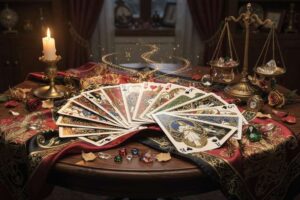
Gypsy Cards — known in German as Zigeuner Wahrsagekarten — are one of the oldest surviving European oracle decks, carrying centuries of folk cartomancy wisdom within their illustrated imagery. If you’ve stumbled across these beautifully illustrated cards and felt drawn to their old-world mystery, you’re not alone. Unlike tarot‘s grand ceremonial symbolism or Lenormand’s crisp playing-card logic, Gypsy fortune telling cards occupy a unique space: deeply personal, surprisingly direct, and rooted in the everyday life of real people seeking real answers. This guide walks you through what these cards are, how a traditional reading works, and how you can begin working with them meaningfully — whether you’re a seasoned cartomancer or a curious beginner.
What Are Gypsy Cards (Zigeuner Wahrsagekarten)?
The Zigeuner Wahrsagekarten — literally translated as “Gypsy Fortune-Telling Cards” — emerged during the 19th century as part of a broader wave of cartomancy tools popular in Central and Eastern Europe. They belong to a family of decks sometimes called Aufschlagkarten (Austrian cartomancy cards), which were produced for popular use rather than occult study. The most iconic edition is the Piatnik deck, published by the Viennese playing card manufacturer Piatnik, and its core imagery has remained remarkably consistent across printings spanning well over a hundred years.
The standard Gypsy Cards deck contains 36 cards, each depicting a figure, object, or scene from everyday 19th-century life. There are no suits in the traditional tarot sense, and no numbered pip cards. Instead, you’ll find named cards such as Sweetheart, Lover, Fortune, Fidelity, Money, Message, Thief, Officer, Malady, Judge, and more. Each card carries a name and an illustration — and it is the combination of name, image, context, and neighboring cards that generates meaning.
It’s worth knowing that these cards did not claim magical or ancient origins. Cartomancy as a structured practice developed largely in the 18th and 19th centuries, shaped by the parlor culture of rising middle classes across Europe. The Gypsy Cards emerged from that same practical tradition — tools designed to offer panoramic insight into a person’s life, used by folk readers and professional fortunetellers alike.
How a Traditional Gypsy Cards Reading Works
The primary reading method for Zigeuner Wahrsagekarten is the tableau — a spread in which most or all of the cards are laid out at once, giving you a full map of a person’s situation rather than a narrow snapshot. This is fundamentally different from the three-card or Celtic Cross spreads familiar to tarot readers, and it produces a very different kind of reading experience.
The Tableau Layout
In the classic Balkan tableau method, 32 of the 36 cards are laid face-up in four rows of eight cards. The remaining four cards are set aside face-down and used later for clarification. Each row carries a temporal meaning:
- First row — the past: what has already unfolded and shaped the present situation
- Second row — the present: current circumstances, feelings, and energies at play
- Third row — the near future: developments that are already in motion and likely to manifest
- Fourth row — fate or final outcome: the longer arc, what the situation is moving toward
Once you’ve interpreted the rows, the four set-aside cards can be placed over specific cards in the tableau to add depth. For example, you might lay a clarifying card over the Money card to understand the nature of a financial situation, or over Malady when a health matter is under discussion.
The Role of the Significator
A crucial step in any tableau reading is identifying the significator — the card that represents the person being read for. In Gypsy Cards, this is typically the Sweetheart (for women) or the Lover (for men), though you can adapt this based on context. Where the significator lands tells you something essential about the querent’s current level of agency:
- First row: The person has already navigated the central issue — they’re ahead of it
- Second row: They are fully engaged with the situation right now, facing it directly
- Third row: The matter is still approaching — they’re preparing for something incoming
- Fourth row: They may feel overwhelmed or driven by forces larger than themselves
- Not present at all: The querent currently has little active agency — events are unfolding around them
This single observation can completely reframe how you read the rest of the tableau, and it’s one of the most powerful features of this system.
The Wish and the Bottom Cards
Traditional Balkan readings often begin with a ritual that grounds the session: the querent is asked to hold a wish in mind — silently, without speaking it aloud, since voicing it is said to dissipate its energy. After the deck is shuffled and cut, the reader examines the two bottom cards. These cards frequently reveal what the person is truly hoping for, acting as an anchor and orientation point for everything that follows.
Reading the Cards: Context Over Single Meanings
One of the biggest mistakes new readers make with Gypsy fortune telling cards is looking up a single meaning for each card in isolation. The system doesn’t work that way. The cards speak through combinations, proximity, and narrative flow.
Consider the Lover card next to Message: on its own, Lover suggests a romantic figure. But beside Message — and perhaps under the clarifying card of Thief — the picture shifts entirely. You might be looking at someone who made many promises but delivered little, a charmer whose words outran his actions. This kind of contextual reading is what separates a meaningful session from a flat recitation of keywords.
Some principles to keep in mind when reading the tableau:
- Read left to right within each row, as you would a sentence. Cards to the left often represent what has preceded or influenced the card to the right.
- Look for clusters — when several emotionally charged cards land together (say, Desire, Thought, and Fidelity), they create a micro-story that deserves attention.
- Note what’s absent. If Fortune or Money never appears near the significator, that absence is itself informative.
- Cross-row connections are valid. If a card in the first row clearly influences one in the third, trust that connection and articulate it.
Traditional readers — particularly those from Serbian and broader Balkan traditions — operated on a powerful principle: the less you know about the querent going in, the sharper your reading becomes. This isn’t a performance challenge. It’s a discipline that keeps your interpretation clean, free from the unconscious bias that comes from knowing too much about the person in front of you.
Common Cards and What They Bring to a Reading
While no single card holds a rigid, unchanging meaning, certain cards tend to carry strong thematic weight that anchors the reading. Here is a brief orientation to some key Zigeuner Wahrsagekarten cards:
- Fortune: Contentment, good luck, a favorable turning point — especially when near the significator
- Fidelity: Loyalty, commitment, a trusted person or stable situation
- Money: Financial matters, material resources, practical concerns
- Message: News incoming, communication, information about to arrive
- Thief: Loss, deception, someone or something taking from you — not always literal theft
- Malady: Health concerns, emotional exhaustion, something draining energy
- Officer: Authority, institutions, legal matters, a person of influence
- Judge: Judgment, decision-making, resolution of disputes or uncertainty
- Desire: Longing, wants, aspirations — the gap between what is and what is wished for
- Thought: Mental preoccupation, planning, someone thinking of the querent
These meanings deepen considerably once you begin placing them in relation to each other and to the temporal rows of the tableau. A Malady card in the first row tells a very different story than one in the fourth.
How to Work With Gypsy Cards as a Modern Reader
You don’t need to be a professional fortune-teller or have a lineage of Balkan grandmothers to work meaningfully with the Zigeuner Wahrsagekarten. What you do need is patience, a willingness to build a narrative rather than collect keywords, and respect for the coherence of the system.
Here are some practical steps for getting started:
- Get familiar with the deck visually. Spend time with each card before you attempt a full tableau. Notice what the illustration suggests beyond the card’s title — body language, objects in the scene, the direction figures are facing.
- Practice solo tableaux. Lay out the full spread for yourself with a genuine question in mind. Read it slowly, row by row, and write down your interpretation before looking at any reference material.
- Study combinations. Choose two cards at random and practice articulating how they modify each other. This is the core skill of European cartomancy.
- Use the four spare cards intentionally. Once you’re comfortable with the base tableau, begin using the clarifier cards to deepen specific areas — especially wherever the significator lands.
- Develop a consistent ritual structure. Whether you begin with the wish practice, a moment of quiet centering, or a specific shuffling method — consistency builds the container that allows genuine insight to arise.
Most importantly: resist the urge to reinvent your method with every reading. Finding a structure that feels natural to you and committing to it is what transforms a card session from guesswork into genuine craft.
Common Misconceptions About Gypsy Fortune Telling Cards
- “These cards are tarot.” They are not. Gypsy Cards are a distinct oracle tradition with their own reading method, card vocabulary, and European folk roots — separate from both tarot and Lenormand, though historically related to the latter.
- “You need psychic ability to read them.” Traditional European cartomancers treated card reading as a learned skill, not a supernatural gift. Observation, pattern recognition, and narrative intelligence are the real tools.
- “Each card has one fixed meaning.” Context is everything in this system. A card’s meaning shifts based on its neighbors, its row, and the question being asked.
- “The deck is ancient.” The Zigeuner Wahrsagekarten developed in the 19th century. It is a historical deck with deep folk roots, but it makes no claim to ancient mystical origins — and doesn’t need to.
- “You must follow a specific spread.” The tableau is the traditional method, but experienced readers adapt the layout and incorporate counting techniques or additional steps as their practice matures.
- “These cards are only for fortune-telling.” Many modern readers use them for reflection, self-inquiry, and situational clarity — not prediction. The cards are versatile.
Final Thoughts
The Gypsy Cards (Zigeuner Wahrsagekarten) offer something rare in modern divination: a grounded, narrative-driven system built for real-life questions. Their power doesn’t come from mystical abstraction — it comes from their ability to map the texture of a human situation with clarity and specificity. When you read the tableau well, you’re not guessing at hidden forces. You’re reading patterns in a spread that mirrors the patterns in a life.
Whether you’re drawn to the historical richness of 19th-century European cartomancy, the visual intimacy of the Piatnik illustrations, or simply the appeal of a system that rewards careful thinking over rote memorization, the Zigeuner Wahrsagekarten are worth your time. Pick up the deck, lay out the cards, and let the story begin to form — one row at a time.
Frequently Asked Questions
What is the difference between Gypsy Cards and Lenormand cards?
Both Gypsy Cards and Lenormand cards are 19th-century European oracle decks that share similar tableau reading methods. The key difference is that Lenormand cards traditionally feature small playing card insets and a standardized 36-card set with specific positional and combination systems, while Gypsy Cards (Zigeuner Wahrsagekarten) use purely illustrated imagery without playing card insets and carry their own distinct set of named cards and folk reading traditions rooted in Central and Eastern European cartomancy.
How many cards are in a Gypsy Fortune Telling Card deck?
The standard Zigeuner Wahrsagekarten deck contains 36 cards. In the traditional tableau reading method, 32 cards are laid out in four rows of eight, while the remaining four cards are held aside to serve as clarifying or covering cards for specific points of interest in the spread.
Do you need to memorize card meanings to read Gypsy Cards?
Memorizing a fixed list of meanings is less important than developing a feel for how cards interact with each other. Traditional European cartomancers emphasized contextual reading — understanding how a card’s meaning shifts based on its neighbors, its row, and the question being asked. Beginning with keyword associations is fine, but the real skill lies in reading combinations and building a coherent narrative across the tableau.
Can you use Gypsy Cards for self-readings?
Yes, absolutely. While traditional readers often preferred reading for others to avoid personal bias, many modern practitioners use the Zigeuner Wahrsagekarten for personal reflection, decision-making, and situational awareness. The key is to approach the reading with as much neutrality as possible — framing a clear question and reading the tableau as if you were observing someone else’s situation.