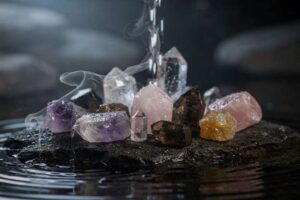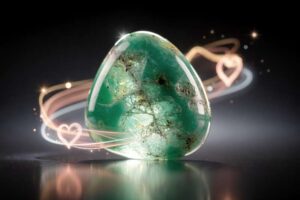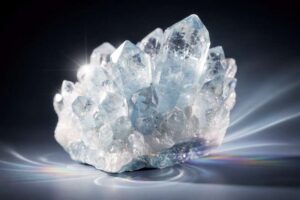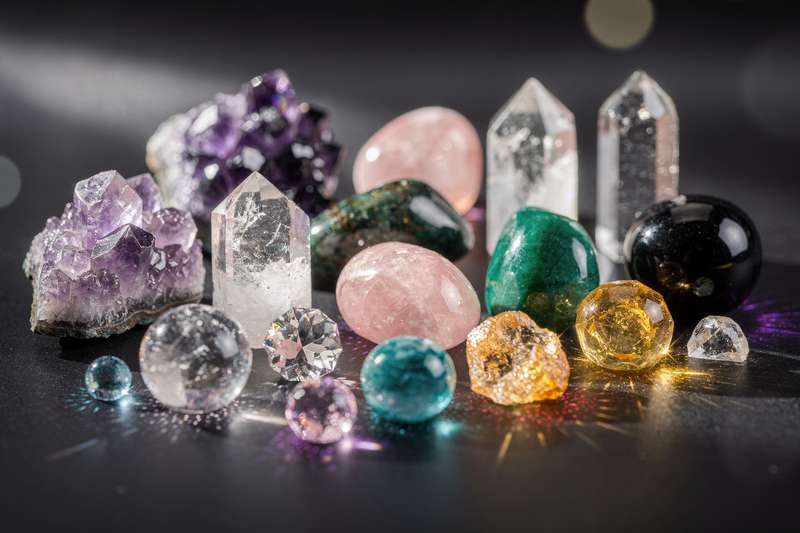
How to identify stones and crystals is one of the most empowering skills you can develop as a crystal healer or collector. The moment you can look at a stone — a glassy chunk of obsidian, a pale lavender amethyst point, or a shimmering piece of labradorite — and know what it is and what it offers energetically, your relationship with the mineral kingdom shifts entirely. Stone identification bridges the gap between casual curiosity and true intentional healing work.
Every crystal on this planet formed over millions of years through extraordinary processes deep within Earth’s core. Heat, pressure, and mineral chemistry combined to create structured molecular patterns called lattices — and those patterns are your first key to identifying any stone you encounter. Understanding how crystals form, what shapes they naturally take, and how their colors carry distinct vibrational frequencies will transform how you choose, use, and care for your collection.
What Crystal Identification Really Means for Your Healing Practice
Crystal identification goes far beyond being able to name a stone at a glance. It is about understanding a mineral’s composition, internal structure, and energetic signature so you can work with it consciously and purposefully. When you confirm that the black stone in your hand is Black Tourmaline — and not Obsidian or Onyx — you know you’re working with a powerful electromagnetic protector, not just a generic dark crystal.
Crystals are classified by their internal structure, known as a crystal system or lattice. As minerals form deep in the earth, their molecules arrange themselves into repeating geometric patterns that determine the crystal’s shape, surface appearance, and — within healing traditions — its energetic behavior. There are six main crystal systems to know:
- Cubic (Isometric): Three equal axes forming cubes, octahedrons, and dodecahedrons. Examples: Pyrite, Diamond, Fluorite, Garnet. Their perfectly balanced structure is associated with harmonizing and magnifying energy in any environment.
- Hexagonal: Four axes with six-sided symmetry. Examples: Emerald, Aquamarine, Beryl. Traditionally linked to heart-centered and throat-centered healing.
- Tetragonal: Two four-sided pyramids joined at the base. Examples: Apophyllite, Zircon. Known in healing work for channeling and directing energy upward.
- Orthorhombic: Three unequal axes forming an elongated shape. Examples: Peridot, Topaz, Danburite. These crystals are associated with transformation and renewal.
- Triclinic: The most asymmetrical system — three unequal axes at oblique angles. Examples: Labradorite, Turquoise, Amazonite. Their irregular structure produces a complex, multi-layered energetic field.
- Trigonal: A subsystem of hexagonal, with an elongated lozenge shape. Examples: Clear Quartz, Amethyst, Calcite, Tourmaline. Among the most energetically versatile crystal families you will encounter.
Identifying Crystals by Color: Your Fastest Guide to Stone Healing Properties
Color is one of the most accessible stone identification methods available to you — and one of the most meaningful. A crystal’s color reflects the specific minerals and trace elements present during its formation, and those elements carry distinct energetic frequencies. Many experienced healers work with color intuitively long before they open a reference book.
One important caveat: some crystals — Calcite, Fluorite, and Tourmaline among them — appear in nearly every color of the spectrum. If color alone doesn’t confirm your identification, cross-reference additional physical properties or use a crystal directory with photographs before drawing a final conclusion.
- Black: Protection, grounding, and transmutation of dense energy. Common black crystals: Black Tourmaline, Black Obsidian, Onyx, Hematite, Jet. Strongly connected to the root chakra.
- White / Clear: Clarity, amplification, and spiritual connection. Examples: Clear Quartz, Selenite, Howlite. Associated with the crown chakra.
- Purple / Violet: Intuition, psychic awareness, and spiritual growth. Examples: Amethyst, Lepidolite, Charoite. Linked to the third-eye chakra and crown chakra.
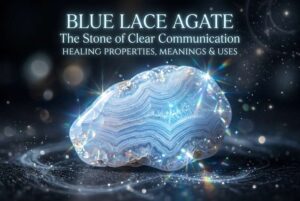
- Blue: Communication, calm, and truthful expression. Examples: Lapis Lazuli, Sodalite, Blue Lace Agate, Aquamarine. Resonates with the throat chakra.
- Green: Heart healing, abundance, and renewal. Examples: Malachite, Green Aventurine, Jade, Emerald. Works with the heart chakra.
- Pink: Unconditional love, compassion, and emotional healing. Examples: Rose Quartz, Rhodonite, Mangano Calcite. Aligned with the heart chakra.
- Yellow / Gold: Confidence, personal power, and joy. Examples: Citrine, Tiger’s Eye, Yellow Calcite. Activates the solar plexus chakra.
- Orange: Creativity, sensuality, and emotional flow. Examples: Carnelian, Sunstone, Orange Calcite. Linked to the sacral chakra.
- Red: Passion, vitality, and physical energy. Examples: Red Jasper, Garnet, Ruby. Root chakra powerhouses, all of them.
A practical reminder: Always cross-reference at least two or three physical properties — not color alone — before confirming an identification. Color is the starting point, not the final word.
Additional Stone Identification Methods Beyond Color and Shape
When color and lattice shape still leave you uncertain, these physical properties offer a reliable path forward.
Hardness: The Mohs Scale
The Mohs scale ranks minerals from 1 (softest — Talc) to 10 (hardest — Diamond). A simple scratch test eliminates a wide range of candidates quickly. Your fingernail registers around 2.5 on the scale, a copper coin around 3.5, and a steel blade around 5.5. If your mystery stone scratches glass with ease, that alone rules out softer minerals like Selenite or Gypsum and points you toward harder crystal families.
Luster
Luster describes how light interacts with a crystal’s surface. Metallic luster — like Pyrite’s golden sheen — looks dramatically different from the glassy or vitreous luster of Quartz, or the silky iridescence of Satin Spar Selenite. Pearly, resinous, waxy, and adamantine lusters each point to distinct mineral families and are worth learning to recognize by sight.
Transparency
Is your stone fully transparent (Clear Quartz, Aquamarine), translucent (Rose Quartz, Green Aventurine), or fully opaque (Malachite, Black Obsidian)? This single characteristic eliminates a vast range of candidates and significantly narrows your identification path.
Texture and Signature Markings
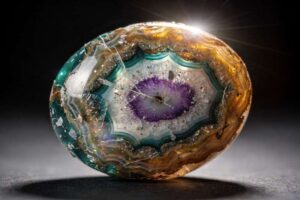
Hold the stone and observe its surface closely. Does it have distinctive concentric banding, like Malachite’s rich green rings? Does it flash a blue-green iridescence when you tilt it under the light — the phenomenon known as labradorescence, unique to Labradorite? Some crystals can be identified by their signature visual traits alone, no reference guide required.
Healing Properties Revealed Through Crystal Identification
Understanding a crystal’s lattice system opens a direct window into how it channels healing energy. Cubic crystals — Fluorite, Garnet, Pyrite — carry a deeply stabilizing quality. They bring balance and coherence to scattered energetic environments. Hexagonal crystals like Emerald and Aquamarine move energy smoothly and fluidly, supporting emotional openness and heart-to-throat communication.
Trigonal crystals — which include the entire Quartz family — are considered among the most energetically potent of all. Their natural six-sided symmetry creates a pronounced amplifying effect, making Clear Quartz in particular an ideal companion for almost any other healing stone. If you’re building a crystal collection for the first time, a natural Clear Quartz point is the single most versatile and universally useful tool you can start with.
Emotional and Mental Benefits of Knowing Your Crystals
There is something quietly grounding about the practice of crystal identification. Learning to sit with an unfamiliar stone and read its physical properties — observing color, testing hardness, examining surface texture — cultivates patience and deep presence. In a world that rewards constant speed, slowing down to truly look at something is its own form of meditation.
Knowing your crystals with confidence also brings clarity and intention to your healing practice. Instead of reaching randomly into a dish and hoping for the best, you choose Black Tourmaline deliberately when you need energetic protection, Amethyst when your mind refuses to quiet, or Carnelian when creative energy has stalled. That intentionality is what elevates crystal work from novelty to genuine practice — and it begins with identification.
Physical Healing Associations by Crystal Type
Within crystal healing traditions, specific stone types are believed to support the body in distinct ways — associations that trace back to color, mineral composition, and the chakra system. Red and orange stones (Garnet, Red Jasper, Carnelian) are linked with circulation, stamina, and physical vitality. Blue stones (Blue Lace Agate, Aquamarine, Sodalite) are traditionally associated with the throat and thyroid area and with calming an overactive nervous system. Green stones (Malachite, Green Aventurine) are connected to heart support and regenerative energy.
Crystal healing is a complementary wellness practice, not a replacement for professional medical care. That said, understanding these traditional associations gives you a far more intentional foundation for building your personal crystal toolkit.
The Spiritual Meaning of Learning to Identify Your Stones
From a spiritual perspective, knowing your crystals is more than practical skill — it is a form of deepened relationship with the Earth itself. Ancient civilizations around the world knew their minerals intimately. Egyptians worked with Lapis Lazuli and Turquoise as sacred ceremonial materials. Romans prized Garnet and Amethyst as symbols of divine favor. Indigenous cultures worldwide built spiritual practices around specific stones drawn from their local lands.
When you learn to identify the crystals in your hands, you step into that long lineage of earth reverence. You acknowledge that these minerals are not interchangeable — that each one carries a distinct frequency, a specific gift shaped by millions of years of geological and chemical history. That recognition, in and of itself, is a sacred act.
How to Use Crystal Identification in Your Daily Practice
Here are practical ways to bring confident stone identification into your everyday healing work:
- Keep a reference guide nearby. A well-illustrated crystal field guide with photos allows you to cross-reference color, shape, luster, and hardness until identification becomes second nature.
- Handle your stones regularly. The more time you spend physically holding crystals, the more their individual textures, weights, and energetic signatures become immediately recognizable to you.
- Use a 10x jeweler’s loupe. This simple tool lets you examine internal structure, natural inclusions, and surface texture up close — a genuine game-changer for any serious stone identification work.
- Attend gem and mineral shows. Seeing hundreds of clearly labeled specimens in person accelerates your identification skills faster than any book or online course.
- Combine analytical observation with energetic intuition. Once you’ve confirmed a stone’s identity through its physical properties, sit with it quietly and notice how your body responds. Your felt sense is a legitimate part of the identification and selection process.
Crystals That Pair Well Together
Once you can reliably identify your stones, building intentional crystal pairings becomes natural and deeply rewarding. Here are some of the most effective and widely used combinations in crystal healing:
- Clear Quartz + Any Stone: Clear Quartz amplifies the energy of whatever it accompanies. Place it alongside any crystal to intensify that stone’s core healing properties.
- Black Tourmaline + Selenite: A classic protection-and-purification duo. Black Tourmaline deflects disruptive energy; Selenite keeps the surrounding space clear and high-vibration.
- Rose Quartz + Amethyst: Heart healing meets mental stillness — a powerful combination for emotional processing, grief work, or restoring inner calm after turbulence.
- Citrine + Green Aventurine: Two of the most celebrated abundance stones in crystal healing, often placed together to create a focused field of prosperity and opportunity.
- Labradorite + Lapis Lazuli: A potent pairing for psychic development and spiritual insight, both working directly with the third-eye chakra to sharpen intuitive perception.
How to Cleanse Your Crystals After Identifying Them
Once you’ve identified a new crystal, cleansing it before use is an essential first step — especially if it passed through many hands before reaching yours. Crucially, knowing a crystal’s identity tells you exactly which cleansing methods are safe for it, since different minerals respond very differently to water, sunlight, and other common methods.
- Moonlight: Safe for virtually all crystals. Place stones outside or on a windowsill under a full moon or new moon to cleanse and energetically recharge them overnight.
- Sound: A singing bowl, tuning fork, or bell cleanses any crystal safely through vibration alone — no water or light required, making it ideal for delicate stones.
- Smoke: Pass your crystal through the smoke of sage, palo santo, or incense to clear its energetic field. Safe for all stone types.
- Earth burial: Placing a crystal directly in soil overnight returns it to its original energetic state — particularly restorative for stones that feel heavy or depleted.
- Avoid water with: Selenite, Malachite, Pyrite, Halite, and any stone rated below 5 on the Mohs hardness scale. Water can physically damage or dissolve these minerals.
- Avoid prolonged sunlight with: Amethyst, Rose Quartz, Fluorite, and Aquamarine — these color-sensitive stones fade noticeably with regular direct sun exposure.
Frequently Asked Questions About Identifying Stones and Crystals
How can I tell if a crystal is real or fake?
Real crystals feel noticeably cool to the touch because mineral structures conduct heat away from your skin, while glass or plastic substitutes warm up quickly in your hand. Natural crystals also tend to display subtle inclusions, slight color variations, or minor surface irregularities — perfect, flawless uniformity is one of the most reliable signs of synthetic material or glass.
What is the easiest way to identify an unknown crystal?
Start with color, then check luster — how light reflects off the surface — and perform a hardness test if possible. Cross-referencing those three properties with a crystal field guide or reputable photo database will reliably identify most commonly available stones. This three-step method works for the vast majority of crystals beginners encounter.
Do all crystals of the same type look identical?
No — the same crystal type can vary widely in color, clarity, and form depending on where it formed and which trace minerals were present. Fluorite, Tourmaline, and Calcite are well-known examples that appear in virtually every color. This is exactly why relying on color alone is never enough — always check multiple physical properties before confirming an identification.
Does the shape of a crystal affect its healing properties?
Within crystal healing traditions, both a crystal’s natural lattice structure and its cut or polished form influence how energy moves. A raw crystal radiates energy outward in all directions, a point focuses energy along a specific axis, and a sphere emits uniformly in every direction. Tumbled stones carry a gentler, more diffused energy field — ideal for everyday carry or placing near the body.