The 22 Acts of Magic with Nancy Antenucci is one of the most inventive approaches to Major Arcana magic you will find in modern tarot practice. Rather than treating the 22 Major Arcana cards as a list of symbols to memorize, Nancy’s framework invites you to live each archetype through music, movement, art, and deep reflection. If you have ever felt that tarot was more than a fortune-telling tool, this approach confirms exactly that. The Major Arcana becomes a spiritual curriculum, and every card a doorway into a part of yourself waiting to be understood. Whether you are brand new to tarot or have shuffled your deck for years, this guide will help you understand the philosophy behind the 22 Acts, give you practical steps to apply it at home, and show you how to blend intuition with structure in a way that feels genuinely alive.
What Are the 22 Acts of Magic?
The 22 Acts of Magic is a workshop concept developed by tarot reader, author, and spiritual mentor Nancy Antenucci. The central idea is simple and powerful: each of the 22 Major Arcana cards represents a distinct energetic state, and instead of just reading about that state, you enact it. You move through it, create something with it, and let it move through you.
A common myth about Major Arcana work is that you need years of study before you can connect with these archetypes. Nancy’s approach turns that on its head. She came to tarot as a child without a guidebook, learning through pure intuition and imagery. Her method honors both the traditional system that centuries of tarot history have built and the personal, lived experience you bring to every card. You do not have to choose between intuition and tradition. The 22 Acts of Magic says you need both, in conversation with each other.
The Major Arcana cards span from The Fool (numbered 0) through The World (numbered 21), giving you exactly 22 distinct archetypes. Each one maps a stage of the soul’s journey from innocent beginnings to integrated wholeness.
Types of Magic Within the 22 Acts Framework
One of the reasons this practice resonates with so many different kinds of practitioners is that it does not demand one single approach. Here are the main modes Nancy weaves together:
- Movement and Dance: Each Major Arcana card carries a physical quality. The Emperor stands firm and rooted. The Star is open and receptive. By embodying a card’s posture or moving to music that captures its energy, you bypass the thinking mind and drop into direct knowing.
- Visual Art and Collage: Creating imagery tied to a card, whether drawing, painting, or cutting images from magazines, anchors abstract archetypes into something tangible. You are literally making the card real in your world.
- Music and Sound: Selecting a song or piece of music that feels like The Moon or The Tower creates an instant emotional bridge. Sound bypasses intellectual analysis and speaks directly to the subconscious.
- Visualization and Meditation: Guided inner journeys through a card’s symbolic landscape let you meet the archetype on its own terms. This is particularly powerful for cards that feel challenging or confusing.
- Journaling and Reflection: Writing freely about what a card brings up for you, without censoring, reveals personal material that no keyword list ever could.
- Group and Community Work: Nancy originally developed this as a workshop, meaning shared exploration deepens individual insight. Online communities and study circles can replicate this beautifully.
How to Practice the 22 Acts of Magic: Step by Step
You do not need to attend a live workshop to benefit from this framework. Here is how to bring it into your own practice, one card at a time.
Step 1 — Set Your Intention for the Journey
Before you pull a single card, take a few quiet minutes to articulate why you are doing this work. Are you seeking self-understanding? Creative inspiration? A deeper tarot practice? Writing your intention in a journal seals the commitment. Think of yourself as a traveler who has just stepped onto a long road. Knowing why you started matters when the path gets interesting later on.
Step 2 — Choose Your Starting Card
You can work sequentially, beginning with The Fool and moving through all 22 Major Arcana in order. Alternatively, you can draw a card at random and work with whichever archetype presents itself. Beginners often benefit from the sequential approach because the Major Arcana tells a coherent story when read from card 0 through card 21. Each stage of the journey builds on the last.
Step 3 — Spend Time Simply Looking
Place the card in front of you and look at it for at least five minutes without reading anything about it. Notice what you feel first. What colors stand out? What figures or symbols catch your eye? What is your gut reaction? This first, unconditioned impression is data. Write it down before you look at any traditional meaning. Your intuitive read is always worth recording.
Step 4 — Research the Traditional Symbolism
Now bring in the traditional knowledge. Read about the card’s historical meanings, its astrological correspondence, its numerological value, and the symbols depicted in your deck. This is not about replacing your intuitive impression but enriching it. Where do the traditional meanings confirm what you felt? Where do they surprise you? The conversation between your instinct and the tradition is where real understanding grows.
Step 5 — Choose a Creative Act
Pick one creative mode that resonates with you today and spend at least 20 to 30 minutes with it. You might find a piece of music that feels like the card and listen with eyes closed. You might sketch the figure in the card from memory, letting your hand move freely. You might stand up, feel into the card’s energy, and let your body move however it wants. There is no right or wrong output here. The act of engaging creatively is the magic itself.
Step 6 — Journal the Experience
After your creative act, open your journal and write without stopping for ten minutes. What came up? What surprised you? Did any memory, emotion, or life situation surface? Many practitioners find that a specific Major Arcana card keeps appearing right when the corresponding life theme is most active for them. Your journal becomes a record of that pattern over time.
Step 7 — Sit With the Card for a Full Day
Keep the card visible in your home or workspace for the rest of the day. Place it on your altar, prop it against your morning coffee mug, or photograph it for your phone’s wallpaper. Notice whether the card’s themes show up in your conversations, your dreams, or the situations you encounter. The Major Arcana archetypes are alive in everyday life once you start looking.
Step 8 — Connect Intuition and Traditional Knowledge
At the end of your day with a card, write a summary in your own words. Describe what this archetype means to you now, after the creative work and the day of attention. Then compare this personal definition to a traditional one. You may find they are surprisingly close. You may find yours is richer and more specific to your life. Both are valid. This synthesis, your voice plus the tradition’s voice, is exactly what Nancy points to when she talks about the relationship between intuition and structure.
Step 9 — Pace Yourself Through All 22 Cards
Give each card its own dedicated time. One card per week gives you a 22-week journey. One card per day gives you a three-week intensive. Neither pace is superior. What matters is that you are genuinely present for each one rather than rushing to tick them all off a list. The Fool’s journey is not a race.
Essential Tools and Supplies
You need far less than you might think to begin this practice.
- A tarot deck you love: Any deck whose imagery speaks to you works. A visually rich deck like the Rider-Waite-Smith makes symbol work particularly accessible for beginners.
- A dedicated journal: Keep all your card impressions, creative notes, and reflections in one place. Over time it becomes an invaluable record.
- Art supplies: Colored pencils, a sketchbook, or even old magazines for collage are enough. No artistic talent required.
- A music playlist: Build a playlist as you go, adding one track per card. You will end up with a 22-song soundtrack of your soul’s journey.
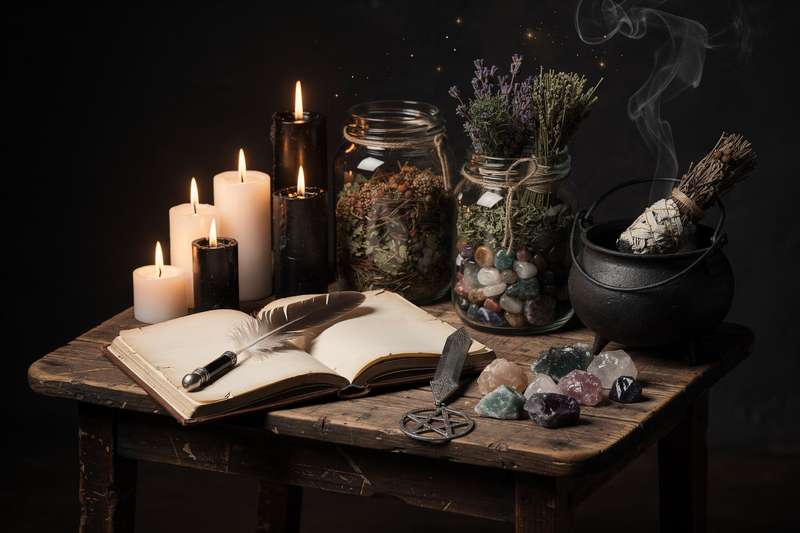
- Candles and crystals (optional): Setting a small altar space with a candle and perhaps a crystal that resonates with the card you are working on creates a container of intention. Amethyst suits cards linked to intuition like The High Priestess. Citrine brightens solar cards like The Sun.
- A quiet space and regular time: This is the most important supply of all. Even 30 minutes of uninterrupted time matters more than any physical tool.
Ethics and Best Practices
Magic of any kind, including the inner magic of working with archetypes, carries responsibility. A few principles keep this practice healthy and grounded.
Work with consent. When you bring tarot or magical reflection into work that involves other people in your life, be mindful that their stories are not yours to process without their knowledge. Keep the focus on your own growth and patterns.
Respect the roots of what you practice. Tarot has a layered history drawing from multiple cultural and spiritual traditions. Approach that history with curiosity and humility rather than treating any tradition as a costume.
Honor what surfaces. The Major Arcana can stir deep material. If a card brings up genuine grief, trauma, or distress, honor that by seeking appropriate support, whether from a trusted friend, a therapist, or a spiritual community. Creative and magical work opens doors. Make sure you have support on the other side.
The guiding principle is harm to none, including yourself. A practice that leaves you depleted or destabilized is not serving you. Move at a pace that feels genuinely nourishing.
Common Beginner Mistakes
- Rushing through all 22 cards at once: Treating this as a checklist robs you of the depth each card offers. Quality of attention beats quantity of cards covered.
- Relying only on keywords: Keywords are useful memory aids, but if you read only from a list you never develop the personal relationship with each archetype that makes tarot genuinely insightful.
- Dismissing traditional meanings entirely: Equally, pure free-association without any grounding in the tradition can leave you spinning without clarity. Nancy herself discovered this the hard way in her early solo years. Both intuition and tradition earn their place.
- Skipping the creative acts: Reading about this method is very different from actually doing the movement, art, or music exercises. The transformation happens in the doing, not the knowing.
- Judging your creative output: If you tell yourself your drawing is bad or your music choice is wrong, you shut the process down. There is no wrong answer when you are doing inner work.
- Comparing your experience to someone else’s: Your relationship with The Tower may look completely different from your friend’s. That difference is not a mistake. It is information about your specific life and soul.
How to Build Your Practice Over Time
The 22 Acts framework is not a one-time event. Many practitioners cycle through the Major Arcana repeatedly, finding that each pass through reveals new layers. After your first full journey, you might return to only the cards most charged with meaning for you, or choose to work seasonally, selecting a card that reflects each new lunar cycle or astrological season.
Consider keeping a long-term practice journal where you revisit past entries. Reading what you wrote about The Tower six months ago and then rereading it after a period of genuine upheaval in your life can be humbling and clarifying. Over years, a practice like this becomes a living autobiography written in archetype. Let it grow with you.
Final Thoughts
The 22 Acts of Magic with Nancy Antenucci reminds us that tarot is not a passive activity. The cards do not speak at you. They speak with you, through the creative and intuitive faculties you already carry. Every Major Arcana card is both a mirror and a teacher. When you engage with them through movement, art, sound, and reflection, you stop being a student of tarot and start being a co-creator with it. Begin with one card, one act, one honest moment of attention. That is all the magic requires.
Frequently Asked Questions
What is the 22 Acts of Magic in tarot?
The 22 Acts of Magic is a spiritual practice framework developed by tarot reader and author Nancy Antenucci. It involves working through each of the 22 Major Arcana cards using creative acts like movement, music, art, and journaling. The goal is to experience each archetype directly rather than just memorizing its traditional meaning.
Do I need to know tarot already to try this practice?
No prior tarot knowledge is required. The framework is designed to let beginners build a personal relationship with the cards from the ground up. Traditional meanings are introduced after your initial intuitive impression, so the learning happens organically as you go.
How long does it take to complete all 22 Acts of Magic?
That depends entirely on your pace. Spending one day per card gives you a 22-day practice, while dedicating one full week to each card stretches the journey to about five months. Many practitioners find that slower, deeper engagement with each card yields more lasting insight than rushing through the sequence.
Can I practice the 22 Acts of Magic without attending a workshop?
Absolutely. The principles translate beautifully to solo home practice. Using a journal, a tarot deck you love, and the step-by-step approach outlined above, you can move through all 22 Major Arcana archetypes on your own schedule. Online tarot communities can also provide a sense of group reflection if you want to share insights with others.