Tarot Card Answers at a Glance
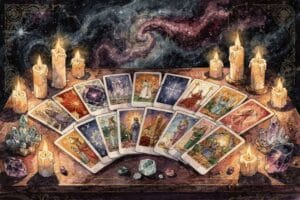
Tarot Card Answers is less a single card and more a philosophy of reading — a method championed by practitioners like Jeffri Lynn, who found in it exactly what she described: “tips to understand the cards on the fly through imagery, symbolism, and even card combinations to consider.” This approach treats every card not as a static definition to memorize, but as a living image rich with layered meaning waiting to be unlocked by your own perception.
The core promise of Tarot Card Answers is confidence. Not the false confidence of having memorized 78 keywords, but the deep, grounded confidence that comes when you look at a card and genuinely understand what it is saying — right now, in this spread, for this question. That is the transformation Jeffri Lynn and thousands of other readers have experienced through this method.
Upright Meaning: When the Cards Begin to Speak
When you approach tarot through an imagery-first lens — the way Tarot Card Answers teaches — the upright energy of any card becomes far more accessible. You are no longer guessing. You are observing: the colors, the figures, the symbols, the direction a character faces, the objects they hold. Each detail is a piece of a story your intuition already knows how to read.
Upright, this approach signals a period of genuine growth in your tarot practice. You begin to honor what rises instinctively when you look at a card. You stop waiting for an external authority to confirm what you already sense. This is reading tarot as it was always meant to be experienced — as a conversation between you, the imagery, and the deeper intelligence within you.
- Trust your first impression — the image speaks before the intellect does
- Notice card combinations — how do neighboring cards modify each other’s message?
- Let symbolism breathe — a single symbol can carry multiple meanings depending on context
- Build confidence through practice — daily one-card draws are one of the most powerful tools available
Reversed Meaning: When You Stop Trusting What You See
The reversed energy of Tarot Card Answers points to one of the most common struggles in tarot learning: the gap between seeing and trusting. You look at a card and something stirs — an impression, a feeling, a knowing — and then the analytical mind steps in and dismisses it. “That can’t be right. I don’t know enough yet.”
This reversal is an invitation to examine where your self-doubt in reading comes from. Are you comparing yourself to advanced readers and feeling perpetually behind? Are you treating tarot as a test you can fail rather than a language you are gradually becoming fluent in? The blocked energy here is not a lack of ability — it is a lack of permission to trust yourself.
“This is exactly what I’ve been looking for to grow my confidence and honor my intuition.” — Jeffri Lynn
The path forward is to return to the basics: look at the imagery, name what you see without judgment, and let that observation be your starting point. Confidence is not a prerequisite for reading tarot — it is the result of reading tarot repeatedly and discovering that your instincts are far more reliable than you believed.
Love & Relationships: Reading the Deeper Story
In a love reading, the Tarot Card Answers philosophy asks you to go beyond the obvious. Rather than fixating on whether a card is “good” or “bad” for romance, you look at the full picture — the imagery, the energy between cards, the story the spread is collectively telling. This is where tarot becomes a genuinely powerful tool for relationships.
Are two figures in neighboring cards facing each other or turning away? What does the color palette of a love spread suggest about its emotional temperature? These are the kinds of questions that transform a tarot reading from a list of keywords into genuine insight. Whether you are exploring a new connection, a long-term partnership, or your relationship with yourself, the imagery-first approach brings remarkable clarity.
Career & Finance: Building a Practice You Can Trust
For those building a professional tarot practice — or using tarot to support career decisions — the Tarot Card Answers method is especially valuable. It gives you a repeatable framework: look at imagery, consider symbolism, examine card combinations, and trust the pattern that emerges.
In terms of career guidance, this approach signals that expertise comes through engaged observation and practice, not through overnight mastery. If you have been considering offering tarot readings, teaching others, or simply using tarot as a daily decision-making tool, this is strong encouragement to move forward. Your growing confidence is a real and earned asset.
- Use tarot for weekly career reflection rather than one-off readings
- Pay attention to which suits dominate your career spreads (Pentacles for practical matters, Wands for passion and direction)
- Card combinations reveal nuance — a single card never tells the whole story
Spirituality: Honoring Your Inner Knowing
At its spiritual core, Tarot Card Answers is about reclaiming your own wisdom. The cards are not an oracle that lives outside of you — they are a mirror that reflects what is already present within your consciousness. When you learn to read through imagery and symbolism rather than through rote definitions, you are developing a form of visual and intuitive literacy that extends far beyond tarot.
Many readers find that working this way — slowly, attentively, trusting what arises — begins to sharpen their intuition in everyday life. They start noticing symbols in dreams, in conversations, in the world around them. Tarot becomes not just a divination tool but a genuine spiritual practice, one that connects them more deeply to their own inner guidance.
Crystals like amethyst and labradorite are wonderful companions for this kind of intuitive reading practice, as both support psychic development and inner clarity. Working with your third-eye chakra through meditation before a reading can also deepen the imagery-reading experience significantly.
Tarot Card Answers in a Reading: What to Watch For
When the spirit of Tarot Card Answers appears in a reading — either through the cards that show up or through the quality of the reading experience itself — here is what to pay attention to:
- Are you over-explaining? A reading that flows naturally is a sign your intuition is active. If you are forcing interpretations, come back to the image.
- What stands out immediately? Your first impression of a card is almost always the most important one. Write it down before you consult any external meaning.
- How are the cards interacting? Card combinations often carry more information than individual cards. A challenging card surrounded by supportive ones tells a very different story than the same card in isolation.
- What does your body tell you? A slight tension in the chest, a feeling of expansion, a sense of recognition — these are physical signals that your intuition is engaged.
- Trust the process. Reading tarot with genuine confidence is not the starting point — it is the destination you reach through consistent, curious practice.
The Tarot Card Answers approach, as experienced by readers like Jeffri Lynn, ultimately reminds us of something profound: the answers are already in the cards, and more importantly, the ability to read them is already within you. Your task is simply to learn the language — one image, one symbol, one spread at a time.
Frequently Asked Questions
What is the Tarot Card Answers method and how does it work?
Tarot Card Answers is an approach to reading tarot that prioritizes imagery, symbolism, and card combinations over rote memorization of fixed meanings. Instead of looking up definitions, you train yourself to observe what is actually depicted in the card and let that observation guide your interpretation. Over time, this builds genuine reading confidence rooted in intuition rather than anxiety.
How do card combinations work in tarot reading?
Card combinations occur when two or more cards in a spread modify or amplify each other’s meaning. For example, a card associated with conflict placed next to a card associated with communication changes the message of both. Learning to read combinations — rather than treating each card as isolated — is one of the fastest ways to deepen your tarot readings.
How long does it take to feel confident reading tarot?
Confidence in tarot reading develops through consistent practice rather than study alone. Many readers find that a daily one-card draw — where they observe the imagery, write their impressions, and then compare to traditional meanings — builds genuine fluency within a few months. There is no fixed timeline; the key is regular, curious engagement with the cards.
Can beginners use the imagery-first approach to tarot?
Absolutely — in fact, imagery-first is arguably the best approach for beginners precisely because it does not require you to have memorized anything first. You simply look at the card and describe what you see. From that honest observation, meaning naturally emerges. This approach also prevents the common beginner trap of reading from memory rather than from the actual spread in front of you.