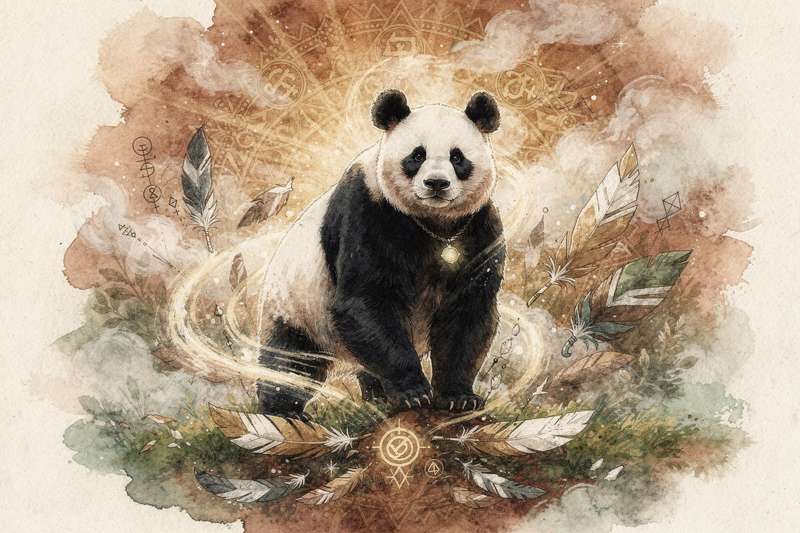
The Panda as a Spirit Animal
The panda spirit animal is one of the most quietly powerful guides in the animal kingdom. As a spirit animal — sometimes called a totem or power animal — the panda brings forward a medicine that is rare in a loud, fast-moving world: the medicine of peaceful presence. If the panda has been showing up in your life — in dreams, in recurring images, in moments where you feel an inexplicable pull toward this black-and-white bear — you are being called to slow down, recenter, and rediscover the strength that lives in stillness.
Unlike predatory spirit animals such as the wolf or hawk, the panda does not hunt. It does not dominate. It sits in its bamboo forest, eating with full attention, resting without guilt, and holding its ground without baring its teeth unless absolutely necessary. This is exactly the kind of wisdom it offers you: the ability to be both soft and unshakeable at the same time.
Panda spirit animal energy works directly on the heart chakra — the energetic center of love, compassion, and emotional balance. When the panda appears as your guide, it is often because your heart has been working overtime, giving to others at the expense of yourself, or because you need to restore harmony between the giving and receiving in your life.
Core Symbolism of the Panda Spirit Animal
The panda carries a rich constellation of symbolic meanings that have been recognized across cultures for centuries. At its heart, panda symbolism is about balance, gentleness, and the quiet power of choosing peace.
- Yin and Yang: The panda’s black-and-white coloring is one of nature’s most vivid symbols of duality. Black represents yin — the receptive, introspective, feminine principle. White represents yang — the active, clear, outward-moving principle. The panda carries both without conflict, making it a living embodiment of harmony between opposites.
- Gentle Strength: Despite its cuddly appearance, a giant panda is immensely strong — capable of climbing trees, swimming rivers, and withstanding harsh mountain conditions. In Chinese tradition, pandas were considered as formidable as tigers. Their power is real; it is simply not aggressive.
- Peace and Harmony: In Chinese culture, pandas are one of the oldest symbols of peace. They are known as the nation’s most treasured animals and have long been associated with the harmonious resolution of conflict.
- Heart-Centered Energy: The panda’s entire way of life is about nourishment — eating bamboo for most of the day, resting deeply, nurturing its young. This makes it a profound symbol of heart-centered living and self-care.
- Personal Boundaries: The panda is largely solitary and protective of its personal space. As a spirit animal, it teaches you that healthy boundaries are not walls — they are the foundation of real connection.
- Gratitude and Simplicity: The panda thrives on one thing: bamboo. This single-minded contentment is a spiritual lesson in gratitude — finding deep nourishment in what is simple and available to you right now.
“The panda teaches that gentleness is not fragility. In a world that glorifies hustle and loudness, this spirit animal invites you to slow down, trust the stillness, and remember that balance is the rarest magic of all.”
What It Means When the Panda Spirit Animal Appears to You
When the panda spirit animal makes itself known in your life, it rarely shows up by accident. Pay attention to where and how you encounter it. Is it arriving in your dreams? Appearing on your social media feed at a moment of stress? Showing up in a book you randomly opened? Each context carries meaning.
It May Be Time to Restore Balance
The most common message the panda brings is one of equilibrium. If your life has been tilting too far in one direction — too much work, too much social activity, too much giving without receiving — the panda is asking you to return to center. Think of the yin-yang: when one side becomes too dominant, the whole system suffers. The panda’s appearance is a signal to audit where your energy is going and to reclaim what is yours.
You Are Being Called to Set Boundaries
If people have been crossing your emotional or personal limits, and you have been quietly absorbing it, the panda spirit animal is showing up to remind you: you are allowed to protect your space. You do not need to roar to be respected. A firm, calm boundary communicated with warmth is the panda’s way — and it works.
Gratitude Is Your Medicine Right Now
The panda can also appear as a reminder to count your blessings. When you find yourself dwelling on lack, on what is missing, on what has gone wrong, the panda nudges you to shift your gaze. Gratitude — real, felt gratitude for the simple things — is one of the most powerful energetic tools you have.
Rest Is Not Laziness
If the panda appears when you are exhausted or burned out, take it seriously. This spirit animal does not glorify overwork. The panda eats, rests, climbs, and rests again. It has no shame about this rhythm. If you have been running on empty, the panda says: stop. Eat something good. Sleep. The work will still be there, and you will approach it better when you are whole.
The Panda Spirit Animal in Chinese and Eastern Mythology
No other culture has a deeper spiritual relationship with the panda than China. In ancient Chinese mythology, the giant panda — known as dà xióng māo — was considered more than just an animal. It was a symbol of imperial power, natural harmony, and peaceful resolution.
One of the most beautiful origin myths tells that pandas were once entirely white. During a great battle between warring tribes, the pandas refused to fight. They stood between the armies in an act of peaceful resistance. As warriors fell around them, the pandas mourned — and their tears, mixing with ash from the battlefield, stained their fur black. The dark patches around their eyes, ears, and limbs are said to be the permanent marks of their grief and their courage. This story captures something essential about panda energy: standing your ground for peace, even when war surrounds you.
Another legend links the panda to Guanyin, the Goddess of Mercy — one of the most beloved figures in East Asian spirituality. According to this tale, Guanyin tamed a fierce, fire-breathing creature by offering it bamboo shoots. The beast was transformed through this act of compassion, becoming docile and gentle. In this story, the panda carries the energy of transforming aggression into compassion — a quality it passes on to those it guides.
In Chinese cosmology, the panda is also deeply connected to the yin-yang philosophy. Its black-and-white coloring makes it a living mandala — a physical manifestation of the universe’s need for both darkness and light, stillness and action, receiving and giving.
The panda also holds status as China’s national treasure and has long been used in panda diplomacy — gifted between nations as a gesture of goodwill and peaceful intent. Even at a geopolitical level, this animal functions as a spiritual ambassador.
In Tibetan folklore, pandas (and their Himalayan cousin, the red panda) appear in stories brought by traveling monks. One legend describes a giant panda that rolled down a mountainside during a landslide, packing loose soil with its body and then planting bamboo roots with its paws to stabilize the earth. Villagers interpreted this as a sign that pandas are earth healers — beings that mend broken landscapes and restore harmony to fractured communities.
In the Japanese Zen Buddhist tradition, the panda’s slow, deliberate movements and complete absorption in simple tasks mirror the ideal of ichigyo zammai — one-action samadhi, or total presence in a single activity. A panda eating bamboo for hours is, in this light, a masterclass in mindfulness.
The Panda Spirit Animal in Other Cultures
While the panda is most deeply rooted in Eastern traditions, its energy resonates across cultures wherever people encounter it. Because giant pandas were largely unknown to Western cultures until the 19th and early 20th centuries, there is no deep indigenous Western mythology around them. However, the panda has rapidly accumulated spiritual meaning in modern neoshamanic and totem traditions.
In contemporary neoshamanistic practice, the panda is recognized as a power animal for those who need support with conflict resolution, self-nurturing, and the cultivation of personal boundaries. Its bear lineage connects it to broader bear medicine — the energy of introspection, hibernation, and inner wisdom — while its unique herbivorous, peace-seeking nature distinguishes it from more aggressive bear totems.
The WWF’s iconic panda logo, designed in 1961, has also given the panda global spiritual resonance as a symbol of endangered hope — the idea that something precious, gentle, and irreplaceable is worth protecting. In this way, the panda has become a collective spirit animal for the modern conservation and environmental healing movement.
In some folk traditions across Asia, carved panda statues were placed near doorways to absorb negative energy and ward off arguments and illness — functioning like spiritual air purifiers. This practice reflects the panda’s association with qi (life force) purification and its capacity to neutralize negative energy through loving, passive presence.
The Shadow Side of the Panda Spirit Animal
Every spirit animal carries both light and shadow, and the panda is no exception. Understanding the shadow aspects of your panda totem is not about self-criticism — it is about wholeness. The same qualities that make the panda beautiful can, when taken to an extreme, become limitations.
Passivity That Avoids Rather Than Chooses
The panda’s peace-loving nature is one of its greatest gifts. But there is a difference between choosing peace from a place of strength and avoiding conflict out of fear. If you find yourself consistently stepping back from necessary conversations, letting important issues go unaddressed, or allowing others to make decisions for you simply because you cannot bear the discomfort of disagreement — that is the panda’s shadow speaking. True panda medicine means standing between armies, not running from the battlefield altogether.
Isolation That Drains Rather Than Restores
Solitude is sacred to the panda, and there is real wisdom in needing quiet time to recharge. But the shadow version of this is withdrawal that becomes avoidance — using alone time to escape the world rather than to restore yourself within it. If your retreating has become isolation, and your boundaries have become walls, the panda is asking you to check in honestly with yourself.
Laziness and Procrastination
The panda’s love of comfort and rest can, in its shadow form, slide into lethargy and procrastination. If you find yourself clinging to your sofa, avoiding tasks that genuinely need your attention, and using peace-seeking as a reason not to act — this is an invitation to summon the panda’s less-seen quality: its quiet, steady determination. The panda eats 40 pounds of bamboo a day. It is not actually lazy. It is consistently, devotedly working toward its nourishment — just without drama.
Overprotectiveness
Female pandas are famously fierce in defense of their cubs. If panda is your spirit animal, you may find that your protectiveness over loved ones occasionally tips into possessiveness or smothering. Love, in panda energy, is meant to be warm and spacious — not gripping.
How to Connect With Your Panda Spirit Animal
Connecting with the panda spirit animal does not require elaborate ritual. This guide is gentle and accessible — it responds to sincerity, stillness, and an open heart.
Meditation in the Bamboo Forest
Sit comfortably, close your eyes, and breathe deeply. Visualize yourself in a misty bamboo forest. The air is cool and green. You hear the soft creak of bamboo in a breeze. Allow a panda to emerge from the mist at its own pace — unhurried, calm. Notice its black eye patches, its deliberate movements, its total comfort in being exactly where it is. Ask it: “What in my life is out of balance?” Do not force an answer. Simply rest in its presence and notice what feelings or images arise.
Creating a Panda Altar
If you keep a spiritual altar, you can invite panda energy into your space with a few simple additions:
- A panda image, figurine, or drawing
- Fresh or dried bamboo stalks
- Black and white candles to honor yin and yang
- Smooth, rounded stones for grounding and wholeness
- Crystals aligned with panda energy: moonstone for yin intuition and emotional balance, howlite for calming an overactive mind, or white jade for resilience and purity
Daily Panda Practices
You do not need a full ritual to absorb panda medicine into your daily life. Try these small, intentional acts:
- Eat one meal in complete silence, chewing slowly and with full attention.
- Spend at least 15 minutes outdoors near trees, water, or any natural space.
- Before reacting to a frustrating situation, pause and ask yourself: “What would a panda do?”
- Write down three things you are genuinely grateful for — not as a habit, but as a felt practice.
- Wear or carry black and white when you need mental clarity or emotional balance.
Signs the Panda Is Your Spirit Guide
How do you know if the panda is not just a passing symbol but a genuine lifelong spirit guide? There are several signs that point toward a deep, ongoing connection:
- You have always felt an unusually strong affection for pandas, even as a child.
- You are naturally peace-seeking and avoid conflict, but when pushed far enough, you can be surprisingly firm.
- You crave quiet, nature-rich environments and feel drained by loud, chaotic spaces.
- You love food — not just eating, but the ritual of it: cooking, sharing, savoring.
- People find you deeply comforting and often come to you with their problems.
- You tend to be emotionally sensitive, picking up on the energy of rooms and people quickly.
- You hold strong values around nonviolence and peaceful resolution.
- Pandas keep appearing in your life in unexpected, seemingly meaningful ways.
If several of these resonate with you, the panda may be more than a spirit animal that visits — it may be woven into the fabric of who you are at a soul level.
Panda Totem vs. Spirit Animal vs. Power Animal
In modern spiritual practice, these three terms are sometimes used interchangeably — but they carry distinct meanings, and it is worth understanding the difference, especially when working consciously with panda energy.
Panda as a Totem Animal
A totem animal is a lifelong guide — an energy that accompanies your soul through this incarnation and often has roots in your ancestral or family lineage. If the panda is your totem, its qualities of gentleness, boundary-setting, balance, and heart-centered strength are deeply embedded in your core personality. You did not choose this — it chose you.
Panda as a Spirit Animal
A spirit animal, in a broader sense, is a guiding presence that may be with you for a season of life rather than a lifetime. The panda may appear as your spirit animal during a period when you need its specific medicine most — when you are recovering from burnout, rebuilding after conflict, or learning to love yourself without apology. When the lesson is integrated, another guide may step forward.
Panda as a Power Animal
A power animal is a specific ally you call upon for particular journeys or challenges. The panda is an extraordinarily effective power animal for conflict resolution, self-care, emotional recovery, and any situation where you need to hold your ground without escalating tension. You can consciously call on panda energy before a difficult conversation, a healing session, or any moment that requires you to be simultaneously soft and strong.
Panda Spirit Animal Dream Interpretations
Dreams featuring the panda are among the most spiritually significant encounters with this guide. Because the mind is relaxed in sleep, your panda spirit animal can communicate most clearly through the dream state. Here is a guide to some common panda dream scenarios:
- A panda resting or sleeping: You need more rest than you are allowing yourself. Burnout may be closer than you think.
- A panda eating bamboo: Pay attention to how you are nourishing your body, mind, and spirit. Simple, consistent self-care is being called for.
- A panda cuddling or playing: Your relationships are warm and healthy — or this is what your soul is longing for. Joy and tenderness are medicine right now.
- A panda rolling or tumbling: Do not take life so seriously. There is laughter available to you if you will let yourself receive it.
- A panda chasing you: You are avoiding something that needs your attention. A situation or emotion you have been running from is asking to be faced with calm courage.
- An aggressive panda: You have been suppressing your needs or anger for too long. A gentle but honest confrontation is overdue.
- A dead panda in a dream: You may be allowing emotions to overwhelm your decision-making, or a period of panda-like peace is coming to a close, making way for new energy.
- A panda in a bamboo forest, relaxed and still: You are on the right path. Trust the direction you are moving in.
Summon the Panda: When to Call This Spirit Animal
There are specific moments in life when calling on your panda spirit animal is particularly powerful. Consider summoning this guide when:
- You are facing a conflict that feels bigger than your patience
- You are recovering from emotional exhaustion or compassion fatigue
- Someone in your life needs gentle but firm boundaries set
- You feel ungrounded, scattered, or out of touch with yourself
- You want to cultivate more gratitude and contentment in daily life
- You are doing healing work — either for yourself or for others
- You need the courage to face something you have been avoiding
- You want to deepen your connection with nature and the earth
Frequently Asked Questions About the Panda Spirit Animal
What does the panda spirit animal represent?
The panda spirit animal represents peace, balance, gentle strength, and heart-centered energy. It teaches you to hold firm personal boundaries with warmth rather than aggression, and to find deep nourishment in simplicity and gratitude. In Chinese tradition, the panda is also a living symbol of yin-yang harmony — the balance of opposites within a whole.
Is the panda a yin or yang spirit animal?
The panda embodies both. Its black fur represents yin — the receptive, introspective, feminine principle — while its white fur represents yang — the active, outward, light-filled principle. This makes the panda one of the most complete symbols of duality in the natural world, and in spirit work it is often called upon specifically to restore balance between these two energies within a person.
What does it mean to dream of a panda?
Dreaming of a panda often carries a message about balance, rest, nourishment, or the need to address an avoided conflict with calm rather than force. The specific meaning depends on what the panda is doing in your dream — a resting panda signals burnout and the need for more rest, while a panda eating suggests attending to how you nourish yourself physically, emotionally, or spiritually.
What crystals work well with panda spirit animal energy?
Smooth, calming crystals align most naturally with panda energy. Moonstone supports yin intuition and emotional balance, howlite calms an overactive mind and eases stress, and white jade connects to the panda’s themes of resilience, purity, and heart-centered strength. Avoid sharp or jagged stones — panda energy prefers softness and rounded forms, reflecting its preference for harmony over intensity.