Reading tarot card combinations is where your practice shifts from memorization to genuine intuition. When you pull multiple cards in a spread, each one speaks to the others—modifying meanings, revealing hidden connections, and creating a story far richer than any single card alone. A standard 78-card deck creates thousands of possible pairings (6,006 ordered two-card sequences, to be exact), but you don’t need to memorize them all. Instead, you need a flexible framework that lets you interpret any combination with confidence.
The Foundation: How Multiple Cards Speak To Each Other
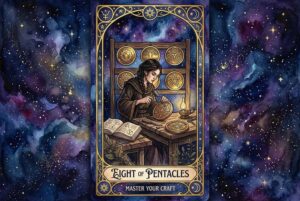
Think of tarot cards as characters in a scene. When the High Priestess appears alone, she embodies intuition and hidden knowledge. Place her beside the Eight of Pentacles, and suddenly you’re looking at developing psychic skills or refining spiritual practice through disciplined study. Put her next to the Tower, and that hidden knowledge might arrive as a shocking revelation that changes everything.
The relationship between cards is everything. Three factors shape how cards interact:
- Position in the spread — Cards earlier in the sequence often represent causes or past influences, while later positions show effects or outcomes
- Elemental chemistry — Fire (Wands) and Air (Swords) amplify each other, while Water (Cups) and Earth (Pentacles) ground and stabilize
- Numerical patterns — Shared numbers create thematic emphasis, while sequential numbers suggest progression or journey
10 Practical Techniques for Reading Tarot Pairings
1. Keyword Bridging
This is your starting point. Assign one keyword to each card, then create a simple sentence connecting them. The Eight of Wands might be “swift movement” while the Six of Cups could be “nostalgia” or “past connections.” Together, they become: “A rapid return to someone or something from your past.”
You can experiment with different keywords for the same card until the combination clicks. The Six of Cups also means “childhood” or “innocence,” so your pairing might read: “Fast travel to your hometown” or “Quick reconciliation with old friends.”
2. Numerology Patterns
Every numbered card carries the energy of its number. When two cards share the same number, that theme intensifies. Two cards both numbered “2” (like the Two of Cups and Two of Wands) create a powerful emphasis on partnerships, choices, and duality.
Sequential numbers tell a story of development. The Ace of Swords followed by the Two of Swords shows a new idea (Ace) immediately meeting indecision or stalemate (Two). The mental clarity you gained now faces obstacles or requires difficult choices.
Numbers also reveal cycle stages:
- 1-3: Beginning phase, seeds being planted, initial impulses
- 4-6: Middle phase, structures forming, challenges and adjustments
- 7-10: Completion phase, harvest time, lessons learned
The Ace of Swords (1) paired with the Empress (3) shows a thought or idea in its birthing stage—the Empress is literally pregnant with this new mental seed, about to bring it into form.
3. Elemental Alchemy
Each suit carries an elemental signature: Wands are Fire, Cups are Water, Swords are Air, Pentacles are Earth. When you understand how these elements interact, combination readings become more nuanced.
Fire and Air feed each other—Wands and Swords together suggest inspired action and quick thinking. Water and Earth nurture—Cups and Pentacles create emotional security and material comfort. But Fire and Water create steam (tension, passion, potential conflict), while Air and Earth can feel stuck or disconnected.
4. Court Card Conversations
When two or more court cards appear together, you’re looking at actual people or different facets of personality. The Queen of Cups next to the King of Swords might represent a couple where one partner leads with emotion and the other with logic. Or it could show you being pulled between your empathic nature and your need for rational boundaries.
Pages next to Kings suggest mentorship or a skill gap. Knights together often mean rapid developments, competing agendas, or youthful energy clashing.
5. Major Arcana Magnification
Major Arcana cards carry more weight than minor cards. When a Major appears in combination, it dominates the narrative. The Tower next to any other card means upheaval is the primary theme—the second card just shows what area of life gets shaken up.
Two or more Majors together signal major life themes and soul lessons. This is karmic territory, big picture stuff. The Hermit and the Star together might mean a period of solitary inner work (Hermit) leading to renewed hope and spiritual clarity (Star).
6. Suit Sequences and Journeys
When multiple cards from the same suit appear, trace the journey they’re showing you. Three Wands cards in a row might show the evolution of a creative project: Ace (inspiration), Four (celebration of early success), Nine (perseverance near completion).
This technique works especially well in larger spreads. Notice where the suit energy clusters and what story those cards tell together.
7. Reversed Cards in Combination
A reversed card changes how energy flows in a pairing. If the first card is upright and the second reversed, the situation begins well but encounters blocks or internalization. The Lovers upright + Three of Swords reversed might suggest a relationship that looks harmonious on the surface but harbors unexpressed pain.
Two reversed cards together can indicate a need to look at shadow material, delays affecting multiple areas, or energy that needs to be released and cleared before progress happens.
8. Visual Storytelling
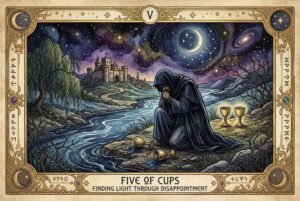
Look at the actual images on your cards. Are figures facing each other or turning away? Is someone offering something while another receives? The Two of Cups shows two people facing each other with cups raised—partnership. Place it next to the Eight of Cups, where a figure walks away from stacked cups, and you have a visual story about someone leaving a relationship or outgrowing a partnership that once felt balanced.
Colors, symbols, and body language in the imagery create intuitive connections your logical mind might miss.
9. Personal Association Layering
Your relationship with each card matters. If the Seven of Swords always makes you think of your clever but evasive ex-partner, that personal association is valid data when it appears in readings. When paired with the Four of Wands (traditionally a card of homecoming and celebration), you might interpret it as “Be cautious about who you invite into your stable foundation” rather than the more generic “celebration with hidden agendas.”
Keep a notebook of your card relationships. They deepen over time and make your readings uniquely yours.
10. Three-Card Triangulation
In three-card spreads, the middle card often acts as a bridge or pivot between the outer two. Past-Present-Future spreads show how energy flows through time. Situation-Action-Outcome spreads show cause and effect. But you can also read all three as a single unit—what do these three cards together want you to understand?
The Fool, Death, and the World is a complete journey from innocence through transformation to integration and completion.
Reading Combined Energies in Different Spreads
The spread structure determines how cards relate. In a Celtic Cross, the “challenge” card transforms the “situation” card’s meaning. In a relationship spread with two positions for each person, you’re comparing parallel energies side by side.
Some guidelines for common structures:
Linear spreads (past-present-future, situation-action-outcome): Read left to right, watching how energy progresses or regresses based on card numbers and suit flow.
Circular spreads (like year-ahead wheels): Each position influences its neighbors. The card for March doesn’t exist in isolation—it’s informed by February and colors April.
Stacked positions (conscious/subconscious, visible/hidden): The upper card is the obvious layer, the lower card is the root cause or hidden influence. They must be read together to understand the full picture.
Common Pairing Patterns You’ll Recognize
After reading for a while, certain combinations become familiar friends:
- Aces together: Multiple new beginnings, abundance of opportunities, potent creative moment
- Cups + Pentacles: Emotional fulfillment meeting material security, relationships bringing practical benefits
- Swords + Wands: Thought meeting action, plans being implemented, mental clarity driving forward momentum
- Court + Ace: A person (Court) bringing or enabling a new beginning (Ace) in that suit’s domain
- Death + Wheel of Fortune: Unavoidable endings and cycles, transformation that’s destined or fated
Building Fluency: Practice Without Pressure
Pull two cards each morning and spend sixty seconds finding connections. Don’t reach for a book. Trust your first impressions, note keywords that arise, see what story wants to emerge. Some days the meaning will be obvious. Other days you’ll feel stuck, and that’s okay—confusion is part of the learning process.
Keep these practice pulls simple. As you grow comfortable with pairs, try three-card pulls. The goal is to train your intuitive muscles to see relationships quickly, not to achieve perfect interpretations every time.
When Combinations Feel Contradictory
Sometimes you’ll pull cards that seem to contradict each other—the joyful Sun next to the sorrowful Three of Swords, for instance. Don’t smooth over the tension. That contradiction is information.
Perhaps the message is: “Find reasons for optimism even in heartbreak” or “Your cheerful facade hides real pain.” Maybe it’s timing—happiness followed by disappointment, or grief that eventually gives way to healing. Let contradictions exist. Life isn’t tidy, and neither are the best readings.
Advanced Practice: Working With Larger Spreads
In spreads with seven or more cards, you’re reading multiple combinations simultaneously. Start by identifying the most important cards (usually Majors, Aces, or cards in key positions like “outcome”), then see how others support or challenge them.
Look for:
- Suit dominance: Lots of Cups means emotional themes; Pentacles heavy spread suggests material/practical focus
- Number patterns: Many 5s might indicate conflict or instability across multiple life areas
- Court card clustering: Multiple people are involved in this situation
- Reversed concentration: Several reversals suggest general blockage, delays, or need for internal work
Read the spread as one cohesive story rather than isolated card meanings. How do the first three cards set up the last three? What does the middle position shift or pivot?
Your Intuition Is the Real Teacher
Every technique here is a training wheel. Eventually, you won’t consciously think “numerology pattern” or “elemental alchemy”—you’ll simply look at cards together and know what they’re saying. That knowing comes from practice, from pulling cards daily, from trusting yourself even when the guidebook says something different.
The cards will teach you their combinations if you let them. Pay attention to which pairings keep appearing in your life. Notice when a combination you read plays out exactly as you sensed. Your accuracy will grow not through memorization but through relationship—with the cards, with your intuition, and with the mysterious intelligence that speaks through both.
Frequently Asked Questions
How many card combinations should I memorize?
None. Memorizing thousands of specific meanings will make you rigid and disconnected from intuition. Instead, learn flexible interpretation techniques—keywords, numerology, elemental relationships—that let you read any pairing organically. Your understanding will deepen naturally through practice.
What if two cards seem to contradict each other?
Contradictory cards are showing you complexity or tension within the situation. They might represent conflicting desires, external versus internal reality, or a transition between two states. Don’t force them to agree—explore what the contradiction itself is trying to communicate.
Do I read cards differently when they’re side-by-side versus in different spread positions?
Yes. Position matters. Cards in a “past-present-future” line show progression through time. Cards in “situation-advice-outcome” positions have a cause-and-effect relationship. Cards in separate positions for two people are meant to be compared. Always let the spread structure guide how you connect the cards.
How do I know which card in a pair is more important?
Major Arcana cards typically carry more weight than minor cards. In spread positions, the outcome position usually matters most. Otherwise, let your eye be drawn to whichever card feels more significant—that intuitive pull is information. Sometimes both cards are equally important, creating a balanced message.