
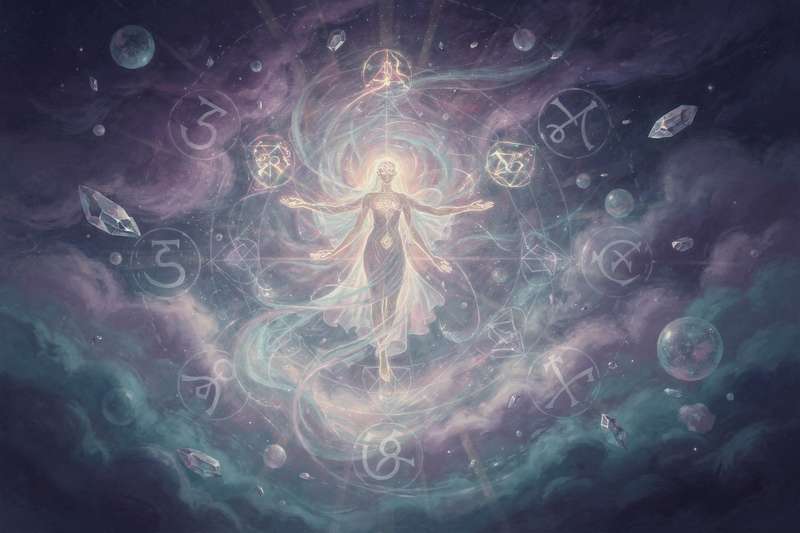
Esoteric symbols in ancient cultures have served as profound gateways between the visible and invisible worlds for thousands of years. These sacred symbols and mystical marks carried encrypted wisdom that spoke directly to the soul, transcending language barriers and cultural boundaries. When you encounter these ancient spiritual symbols today, you’re touching the same threads of meaning that guided mystics, priests, and seekers throughout human history.
From the temples of Egypt to the caves of Celtic lands, every civilization developed its own visual vocabulary of the divine. These weren’t mere decorations—they were tools for transformation, keys to unlock higher consciousness, and maps for spiritual journeys. Understanding their meanings allows you to access wisdom that has been carefully preserved across millennia.
What Esoteric Symbols Represent in Spiritual Traditions
Sacred symbols function as concentrated packages of spiritual truth. Unlike written language that explains concepts linearly, a single symbol can hold multiple layers of meaning simultaneously. When you meditate on the Ankh or trace the pattern of the Flower of Life, you’re engaging with teachings that operate beyond rational thought.
These symbols act as bridges between your conscious mind and deeper levels of awareness. Ancient cultures understood that certain geometric patterns, shapes, and images resonated with universal principles—creation, destruction, balance, transformation. They encoded their most profound insights into forms that could be recognized instantly, felt intuitively, and passed down through generations without losing their essential power.
The beauty of esoteric symbolism lies in its universality. While specific interpretations varied between Egypt, Greece, China, and Celtic lands, the core themes remained remarkably consistent. Circles represented wholeness and eternity. Spirals symbolized growth and evolution. Intertwining serpents spoke of duality finding unity. This shared symbolic language suggests that ancient mystics were tapping into genuine patterns woven into the fabric of existence itself.
Ancient Egyptian Symbols: Life, Death, and Resurrection
Egyptian culture gave us some of the most enduring mystical symbols in human history. The Ankh, resembling a cross with a loop at its crown, represented eternal life and the union of masculine and feminine principles. You’ll find it in the hands of gods and pharaohs in countless hieroglyphic scenes, symbolizing their dominion over both physical and spiritual realms.
The Eye of Horus carries equally powerful meaning. This stylized eye with distinctive markings beneath it symbolized protection, healing, and wholeness. According to myth, the god Horus lost his eye in battle, but it was restored—making it a symbol of regeneration and divine restoration. When you wear or meditate upon the Eye of Horus, you’re invoking protection against negative energies and calling in the power of spiritual sight.
The Ouroboros—the serpent consuming its own tail—appears in Egyptian alchemy and spread throughout the Mediterranean world. This symbol captures the eternal cycle of death and rebirth, the concept that endings are always beginnings, and that all existence moves in spirals rather than straight lines. It reminds you that transformation is constant and that what appears to be destruction is often just preparation for renewal.
Sacred Geometry in Egyptian Temple Design
Egyptian architects encoded profound wisdom into the very structures they built. The pyramids themselves function as three-dimensional symbols, their proportions reflecting mathematical relationships found throughout nature. Temple complexes were designed as symbolic journeys, with initiates moving through progressively more sacred spaces that mirrored stages of spiritual awakening.
Celtic and European Sacred Symbols
The Triskelion, featuring three spirals radiating from a central point, stands as one of the most recognizable Celtic symbols. This triple spiral represents movement, progress, and the interconnected nature of existence. It can symbolize past-present-future, birth-life-death, or mind-body-spirit—three aspects that appear separate but emerge from a unified source.
Celtic knotwork, with its endless interwoven patterns, carries deep esoteric meaning. These intricate designs have no beginning or end, representing the eternal nature of spirit and the interconnectedness of all life. When you trace a Celtic knot with your finger or your gaze, you’re following a meditation on infinity and the way all things loop back to their source.
The labyrinth appears throughout European sacred sites, particularly in medieval cathedrals. Unlike a maze designed to confuse, a labyrinth has a single winding path that leads inevitably to the center. Walking a labyrinth becomes a moving meditation, symbolizing your spiritual journey toward the divine center of your being. The path may twist and turn, but if you keep walking, you will reach the heart.
Chinese and Eastern Mystical Symbols
The Yin Yang symbol encapsulates the entire philosophy of Taoist thought in one elegant image. The circle divided into black and white swirling sections, each containing a dot of its opposite color, teaches you that duality is an illusion. Light contains darkness; darkness contains light. Masculine and feminine, action and receptivity, expansion and contraction—all opposites are actually complementary forces that create wholeness through their interaction.
This principle has profound implications for your spiritual practice. Instead of trying to eliminate what you perceive as negative qualities, the Yin Yang teaches balance. You honor both your light and shadow, recognizing that each has its place and purpose. True harmony emerges not from choosing one side but from honoring the dance between polarities.
Eastern mandalas, particularly in Hindu and Buddhist traditions, serve as visual representations of the cosmos and the human psyche. These intricate circular designs radiate from a central point, showing how all complexity emerges from unity. Creating or meditating on mandalas helps you recognize the sacred geometry underlying apparent chaos, bringing order to your inner world.
The Language of Sacred Geometry
The Flower of Life ranks among the most powerful symbols in sacred geometry. This pattern of overlapping circles creates a flower-like design that contains the templates for all forms in creation. You’ll find it carved into temples in Egypt, etched into stones in Turkey, and drawn in manuscripts across cultures—evidence that ancient mystics recognized its fundamental importance.
Within the Flower of Life, you can find numerous other sacred patterns: the Seed of Life, the Tree of Life, the Fruit of Life, and Metatron’s Cube. Each reveals different aspects of how consciousness becomes form, how the one becomes the many, and how all creation shares common structural principles. Meditating on these patterns can shift your awareness from seeing separate objects to recognizing the unified field from which everything emerges.
The Seed of Life, composed of seven overlapping circles, represents the seven days of creation and the foundational pattern from which more complex forms unfold. It symbolizes potential, fertility, and the moment before manifestation when all possibilities exist simultaneously. Working with this symbol can help you connect with creative energies and bring new projects into being.
The Golden Ratio and Divine Proportion
Many esoteric symbols incorporate the golden ratio—a mathematical proportion found throughout nature in seashells, flowers, and galaxies. Ancient builders used this ratio in sacred architecture because it resonates with something deep in human perception, creating a sense of rightness and beauty. This suggests that these symbols work not just conceptually but also through their inherent geometric harmony.
Symbols of Transformation and Alchemy
The Caduceus, featuring two serpents winding around a central staff topped with wings, represents the alchemical principle of transformation through the union of opposites. Though now often associated with medicine, its original meaning relates to Hermes, the messenger god who moved between worlds. The two serpents symbolize opposing forces—solar and lunar, masculine and feminine, volatile and fixed—that must intertwine and balance to create transformation.
In your spiritual work, the Caduceus reminds you that true change requires integrating polarities. You cannot reach wholeness by rejecting half of yourself. The central staff represents your spine or axis of being, while the serpents are the energies that must rise and interweave to awaken higher consciousness. The wings at the top symbolize the freedom and spiritual elevation that comes from this integration.
The Pentagram, a five-pointed star often enclosed in a circle, has been used for protection and spiritual work across cultures for thousands of years. Each point represents one of the five elements—earth, air, fire, water, and spirit—with spirit at the top position showing consciousness directing material forces. Despite modern misconceptions, the upright pentagram traditionally symbolizes humanity’s divine potential and the harmonious relationship between physical and spiritual dimensions.
How to Work With Ancient Symbols in Your Practice
You don’t need to be an expert to benefit from these ancient symbols. Simply having them in your awareness begins to activate their meaning in your consciousness. Here are practical ways to incorporate esoteric symbols into your spiritual practice:
- Create a symbol meditation space: Choose one symbol that resonates with your current journey and place an image of it where you’ll see it daily. Spend a few minutes each day gazing at it softly, allowing meanings to surface without forcing interpretation.
- Draw or trace symbols mindfully: The act of recreating sacred geometry or ancient symbols with your own hand creates a direct energetic connection. Use this as a moving meditation, focusing your intention while your hand moves.
- Wear symbols as talismans: Ancient peoples wore protective symbols on amulets and jewelry. Choose pieces that hold genuine meaning for you rather than following fashion trends.
- Place symbols in your environment: Position meaningful symbols in areas corresponding to their energy—protective symbols near entryways, symbols of abundance in workspace, symbols of love and unity in relationship areas.
- Study one symbol deeply: Rather than collecting superficial knowledge about many symbols, choose one to explore thoroughly. Research its history across cultures, meditate on it regularly, and notice how it shows up in nature and architecture around you.
Journaling Prompts for Symbol Work
Deepen your connection with esoteric symbols through reflective writing. Try these prompts:
- What does the cycle represented by the Ouroboros look like in my own life right now?
- How can the balance shown in the Yin Yang help me integrate opposing aspects of my personality?
- If I were to walk the labyrinth of my spiritual journey, what would I find at the center?
- Which ancient symbol appears most frequently in my awareness, and what might it be teaching me?
The Universal Patterns Behind Cultural Variations
While each culture expressed esoteric wisdom through unique symbols, certain patterns appear universally. The circle appears in virtually every tradition as a symbol of wholeness, eternity, and the divine. Spirals represent evolution, growth, and the journey inward or outward. Triangles symbolize trinity principles—body-mind-spirit, past-present-future, creation-preservation-destruction.
These recurring patterns suggest that ancient mystics across the globe were perceiving genuine structures underlying reality. Whether they called it the Tao, Brahman, the One, or the Divine Mind, different traditions pointed toward the same truth using similar visual language. This convergence validates the power of these symbols—they emerge from direct mystical experience rather than arbitrary cultural invention.
Understanding this universality empowers you to work with symbols from various traditions without cultural appropriation concerns, as long as you approach them with respect and genuine spiritual intent. You’re not stealing another culture’s property but rather recognizing shared human heritage and collective wisdom.
Common Misconceptions About Esoteric Symbols
- Inverted symbols are always negative: Many people fear inverted pentagrams or reversed symbols, but context matters tremendously. In some traditions, inversion simply represents different phases or aspects of the same principle.
- Older symbols are more powerful: Age doesn’t automatically confer power. What matters is the depth of meaning invested in a symbol and your personal resonance with it. A newly created symbol charged with sincere intention can be just as effective as an ancient one.
- You must belong to a tradition to use its symbols: While respecting cultural context is important, many esoteric symbols have been shared across cultures for millennia. Universal symbols like the Flower of Life appear in so many traditions that no single culture can claim exclusive ownership.
- Symbols work magically without understanding: While symbols do operate on subconscious levels, your conscious understanding and intention amplify their effectiveness. Study and reflection deepen your connection rather than diminishing mysterious power.
- All symbol meanings are fixed and universal: Symbols are living things that evolve. While core meanings remain stable, each generation and individual adds layers of interpretation based on direct experience.
- Esoteric symbols are only for advanced practitioners: These symbols were created to communicate with everyone, from novices to masters. You don’t need special initiation to begin working with them meaningfully.
Symbols as Living Bridges to Wisdom
The esoteric symbols of ancient cultures remain vitally relevant because they address timeless aspects of human experience. Your struggles with duality, your search for wholeness, your questions about life’s meaning—these are the same challenges faced by seekers throughout history. The symbols that helped them can help you too.
Think of these symbols not as relics to be studied academically but as living bridges connecting you to streams of wisdom that flow beneath the surface of ordinary awareness. When you engage with the Ankh, you join a current of energy that has flowed through countless individuals across thousands of years. You become part of an unbroken chain of seekers reaching toward the same light.
Your engagement with these symbols also helps keep them alive. Symbols lose power when they become mere historical artifacts. They gain power when living humans invest them with attention, contemplation, and genuine spiritual work. By bringing ancient symbols into your contemporary practice, you honor the wisdom of the past while making it relevant for the present.
Final Thoughts
Esoteric symbols in ancient cultures represent humanity’s most elegant attempt to capture infinite truth in finite form. They are gifts from the ancestors—tools for transformation that remain as relevant today as when they were first inscribed in stone or drawn in sacred texts. These symbols remind you that you’re part of an unbroken lineage of seekers, each generation passing the torch of wisdom to the next.
As you continue your spiritual journey, let these ancient symbols serve as companions and guides. They don’t demand belief or blind faith—only your willingness to look, to wonder, and to allow their meanings to unfold in your awareness. In a world increasingly dominated by literal language and digital information, these visual keys to mystery offer a different way of knowing, one that speaks directly to your soul without the filter of intellectual analysis.
The wisdom encoded in these sacred marks is patient and inexhaustible. It has waited thousands of years and will wait as long as necessary for you to recognize it. All you need to do is pause, look closely, and allow yourself to see beyond the surface into the luminous depths where ancient mysteries still whisper their eternal truths.
Frequently Asked Questions About Esoteric Symbols
What is the most powerful ancient esoteric symbol?
No single symbol holds universal supremacy—power depends on resonance and intention. The Flower of Life, Ouroboros, and Ankh are considered particularly potent across traditions, but the most powerful symbol for you is the one that speaks directly to your soul and current spiritual needs.
Can using esoteric symbols from different cultures create spiritual confusion?
Not if you approach them with understanding and respect. Many symbols share core meanings across cultures, reflecting universal truths. Study each symbol’s context and use them with clear intention rather than randomly mixing traditions without comprehension.
How do I know which ancient symbol to work with?
Notice which symbols appear repeatedly in your awareness or create strong emotional responses when you encounter them. Your intuition often guides you toward symbols carrying messages your soul needs to hear at specific times in your journey.
Are esoteric symbols connected to specific chakras or energy centers?
Many practitioners find natural correspondences between certain symbols and chakras. The Ankh resonates with the crown chakra, the Yin Yang with the sacral or solar plexus, and protective symbols like the Eye of Horus with the third eye. Trust your personal experience of these connections.