What Are Aspects in Your Birth Chart?
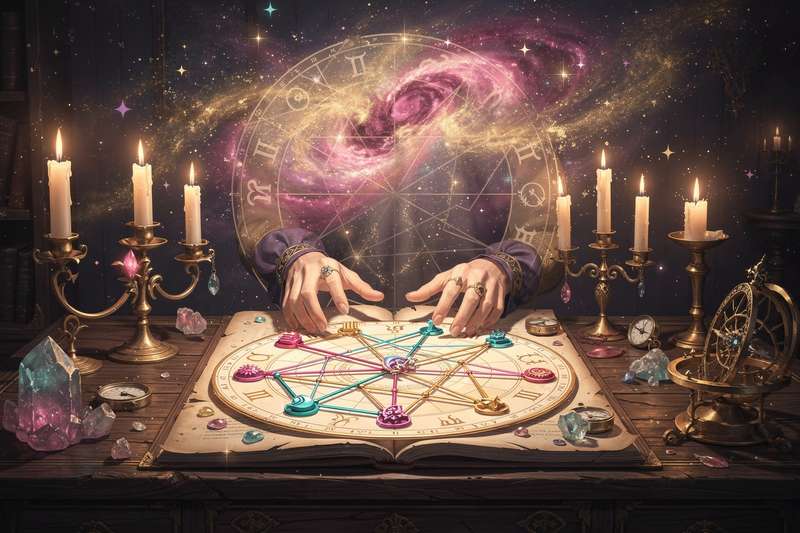
Aspects are the angles formed between planets in your birth chart. Think of them as conversations happening between different parts of your personality. When two planets form an aspect, they’re creating a specific distance or angle that either supports, challenges, or transforms your inner world.
Understanding aspects is like learning the grammar of astrology. While your sun sign describes your core identity and your moon sign reflects your emotional nature, aspects show you how these planetary energies actually interact with each other. They reveal whether your inner drives flow smoothly together or whether you’re working with creative friction that pushes you toward growth.
The distance between planets is measured in degrees, and different degree measurements create different types of aspects. Each type carries its own flavor—some feel supportive and easy, while others demand your attention and effort.
The Seven Major Aspects Explained
There are seven primary aspects that astrologers focus on when reading your birth chart. Let’s break down each one:
1. The Conjunction (0°)
A conjunction occurs when two planets are in the same sign, typically within 8-10 degrees of each other. This is the most intense aspect because the planets are merged together—their energies blend into one unified force. Conjunctions amplify whatever they touch. If you have Venus conjunct Mars, your romantic desires and sexual energy are fused together. With Mercury conjunct Jupiter, your thinking and communication become expansive. Conjunctions aren’t inherently good or bad; they simply magnify.
2. The Sextile (60°)
A sextile forms when planets are approximately 60 degrees apart. This is a soft, supportive aspect that creates gentle flow between two planetary energies. Sextiles feel natural and easy—they’re the aspects where things happen without much struggle on your part. A Moon sextile Venus, for example, makes it easier to express your emotions warmly. Sextiles are gifts, but because they come so easily, you might need to actively engage with them to build real strength.
3. The Square (90°)
Squares occur at 90 degrees and are the classic hard or challenging aspect. Two planets in a square are at odds with each other, creating internal tension and friction. This might sound negative, but squares are actually your greatest teachers. A Sun square Saturn might mean you struggle with self-doubt, but this struggle develops resilience and character. Squares push you to integrate conflicting parts of yourself. Without squares, you’d have little motivation to grow.
4. The Trine (120°)
Trines form at 120 degrees and are considered the most harmonious aspect. When planets trine each other, their energies flow in compatible directions. A Moon trine Sun creates emotional alignment with your core identity. A Venus trine Mars brings natural harmony between your desires and your ability to pursue them. Trines feel lucky, almost effortless. They’re your inner gifts—the areas where you don’t have to try as hard because everything clicks.
5. The Quincunx or Inconjunct (150°)
The quincunx is a 150-degree aspect that creates a sense of awkwardness or adjustment. With this aspect, two planets aren’t speaking the same language. Your instinct is to make them work together, so you’re constantly fine-tuning, adapting, and problem-solving. A Sun quincunx Moon, for instance, means your core identity and emotional needs don’t naturally align—but through conscious effort, you develop flexibility and adaptability that others admire.
6. The Opposite or Opposition (180°)
Oppositions form at 180 degrees, with planets directly across from each other. This is a hard aspect that creates a push-pull dynamic. You experience these two energies as polarized—they feel like opposites that can’t coexist. A Venus opposition Mars creates attraction and friction simultaneously. The key to working with oppositions is realizing they’re not meant to be resolved into sameness; they’re meant to be balanced. You learn to give each energy its proper place and timing.
7. The Semi-Sextile (30°)
A semi-sextile occurs at 30 degrees and is considered a minor aspect, though still meaningful. It creates a slight tension or awareness between two planetary energies. You notice something is slightly off or requires minor adjustment, but it’s not as demanding as a square. Semi-sextiles often indicate areas where you’re becoming aware of something that needs attention.
Soft Aspects vs. Hard Aspects
Astrologers group these aspects into two categories: soft (easy) and hard (challenging).
Soft aspects include sextiles and trines. They create flow, ease, and natural talent. These are the aspects where things happen without much resistance. If your chart is heavily aspected with soft aspects, you might find success comes relatively easily—but you might also lack the driving force that creates real depth and resilience.
Hard aspects include squares, oppositions, and quincunxes. They create tension, friction, and the need for conscious integration. While they feel more challenging to live with, they’re actually your greatest allies for personal development. The friction they create motivates you to work on yourself, overcome obstacles, and build real strength.
The ideal birth chart has a healthy mix of both. The soft aspects give you gifts and natural abilities; the hard aspects give you purpose and the fuel to grow beyond your comfort zone.
How to Find Aspects in Your Birth Chart
Now that you understand what aspects are, here’s how to find them in your own chart:
Step 1: Get Your Accurate Birth Chart
You’ll need your exact birth time, date, and location. Without your precise birth time, your rising sign and house positions will be inaccurate, and this affects which aspects show up in your chart. If you don’t have your birth time, you can request it from the hospital where you were born, or check your birth certificate.
Step 2: Calculate or Generate Your Chart
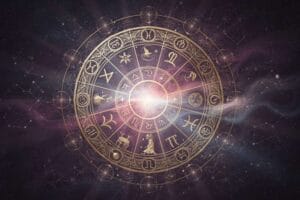
Use a reliable online tool or astrology software to generate your natal chart. Many sites (like Cafe Astrology, Co-Star, or The Pattern) will automatically calculate your aspects for you. You’ll see your planets plotted on a circular chart wheel, with degree numbers showing their positions.
Step 3: Identify the Aspects Listed
Most birth chart calculators will provide an aspect table or list showing which planets form aspects with each other. They typically show the type of aspect (conjunction, sextile, square, etc.) and the exact degree. Look for aspects that have a tight orb—the closer the aspect is to exact, the stronger its influence in your life.
Step 4: Consider Orbs
Orbs are the allowable degree range for an aspect to “count.” A conjunction might be considered valid within 8 degrees on either side, while a trine might have a 6-degree orb. Tighter orbs are considered more powerful. An aspect that’s exact (0 degrees off) will feel more pronounced than one that’s at the edge of its allowed range.
Step 5: Map Out Your Major Aspects
Write down or screenshot your key aspects. Focus first on aspects involving your personal planets (Sun, Moon, Mercury, Venus, Mars) because these affect you most directly. Then look at aspects involving outer planets (Jupiter, Saturn, Uranus, Neptune, Pluto) as these influence longer-term themes in your life.
Reading the Aspects That Matter Most
Not all aspects carry equal weight. Focus your attention on:
- Personal planets to personal planets: Sun, Moon, Mercury, Venus, and Mars aspects directly shape your personality and how you move through the world
- Personal planets to outer planets: These show how larger life themes interact with your core self
- Tight orbs: Aspects within 1-2 degrees are much more influential than those at the edge of their allowed range
- The Ascendant and Midheaven: Aspects to these angles reveal how others perceive you and your public presence
What Your Aspects Reveal About You
Once you’ve identified your major aspects, you’re reading the story of how different parts of yourself interact. A person with many trines might feel naturally talented but could benefit from cultivating more discipline. Someone with many squares might be driven and resilient but could benefit from learning to ease up and trust the flow.
Your aspects don’t determine your destiny—they reveal your inner dynamics. They show you where you have natural gifts, where you face challenges that build character, and where you need to practice conscious integration of seemingly opposing desires or energies.
The goal isn’t to have a “perfect” chart with only soft aspects. The goal is to understand your unique combination of gifts and challenges so you can work with your natal blueprint intentionally.
FAQ
What does it mean if I have mostly hard aspects in my birth chart?
A chart heavy with hard aspects means you’re wired for growth and resilience. You likely face challenges that push you toward self-improvement, and you have the inner drive to overcome obstacles. While your path might feel more demanding than someone with many soft aspects, you’re building genuine strength and character. Hard aspects create motivation; they’re not a sign of a difficult life, but rather a personality that’s geared toward transformation.
Can aspects change over time?
Your birth chart aspects never change—they’re your natal blueprint. However, transiting planets (planets moving in real time) constantly form new aspects to your natal planets. These transiting aspects create cycles of influence throughout your life. An upcoming square from transiting Saturn might activate a growth period, while a trine from transiting Jupiter might bring opportunity. This is why your birth chart aspects remain steady while your experience shifts with planetary cycles.
Which aspect is the most powerful?
The conjunction is technically the most intense because the planetary energies are merged completely. However, the most powerful aspect for your life depends on which planets are involved and whether you’re conscious of working with it. A tight conjunction between two minor planets might matter less than a wide square between your Sun and Saturn if that square is teaching you critical life lessons.
Should I be worried if I have a lot of squares in my chart?
No. Squares are challenging, but challenges create growth. Many successful, accomplished people have heavy square placements because squares provide the drive and determination needed to overcome obstacles and achieve meaningful goals. Rather than seeing squares as problems, view them as your inner compass pointing toward areas where you’re meant to develop mastery and resilience.